

Driving 30% of all daily crypto trading volume, Bitcoin futures allow participants to trade the price velocity of Bitcoin without the administrative burden of owning the actual underlying asset.
What Is a Bitcoin Futures Contract?
When you trade a Bitcoin futures contract, you are not purchasing digital tokens from a peer-to-peer wallet. Instead, you are purchasing a binding financial contract that obligates you to settle the price difference when the contract expires or when you close the position. This allows investors to gain full price exposure to Bitcoin’s volatility while keeping their capital entirely within standard trading networks.
How Bitcoin Futures Work: Long vs. Short
Main guide: What is long and short in Crypto Futures Trading
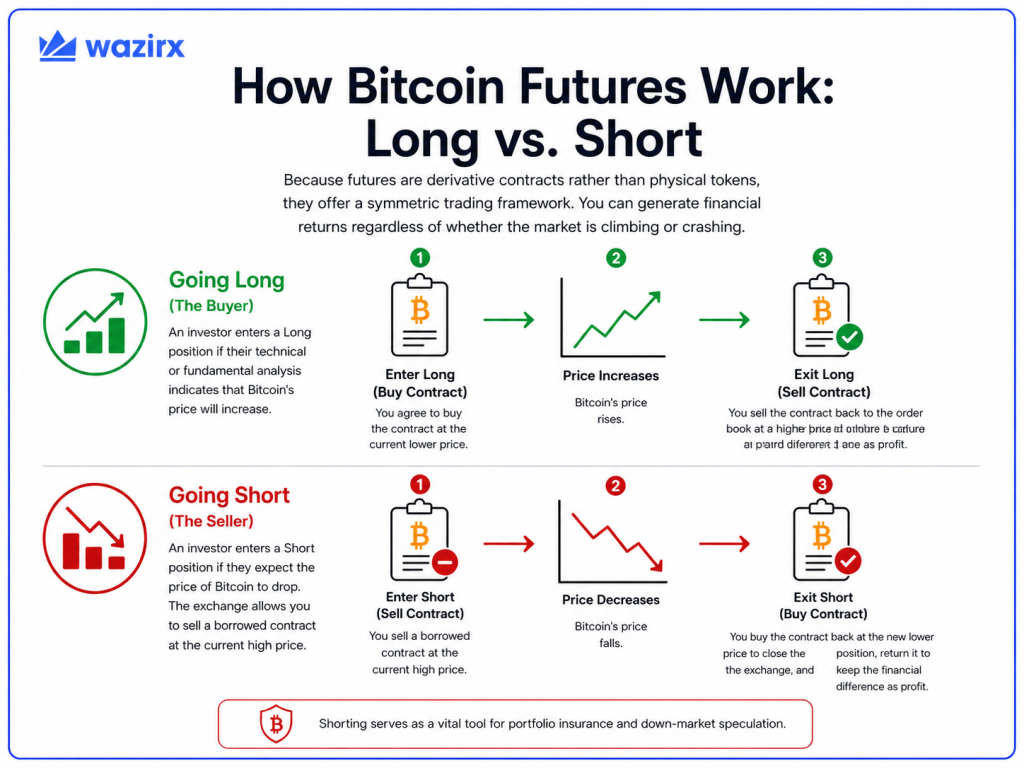
Because futures are derivative contracts rather than physical tokens, they offer a symmetric trading framework. You can generate financial returns regardless of whether the market is climbing or crashing.
Going Long (The Buyer)
An investor enters a Long position if their technical or fundamental analysis indicates that Bitcoin’s price will increase. You agree to buy the contract at the current lower price, aiming to sell it back to the order book later at a higher valuation, capturing the upward difference as net profit.
Going Short (The Seller)
An investor enters a Short position if they expect the price of Bitcoin to drop. The exchange allows you to sell a borrowed contract at the current high price. When the price falls, you buy the contract back at the new lower valuation to close the position, returning the contract to the exchange and keeping the financial difference as profit. Shorting serves as a vital tool for portfolio insurance and down-market speculation.
Traditional Futures vs. Perpetual Futures
Main guide: Perpetual vs Traditional Futures differences explained
The crypto derivatives landscape features two distinct species of futures contracts. Understanding their structural differences is critical for selecting the right instrument for your timeframe.
1. Traditional Delivery Futures (Calendar Contracts)
Standardized by legacy institutions like the Chicago Mercantile Exchange (CME), these contracts mirror traditional commodities. They have a strict, unyielding Expiration Date (typically the last Friday of the contract month).
As the expiration date approaches, the contract price naturally converges with the actual spot price of Bitcoin. Upon expiration, the contract undergoes automated Cash Settlement—meaning the exchange calculates the net profit or loss in fiat currency and automatically updates your balance, closing the position permanently.
2. Perpetual Futures (Perps)
Main guide: Crypto Perpetual Futures Explained
Perpetual contracts are a digital-native innovation born within the crypto ecosystem. Unlike standard contracts, perpetual futures never expire. You can hold a position open for months or even years, provided you maintain enough collateral.
Because there is no expiration date to force the price to meet the spot market, exchanges utilize a self-correcting mechanical system called the Funding Rate:
- If the market is overwhelmingly bullish and the perpetual price drifts higher than the spot price, Long traders are forced to pay a recurring fee to Short traders every few hours.
- If the market is crashing, Short traders must pay a fee to Long traders.
This fee structure acts as an economic tether, continuously pulling the perpetual contract price back in line with the actual spot valuation.
Structural Comparison: Spot vs. Futures Trading
Main guide: Crypto Spot vs Crypto Futures Trading
To optimize your capital placement, it is vital to contrast the operational differences between standard spot purchasing and derivative trading.
| Feature | Spot Bitcoin Trading | Bitcoin Futures Trading |
| Asset Ownership | You own actual BTC tokens in a wallet. | You own a contractual claim tracking BTC price. |
| Market Access | High structural barrier (Wallets, keys, spot AML). | Low barrier (Standard trading accounts, deep liquidity). |
| Directional Flexibility | Profit can only be made on upward moves. | Profit can be made on upward (Long) or downward (Short) moves. |
| Leverage Availability | None. You must provide 100% of the capital. | High. Positions are backed by margin borrowing. |
| Holding Constraints | Free to hold indefinitely with zero recurring fees. | Subject to contract expiry or ongoing funding rate costs. |
The Double-Edged Sword: Margin and Leverage
Main guide: Leverage in Crypto Futures Trading
The primary financial mechanism driving futures volume is Leverage. Leverage allows an investor to control a massive market position using only a fraction of the total capital upfront, known as the Initial Margin.
The Math of Amplification
Suppose you want to trade Bitcoin using a capital baseline of ₹4,000. In the spot market, your upside is strictly limited to what a ₹4,000 purchase can deliver. If Bitcoin moves up by a healthy 10%, your spot position grows by ₹400.
If you take that same ₹4,000 capital into the futures market and apply 10x Leverage, the exchange expands your active market position to ₹40,000.
Spot Market (1x): ₹4,000 Capital —> 10% Price Move —> ₹400 Profit/Loss
Futures Market (10x): ₹4,000 Capital —> 10% Price Move —> ₹4,000 Profit/Loss
Now, when Bitcoin moves by that same 10%, your profit is calculated on the full ₹40,000 leveraged position, yielding a ₹4,000 gain: effectively a 100% return on your initial principal.
The Threat of Liquidation
Main guide: Liquidation in Crypto Futures Trading
While leverage magnifies your returns, it introduces an absolute risk barrier known as Liquidation. Because the exchange loans you the expanded capital, its automated risk matching engine monitors your account continuously. If the market moves against your 10x position by just 10%, your unrealized losses hit ₹4,000, entirely consuming your initial margin.
To protect its own balance sheet, the exchange instantly triggers an automated market order, seizing your collateral and closing your trade to clear the debt. In high-leverage positions, even a split-second price volatility wick can trigger your liquidation price, wiping out your margin instantly.
Final Thoughts
Bitcoin futures represent an exceptionally powerful financial instrument. However, it must be approached with professional reverence. Leverage is not a shortcut to wealth; it is a precision risk tool that requires strict stop-loss boundaries, a deep understanding of contract specifications, and absolute emotional neutrality.
Master the core rules of margin management, track funding metrics, and integrate hedging frameworks into your daily execution, and you will have a trading strategy that is less of speculative guesswork and more of institutional grade discipline.
FAQS
Bitcoin is the actual crypto asset you can buy, hold, transfer, or use on-chain. Bitcoin futures are trading contracts that track BTC’s price, letting traders take long or short positions without owning Bitcoin directly.
BTC futures let traders speculate on Bitcoin’s future price. If you expect BTC to rise, you can go long. If you expect BTC to fall, you can go short. Many futures markets also allow leverage, meaning traders can control a larger position with a smaller margin amount.
Bitcoin futures carry higher risk than spot trading because price moves can be amplified by leverage. Traders can face liquidation, funding-fee costs, sudden volatility, and losses greater than expected if risk controls are weak.
It depends on the contract type. Traditional Bitcoin futures have expiry dates, while perpetual BTC futures do not expire and can be held as long as margin requirements are maintained. However, perpetual contracts may charge funding fees over time.
 Disclaimer: Click Here to read the Disclaimer.