

What Is the Bitcoin Supercycle Theory?
Synopsis: This article explains what the Bitcoin supercycle theory is, why it emerged, how it differs from the traditional four-year halving cycle model, and what assumptions it makes about Bitcoin’s future price behavior.
TL;DR
- The Bitcoin supercycle theory argues that Bitcoin’s price is no longer governed by rigid four-year halving cycles.
- Demand, institutional capital, and global liquidity now play a larger role than issuance mechanics.
- The theory does not predict perpetual gains, but explains why price behavior has changed as Bitcoin matured.
Bitcoin Supercycle Theory Definition
The Bitcoin supercycle theory is the idea that Bitcoin’s price is no longer primarily governed by halving-driven four-year cycles, but instead moves within a longer-term adoption-driven trend shaped by demand, capital flows, and global economic conditions.
Rather than repeating a fixed boom-and-bust pattern every four years, Bitcoin is viewed as progressing through phases within a broader adoption-driven cycle.
What the Bitcoin Supercycle Theory Does Not Claim
- It does not claim that Bitcoin will only go up
- It does not claim that bear markets will disappear
- It does not claim halvings are irrelevant
- It does not guarantee exponential growth
Why Is It Called a “Supercycle”?
The term “supercycle” is used because the theory describes a cycle that operates above and across the traditional four-year halving rhythm. Instead of repeated resets, price movements are seen as phases within a longer multi-decade adoption curve.
Instead of price fully resetting after each cycle, movements are seen as expansions and consolidations within a longer multi-decade adoption curve. Halvings still occur, but they no longer serve as the primary driver of Bitcoin’s price behavior.
2 Core Ideas Behind the Bitcoin Supercycle Theory
The theory can be reduced to two central ideas that explain why rigid four-year price cycles may no longer apply.
- The halving is no longer the primary force determining when major price moves occur.
- Bitcoin’s price is increasingly driven by broader demand and economic conditions rather than by internal supply mechanics alone.
1. The Halving Theory on Bitcoin’s Price Movements
Since 2011, the dominant explanation for Bitcoin’s price behavior has been built around block reward halvings. The halving offered a clear, observable explanation for an otherwise chaotic market. The logical justification of this phenomenon was that: If supply growth drops sharply and demand stays constant or rises, the price should increase. The conclusion became stronger after repetition.
| Halving date | Block reward change | New BTC/day before | New BTC/day after | Approx. BTC price on halving | Price peak after halving |
| 28 Nov, 2012 | 50 → 25 BTC | ~7,200 BTC | ~3,600 BTC | ~$12.2 | ~>$1,000 by late 2013 |
| 9 Jul, 2016 | 25 → 12.5 BTC | ~3,600 BTC | ~1,800 BTC | ~$650–$660 | ~<$20,000 by Dec 2017 |
| 11 May, 2020 | 12.5 → 6.25 BTC | ~1,800 BTC | ~900 BTC | ~$8,800–$8,900 | ~<$69,000 Nov 2021 |
| 19–20 Apr, 2024 | 6.25 → 3.125 BTC | ~900 BTC | ~450 BTC | ~$63,900–$64,900 | Highest prices mid-2025 (~>$125,000) |
2. Bitcoin Then vs Now: The Rise of Institutional Capital
Bitcoin’s price is now driven by capital flows that simply did not exist during earlier cycles. In 2012–2016, Bitcoin traded only a few hundred million dollars per day, had no regulated investment products, and was dominated by retail traders and miners.
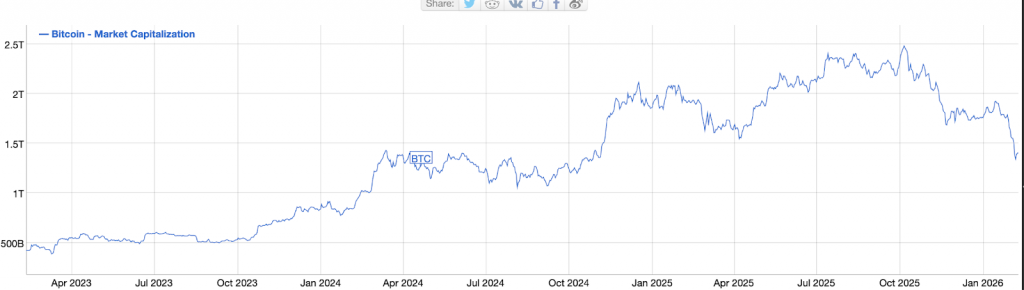
Caption: Evolution of Bitcoin’s Market Cap
By contrast, after US spot Bitcoin ETFs launched in January 2024, net inflows crossed $10 billion within three months, with daily ETF volumes often exceeding $2–5 billion, rivaling entire market turnover from earlier cycles.
| Year | Bitcoin ETF Net Flows | Notes |
| 2024 | ~$36.2 B net inflows⁺ | Spot Bitcoin ETFs launched on 11 Jan, 2024; IBIT led with ~$38 B while GBTC saw ~$21 B outflows. |
| 2025 | ~$50–55 B net inflows⁺ | Combined spot ETF flows approached ~$50–55 B by late 2025. |
Source: TradingView
Note: Large-scale spot Bitcoin ETF flows only became possible after regulatory approval in 2024; comparable instruments did not exist during earlier cycle periods.
Analysts like Lyn Alden have noted that Bitcoin now trades as a liquidity-sensitive macro asset, responding to interest rate expectations and capital allocation decisions rather than just issuance mechanics. This scale and type of demand did not exist when halving-led cycle theories first formed.
| Aspect | Traditional 4-Year Cycle | Supercycle Theory |
| Primary driver | Halving supply cuts | Demand and liquidity |
| Timing of highs | After halving | Before or after halving |
| Bear markets | Full resets | Consolidations |
| External forces | Minor role | Major influence |
Why a New Theory for Bitcoin Came To Be?
The traditional Bitcoin halving cycle model started breaking down in observable, uncomfortable ways, and people needed a better explanation for what they were seeing in real time.
Evidence Cited in Support of the Bitcoin Supercycle Theory
1. New all-time highs before the 2024 halving
Bitcoin reached a new all-time high of about $73,700 on 14 March 2024, more than a month before halving on 19–20 April 2024. In earlier cycles, new highs occurred well after the halving. This move showed that price growth was not waiting for a supply reduction and was instead driven by strong demand already present in the market.
2. Multiple peaks within the 2020–2024 cycle
Bitcoin peaked near $64,000 on 14 April 2021, then fell roughly 55 percent to around $29,000 by July 2021. Instead of entering a long bear market, the price recovered and reached a higher peak of about $69,000 on 10 November 2021. This two-peak structure did not fit the traditional model of a single blow-off top followed by a full-cycle reset.
3. Macro-driven drawdowns in 2022
From November 2021 to November 2022, Bitcoin fell from around $69,000 to $15,500, a drawdown of roughly 78 percent. Unlike earlier cycle crashes, this decline coincided with aggressive US Federal Reserve rate hikes, tightening global liquidity, and major crypto failures. Key events included the Terra collapse in May 2022 and the FTX collapse in November 2022, pointing to external causes rather than purely internal cycle dynamics.
4. Persistent institutional demand via ETFs
US spot Bitcoin ETFs launched in January 2024 and quickly became a major source of demand. By March 2024, cumulative net inflows exceeded $10 billion, with some days seeing inflows greater than the daily new Bitcoin supply of about 900 BTC pre-halving. These inflows were steady and price-insensitive, creating sustained buying pressure that did not exist in earlier cycles.
Origins of the Bitcoin Supercycle Theory
The Bitcoin supercycle theory emerged gradually between 2019 and 2021, as analysts observed that Bitcoin’s price behavior no longer fit the traditional four-year cycle framework.
As Bitcoin matured, gained institutional participation, and became more connected to global financial markets, the assumptions behind the older model began to weaken.
Current status of the Bitcoin Supercycle Theory(Feb 2026)
The supercycle theory is not a proven model or consensus view. It is an explanatory framework used by analysts to interpret recent price behavior that does not fit older cycle models. Its validity depends on whether current market structures persist.
Final Takeaway
The Bitcoin supercycle theory exists because Bitcoin stopped behaving the way the four-year halving model predicted. As demand, capital flows, and global liquidity became more influential than issuance mechanics, the traditional cycle framework lost explanatory power. The supercycle theory does not promise perpetual gains, but it offers a way to understand Bitcoin as a maturing asset operating within a longer-term adoption-driven cycle.
Frequently Asked Questions
Is the Bitcoin supercycle theory a proven or widely accepted model?
No. The Bitcoin supercycle theory is not a proven model or a consensus view. It is an explanatory framework used by analysts to interpret recent price behavior that does not fit the traditional four-year halving cycle. While some market participants find it useful, others continue to rely on halving-based or macro-driven models. Its validity depends on whether current market conditions persist.
Does the Bitcoin supercycle theory mean Bitcoin will only go up over time?
No. The supercycle theory does not claim that Bitcoin’s price will rise continuously or without major drawdowns. Volatility, corrections, and bear markets are still expected. The theory focuses on how price cycles may be structured, not on guaranteeing upward price movement or eliminating risk.
Are Bitcoin halvings still important under the supercycle theory?
Yes. Bitcoin halvings remain a fundamental part of Bitcoin’s supply schedule and still reduce the rate of new issuance. However, under the supercycle theory, halvings no longer act as the primary timing mechanism for major price moves. Their influence is seen as secondary to demand, liquidity, and broader market conditions.
How is the Bitcoin supercycle theory different from the traditional four-year halving cycle model?
The traditional model assumes that Bitcoin price cycles are primarily driven by halving-induced supply shocks followed by boom-and-bust resets. The supercycle theory argues that demand, institutional capital, and macroeconomic conditions now play a larger role, leading to price movements that do not strictly follow four-year patterns.
What evidence is commonly cited in support of the Bitcoin supercycle theory?
Analysts often cite new all-time highs before the 2024 halving, multiple price peaks within the 2020–2024 cycle, macro-driven drawdowns in 2022, and sustained institutional demand through spot Bitcoin ETFs launched in 2024. These observations suggest that Bitcoin’s price behavior has become less dependent on the timing of halvings alone.
When did analysts begin discussing the idea of a Bitcoin supercycle?
The concept began appearing between 2019 and 2021, as Bitcoin recovered more quickly from prior drawdowns and attracted increasing institutional interest. Discussions intensified as Bitcoin’s price behavior diverged from earlier cycle patterns and became more responsive to global liquidity and macroeconomic conditions.
Could the Bitcoin supercycle theory turn out to be wrong in the future?
Yes. The supercycle theory depends on the continuation of current market structures, including institutional participation and macro influence. If these conditions change or reverse, Bitcoin could revert to more halving-dominated behavior. The theory should be viewed as conditional, not permanent.
 Disclaimer: Click Here to read the Disclaimer.