

Iran’s $7.8 Billion Parallel Crypto Economy: How It Works and What the War Has Done to It
Iran’s crypto ecosystem is not a retail trading market. It is a state-managed financial architecture built specifically to move money across borders without touching the US dollar system. And the US-Israel war that began on February 28, 2026 has put this entire structure under enormous stress.
Here is a deep look at how Iran built its crypto shadow economy, who controls it, what the strikes have done to it, and what signals intermediate traders should be watching right now.
Get WazirX News First
TLDR
- Iran’s crypto ecosystem reached $7.78 billion in 2025, used primarily to bypass international sanctions via Bitcoin mining and USDT settlement.
- The IRGC controls over 50% of all Iranian crypto inflows, making it one of the largest state actors in any country’s digital asset economy.
- US-Israeli military strikes caused Iran’s crypto transaction volumes to collapse by around 80%, driven by internet blackouts and exchange suspensions rather than infrastructure failure.
- For traders, this conflict is reshaping BTC’s safe-haven narrative, driving privacy coin demand, and creating new compliance exposure across global exchanges.
Iran’s Crypto Ecosystem: The Scale
Iran’s parallel crypto economy is as large as the GDP of some small nations. According to Chainalysis, the ecosystem reached $7.78 billion in on-chain value in 2025, growing faster year-over-year than the previous period.
This is not speculative retail activity. The volume is tightly correlated with political flashpoints: missile exchanges, domestic protests, international sanctions tightening, and military escalation. Every major geopolitical event in Iran over the past three years has produced a measurable spike in its crypto transaction data.
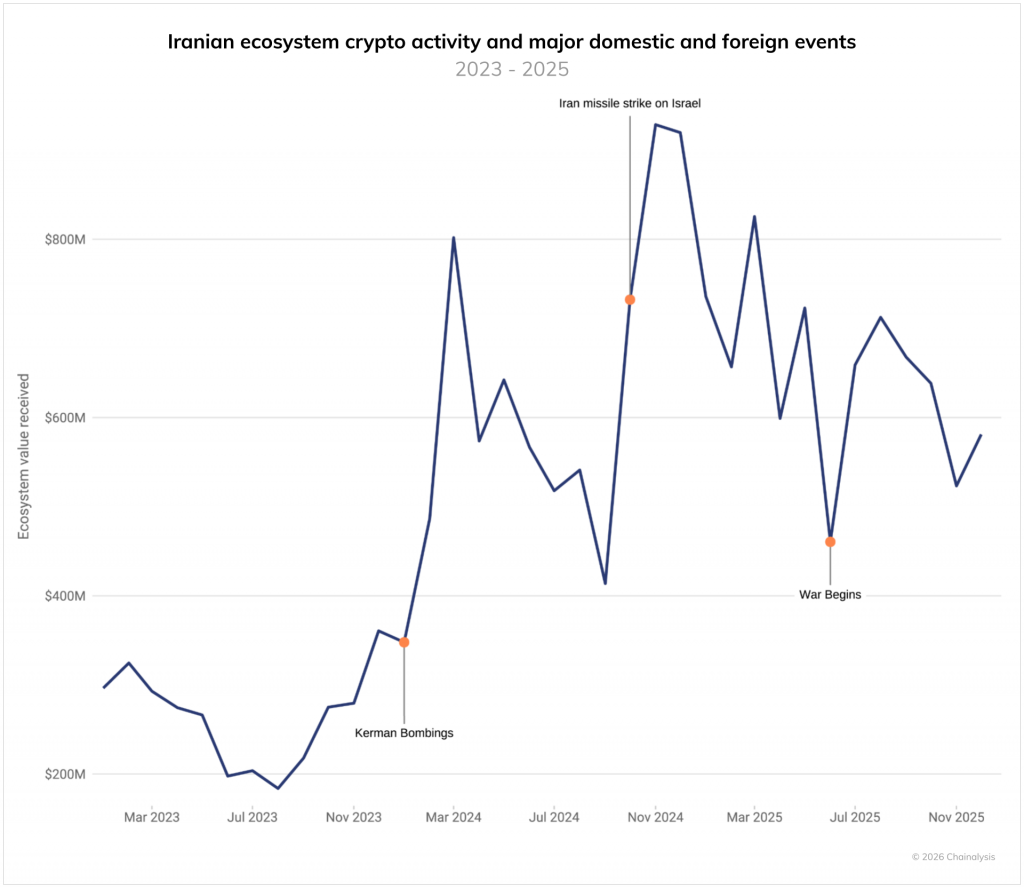
The ecosystem serves two distinct groups with opposite purposes. The Iranian state and IRGC use it to move hard currency for international trade and military procurement. Ordinary Iranians use it to escape a collapsing rial that has lost nearly all of its value against major currencies.
The Mining Engine: How Iran Converts Cheap Power Into Hard Currency
Iran legalised crypto mining in 2019. The model was straightforward and effective.
The government offers licensed mining operators heavily subsidised electricity rates in exchange for one condition: miners must sell their minted BTC to Iran’s central bank. The central bank then has a liquid, globally transferable asset it can use to pay overseas counterparties for machinery, fuel, consumer goods, and other imports without routing a single transaction through the US-controlled SWIFT banking network.
In practice, the mechanism looks like this:
- A licensed miner receives subsidised power from the state grid
- The miner converts that electricity into Bitcoin through proof-of-work mining
- The mined BTC is sold to Iran’s central bank at a set rate
- The central bank transfers BTC to an overseas counterparty as payment for goods or services
- The transaction settles on a public blockchain but the counterparty identities remain opaque
This is not a workaround. It was a designed financial pipeline that turns domestic energy resources into a censorship-resistant asset class that moves freely across borders.
The risk to this system is the power grid. Iran has historically imposed seasonal mining bans to ease strain on electricity infrastructure. Military strikes that damage generation or transmission capacity would directly reduce the country’s ability to mine, removing one of its primary hard-currency channels.
Chart/Data: Bitcoin hashrate contribution from Iran-linked mining pools: CoinMarketCap
USDT: The Shadow Dollar
Bitcoin handles the mining-to-trade pipeline. But for day-to-day settlement, Iran’s economy runs on USDT.
Tether’s dollar-pegged stablecoin has become the standard settlement currency in sanctioned economies for two reasons.
- First, it offers price stability that Bitcoin cannot: a payment denominated in USDT does not fluctuate between agreement and delivery.
- Second, USDT transfers faster than Bitcoin and operates across multiple blockchains, making it more flexible for the kind of commercial transactions Iran needs to conduct.
The USDT-toman pair, which connects the crypto dollar economy to Iran’s domestic fiat currency, is the most sensitive point in the entire system.
When the US-Israeli strikes hit in late February 2026, Iran’s central bank moved quickly: it directed major exchanges including Nobitex, Wallex, and Tabdeal to suspend trading of the USDT-toman pair almost immediately. That single action tells you how critical the stablecoin bridge is to Iran’s financial infrastructure.
The compliance risk for global exchanges here is significant. Binance previously faced accusations that it fired investigators who raised concerns about Iran-linked USDT flows moving through the platform. US OFAC sanctions increasingly target specific wallet addresses and stablecoin issuers are under pressure to enforce freezes. Any exchange with exposure to these flows faces regulatory scrutiny.
The IRGC Factor: A State Actor on the Blockchain
This is the detail that makes Iran’s crypto economy unlike any other in the world.
The Islamic Revolutionary Guard Corps, Iran’s primary military branch, now controls the majority of the country’s on-chain activity. Blockchain analytics firm Chainalysis estimates that IRGC-linked wallet addresses accounted for more than 50% of total Iranian crypto inflows in Q4 2025, with over $3 billion in value received last year alone.
This figure reflects only wallets that have been publicly tied to sanctions listings. The true on-chain footprint is likely larger.
The IRGC uses crypto across its network of commercial fronts, overseas affiliates, and sanctioned procurement channels. For traders, this matters because it means the Iranian crypto ecosystem is not just a speculative market that can be ignored. It is active on the same blockchains that host global DeFi, stablecoin liquidity, and institutional flows. The compliance and sanctions exposure it creates touches exchanges, liquidity providers, and on-chain protocols that Indian traders interact with every day.
📊 [Chart/Data: IRGC-linked address share of total Iranian crypto inflows Q1 2024 to Q4 2025] – Chainalysis
What the War Did: An 80% Volume Collapse
On February 28, 2026, joint US-Israeli strikes killed Supreme Leader Ayatollah Khamenei and senior IRGC leadership. The crypto market’s immediate reaction was a sharp drop in Bitcoin below $64,000, followed by a partial recovery as Iran’s leadership change was confirmed.
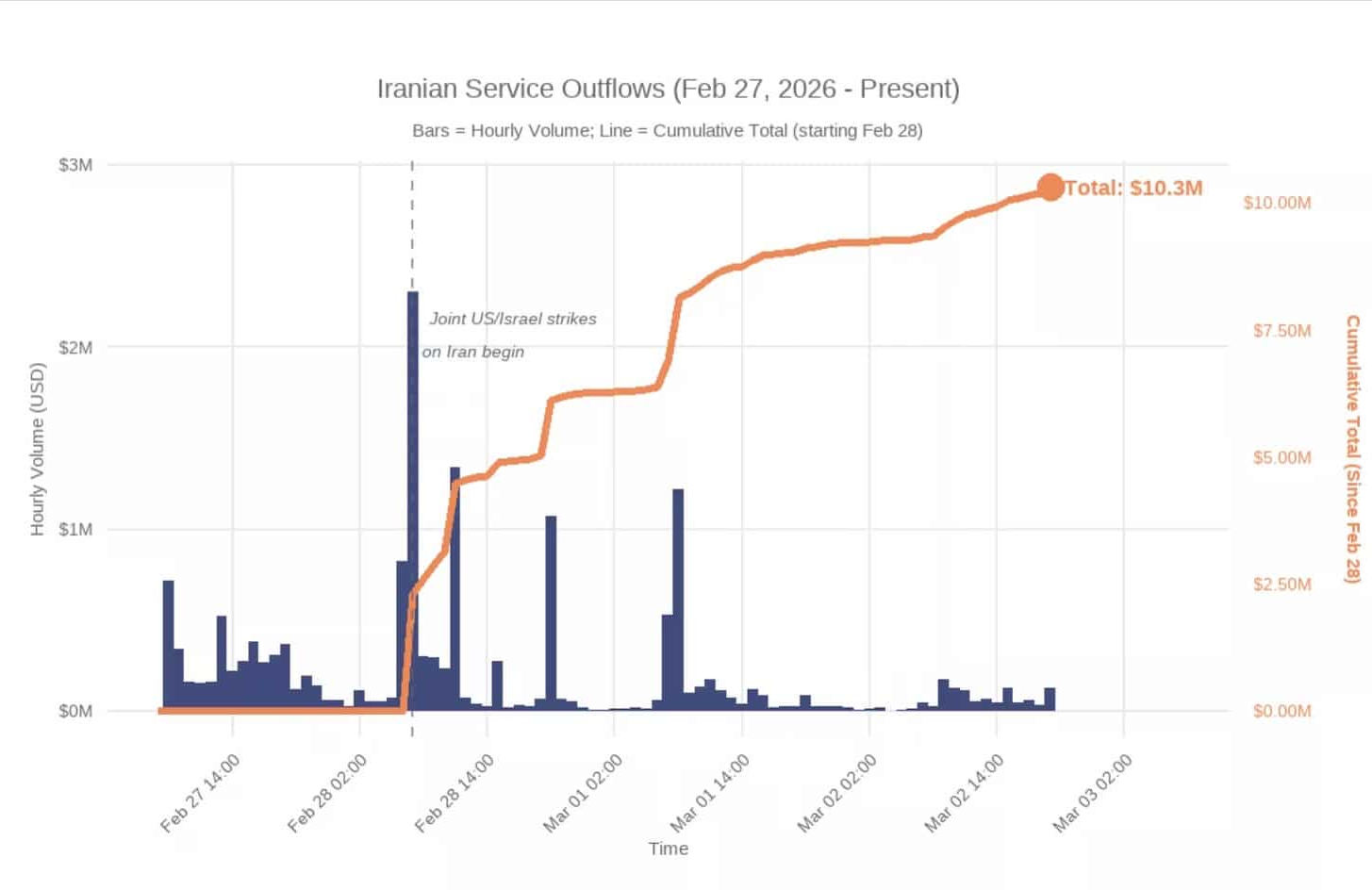
Inside Iran, the impact on the crypto ecosystem was far more severe. Blockchain intelligence firm TRM Labs reported that Iranian crypto transaction volumes fell by approximately 80% following the strikes.
The collapse was not caused by infrastructure destruction. The underlying blockchain networks continued to function normally. The drop was driven by three compounding factors: internet blackouts imposed during the conflict restricted access to exchanges and wallets; local exchanges implemented defensive measures to preserve solvency during the chaos; and Iran’s central bank suspended the USDT-toman trading pair across major platforms.
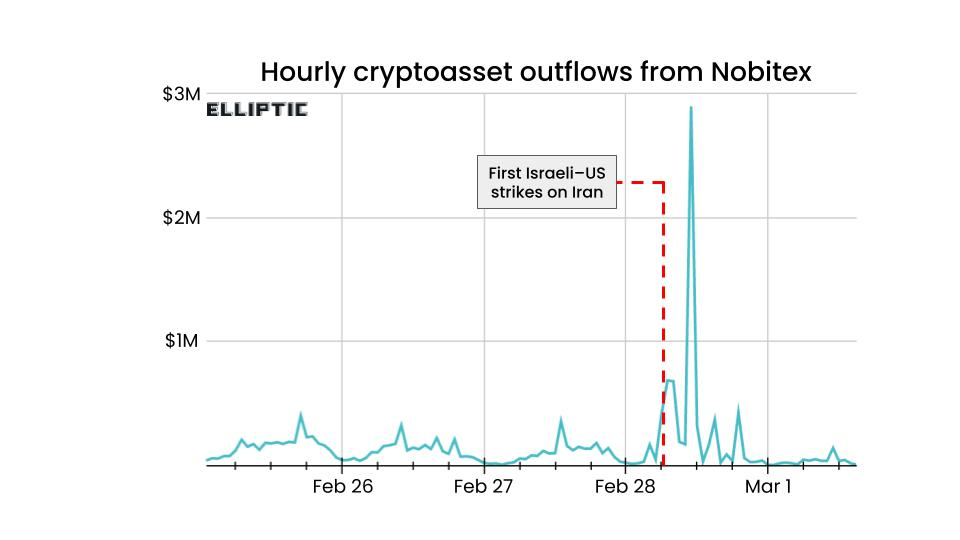
TRM Labs characterised the ecosystem as moving into “risk containment mode” rather than systemic failure. Major domestic platforms including Nobitex remained operationally intact. Competitor analytics firm Elliptic reported a 700% spike in outflows from Nobitex, suggesting significant capital flight. TRM offered a more conservative reading, noting that Nobitex’s combined inflows and outflows of roughly $3 million were not necessarily unusual given the context.
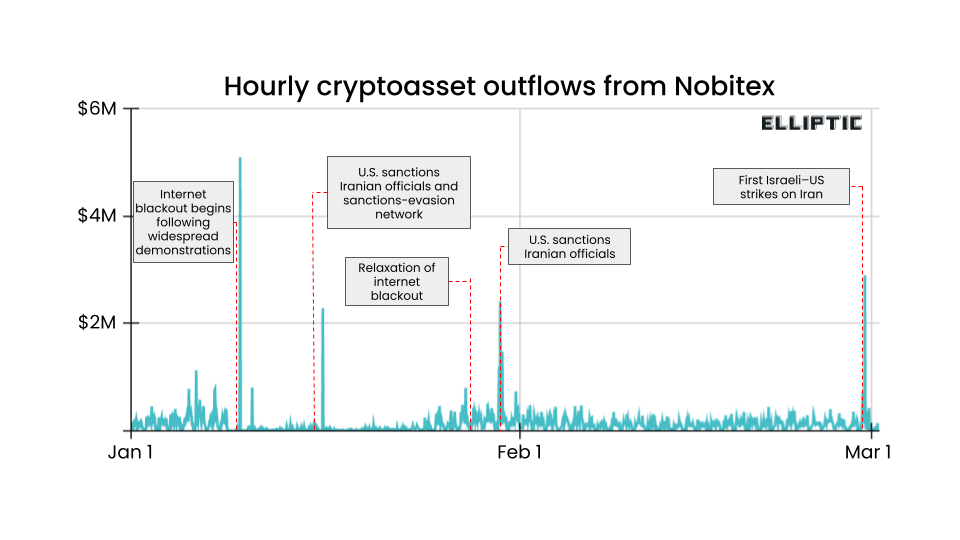
What both firms agree on: this is not the death of Iran’s crypto infrastructure. It is a stress test that the system is, so far, surviving.
Capital Flight: Ordinary Iranians Are Moving to Self-Custody
Away from the state apparatus, ordinary Iranians are using the conflict as a trigger to move their crypto off exchanges and into personal wallets.
Chainalysis data shows that Iranian exchange-to-personal-wallet withdrawal activity spiked sharply during the conflict, mirroring a pattern observed during the June 2025 clashes and the domestic protests of late 2025. During the protest window, Iranians had already increased Bitcoin withdrawals to personal wallets at significantly elevated rates compared to pre-protest periods.
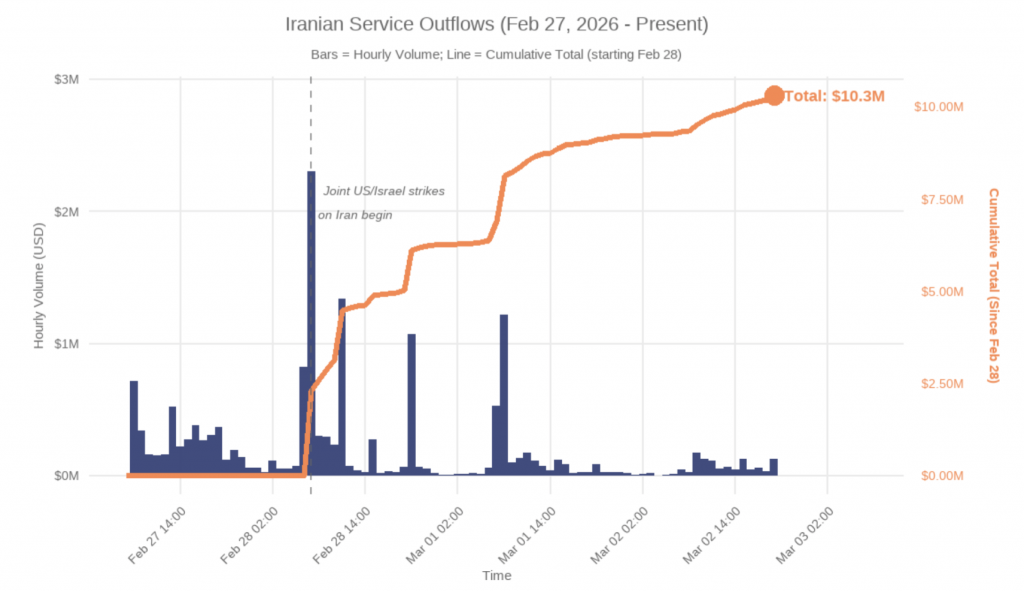
The driver is straightforward. The Iranian rial has collapsed to near-worthlessness against major currencies.
In an environment where the domestic currency cannot preserve value and government-controlled financial channels can be frozen, a self-custodied Bitcoin wallet offers something the banking system cannot: censorship resistance and portability.
If a citizen needs to flee or operate outside government-controlled channels, BTC in a hardware wallet travels with them.
This behaviour is not unique to Iran. The same pattern has been observed in every economy experiencing war, hyperinflation, or government crackdown. Iran is the largest and most advanced case study currently active.
Bitcoin’s Real Role: Settlement Layer, Not Digital Gold
The US-Iranian conflict has reopened one of crypto’s most persistent debates: is Bitcoin digital gold?
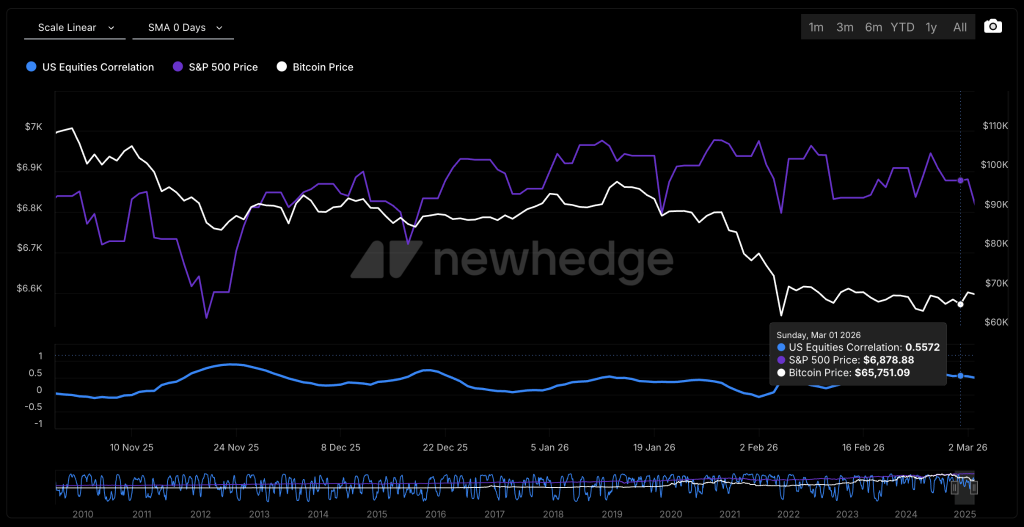
The answer, based on price behaviour over the past week, is no. Bitcoin did not rally when the strikes began. It fell sharply, recovered partially on news of Khamenei’s confirmation of death, then retreated again as the broader risk-off environment deepened. Gold, by contrast, climbed to $5,350 an ounce as investors sought shelter.
Bitcoin’s 30-day rolling correlation with the S&P 500 stood at 0.55 as of March 1, 2026. It continues to trade as a risk asset, not a safe haven. When equities sold off on the Iran escalation, Bitcoin followed.
But Bitcoin’s real role in this conflict is more useful than gold’s: it is the settlement layer.
When equity markets are closed for the weekend and FX markets are thin, crypto is the only 24-hour arena where institutions can rebalance, hedge, and move collateral. That is exactly what happened across the weekend of the initial strikes. It does not make Bitcoin a safe haven. But it does make it structurally important in a world where geopolitical events can move markets at 3am on a Saturday.
For traders using crypto futures to navigate volatility, understanding this distinction matters. Bitcoin during a geopolitical shock is not a hedge. It is a risk-on asset that happens to be the most liquid market open when everything else is shut.
Privacy Coins and the Sanctions Premium
One asset class that has benefited directly from the Iran conflict and broader sanctions environment is privacy-oriented cryptocurrencies.
Zcash (ZEC) and Monero (XMR) offer transaction anonymity that Bitcoin’s transparent public ledger does not. In high-intensity conflict scenarios involving heavy sanctions, their utility increases because they make it harder for blockchain analytics firms to trace the origin or destination of funds.
ZEC is up over 500% in the past year.
XMR has gained over 56% despite a major correction. Both have shown sensitivity to sanctions-related news cycles. The Iran conflict is one of the clearest demand drivers for this category of assets currently active in the market.
The risk is regulatory. Western governments have been increasingly hostile to privacy coins. Japan has banned them from exchanges outright. If a major global crackdown on ZEC and XMR follows an escalation in Iran-related sanctions enforcement, the regulatory risk premium could reverse sharply.
What Traders Should Watch
The Iran situation creates several forward-looking signals for crypto traders:
- BTC price and Strait of Hormuz. If the Strait reopens and oil prices stabilise, the macro risk-off pressure on BTC eases. Trump has stated the US may escort tankers through the strait. A resolution here is the single biggest catalyst for a BTC recovery rally in the near term.
- USDT compliance actions. Watch for OFAC sanctions designations targeting specific USDT wallet addresses linked to Iranian entities. These create compliance risk for any exchange holding those addresses in its order books and can trigger rapid liquidity shifts.
- Bitcoin ETF flows. US spot Bitcoin ETFs snapped a four-week outflow streak with $458 million in single-day inflows on March 3, 2026, even as the conflict was escalating. ETF flow direction is the clearest institutional sentiment signal available right now. If inflows continue despite geopolitical noise, it signals institutions are buying the dip rather than fleeing.
- Privacy coin momentum. ZEC and XMR tend to spike around sanctions escalation events. If the Iran conflict deepens and new sanctions packages are announced targeting crypto rails, these assets typically react quickly.
- Iran’s power grid. Further military strikes on Iranian energy infrastructure would directly reduce Iran’s Bitcoin mining output. While Iran’s share of global hash rate is not dominant, a sustained disruption would be noticed on-chain and could affect mining sentiment more broadly.
You can track BTC, USDT, and relevant altcoins directly on WazirX as this situation develops.
Iran’s Crypto Economy at a Glance
| Metric | Figure |
| Total ecosystem size (2025) | $7.78 billion |
| IRGC share of on-chain inflows (Q4 2025) | 50%+ |
| IRGC value received (2025) | $3 billion+ |
| Volume drop after Feb 28 strikes | ~80% |
| Primary stablecoin used | USDT (USDT-toman pair) |
| BTC price reaction to strikes | Fell to ~$64,000, partial recovery |
| ZEC 1-year performance | +500%+ |
| BTC ETF inflow snap (March 3) | $458 million single day |
Final Thoughts
Iran’s crypto ecosystem shows how digital assets can evolve beyond trading into real geopolitical infrastructure. Bitcoin mining, USDT settlement, and on-chain transfers have become tools for moving value across borders when traditional finance is restricted. For traders, the lesson is clear: crypto markets do not operate in isolation. Sanctions, wars, and global policy shifts increasingly shape liquidity, volatility, and how blockchain networks are used in the real world.
Frequently Asked Questions
Iran has built a $7.78 billion on-chain financial network that allows the state to conduct international trade and move hard currency without using the US dollar or SWIFT banking system. It combines state-licensed Bitcoin mining, USDT stablecoin settlement, and a large on-chain footprint controlled primarily by the IRGC.
Licensed miners use subsidised electricity to produce Bitcoin and sell it to Iran’s central bank. The central bank then transfers BTC directly to overseas counterparties as payment for imports, bypassing US-controlled banking infrastructure entirely. The transaction settles on a public blockchain but counterparty identities can remain opaque.
USDT offers dollar-pegged price stability that Bitcoin does not. A commercial transaction agreed at a specific dollar value does not change between agreement and settlement when denominated in USDT. It is also faster and more flexible across multiple blockchains compared to Bitcoin transfers.
No. TRM Labs reported an 80% drop in transaction volume, but attributed this primarily to internet blackouts and exchange defensive measures rather than infrastructure failure. Major exchanges including Nobitex remained operational. The ecosystem moved into risk containment mode rather than systemic collapse.
Bitcoin currently trades with a 0.55 correlation to the S&P 500. During acute geopolitical stress, it behaves as a risk asset rather than a safe haven. Gold rallied because investors sought a traditional inflation and uncertainty hedge. Bitcoin fell because investors treated it as a speculative asset to reduce during a risk-off environment.
The Islamic Revolutionary Guard Corps accounts for over 50% of Iran’s total crypto inflows according to Chainalysis. IRGC-linked addresses received over $3 billion in 2025. The IRGC uses crypto across its network of commercial fronts and overseas affiliates for procurement and value transfer across sanctioned channels.
Indian traders using regulated platforms like WazirX transact through KYC-compliant infrastructure. The compliance risk is primarily relevant to global exchanges and DeFi protocols that may have exposure to IRGC-linked wallet addresses. Understanding the sanctions landscape helps traders assess which platforms and assets carry elevated regulatory risk.
Iran’s crypto ecosystem reached approximately $7.78 billion in on-chain activity in 2025, according to blockchain analytics firm Chainalysis. The ecosystem is driven by state-licensed Bitcoin mining, USDT stablecoin settlement, and trading through domestic exchanges. It serves both the Iranian government, which uses crypto for international trade under sanctions, and ordinary citizens seeking protection from the rapidly depreciating Iranian rial.
Sanctioned countries sometimes use cryptocurrency because blockchain transactions allow value to move globally without relying on traditional banking systems such as the US dollar clearing network or the SWIFT payment system. Assets like Bitcoin and stablecoins can enable cross-border transfers even when access to international banks is restricted.
Ready to trade Bitcoin, USDT, and other assets discussed in this article? Start trading on WazirX.
 Disclaimer: Click Here to read the Disclaimer.