

Get WazirX News First
Once you get into crypto, you’re going to have many questions about it, but one that stays at the top of the list is: Where is crypto stored?
It is a fair question. When we imagine money, we tend to visualise things like bank accounts, safety deposit boxes, or physical wallets. Crypto operates in an entirely different way. For example, there are no actual bank vaults filled with digital coins. None of your assets is held by one central authority that physically keeps your money.
To understand crypto storage, you first need to understand what cryptocurrency actually is.
What is Cryptocurrency?
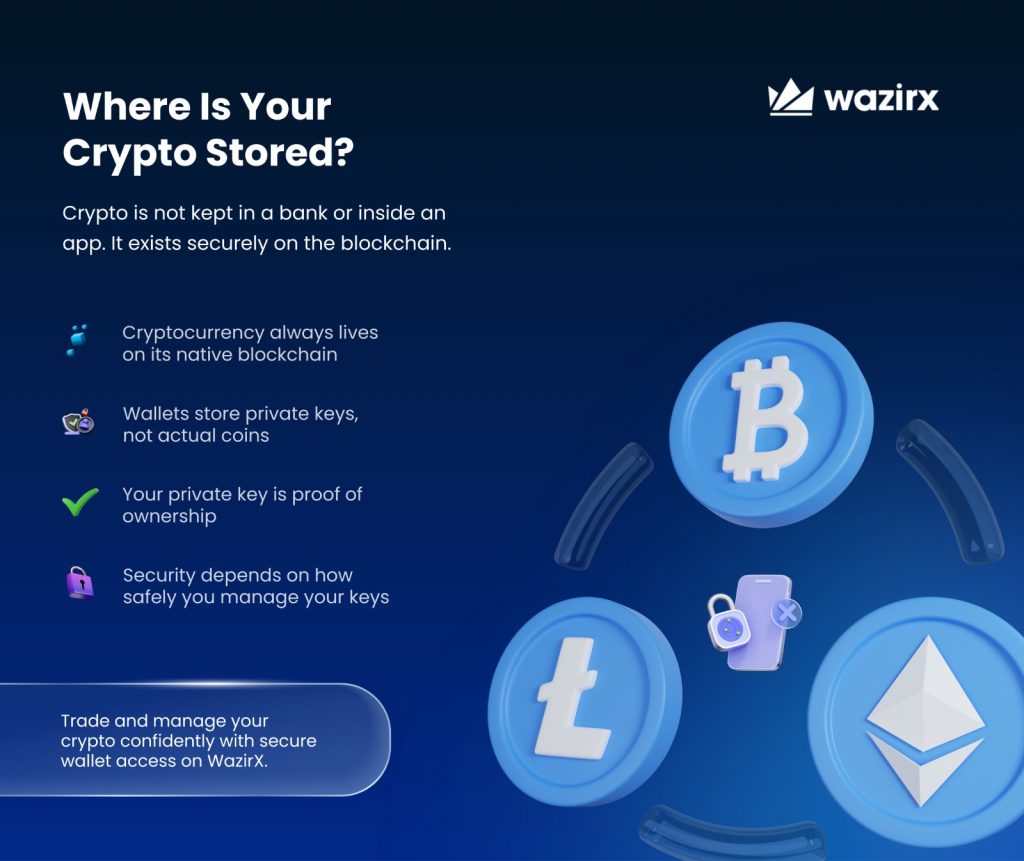
Cryptocurrency is not a physical object, it is a record on a blockchain. A blockchain is a distributed digital ledger maintained by thousands of computers around the world. Every transaction is verified and permanently recorded on this ledger.
So technically speaking, crypto is stored on the blockchain. That answers part of the question. But it does not explain ownership, and that is where wallets enter the picture.
Crypto Wallet Explained in Simple Terms
When people hear the term wallet, they assume it stores coins. In reality, a wallet does not store your crypto the way a physical wallet stores cash.
A crypto wallet stores the cryptographic keys that allow you to access and control your assets on the blockchain.
There are two key components involved:
- Public Key: Your public key acts like an address, you share it when you want to receive crypto.
- Private Key: Your private key proves ownership, it allows you to send crypto and authorise transactions.
The crypto itself remains on the blockchain at all times; your wallet simply gives you access to it. This is the foundation of digital asset storage.
If someone gains access to your private key, they control your funds. If you lose it, you lose access permanently. That is why understanding how crypto wallets work is critical before investing seriously.
How Crypto Wallets Work During a Transaction
Let us say you want to send Bitcoin to someone. You open your wallet and enter the recipient’s public address.
When you confirm the transaction, your wallet uses your private key to digitally sign it. This signature proves to the network that you are the legitimate owner. The transaction is then broadcast to the blockchain network, verified by validators, and recorded on the ledger.
The wallet did not move coins from one place to another. It authorised a change in the blockchain record, which is how crypto actually moves.
This is often where confusion about where Bitcoin is stored comes from. Bitcoin is not sitting inside an app or exchange account. It is always on the Bitcoin blockchain, and what you control is the access through trusted exchange apps like WazirX.
Types of Crypto Storage
When discussing crypto storage, you will often hear about hot wallets and cold wallets.
- Hot wallets are wallets that are accessible via the internet.
Examples of hot wallets include exchange wallets, mobile wallets, or web wallets, and they are a convenient way for people to actively trade. - Cold wallets are offline storage solutions that are physical devices.
Examples include hardware devices that typically hold crypto for a longer duration, as they provide better protection against online threats.
Each method has its own purpose. Active traders often utilize integrated exchange wallets because of their ease of use and efficiency, while long-term holders prefer cold storage for extra security.
What is most important is not where you store your crypto, but rather how safely you manage your private keys.
So, Where are Cryptos Really Stored?
To answer this question, we need to understand where coins are created.
Cryptos are created directly on their native blockchains. New coins are issued through network processes such as mining or validation. In proof-of-work systems, miners add new blocks to the blockchain and receive newly created coins as rewards. In proof-of-stake systems, validators confirm transactions and are rewarded with newly issued tokens. In both cases, coins come into existence on the blockchain itself; you own the coin based on an associated private key that is linked to your blockchain address.
There aren’t any banks that keep physical coins, nor are there any vaults that hold “real” coins. All ownership of any given coin on the blockchain is proven by cryptographic signatures/data recorded on a completely decentralised network (the crypto blockchain).
Once you grasp this idea about how coins are created and exist in the world, everything associated with crypto becomes less abstract and makes more sense.
Managing Crypto Storage with Confidence
Understanding where crypto is stored is not just technical knowledge. It directly affects how you approach security, risk, and trading.
Using a reliable platform matters; secure key management, strong infrastructure, and smooth trading experience all play a role in protecting your assets.
WazirX offers integrated wallet functionality within a streamlined trading environment. Users can buy, sell, and manage a wide range of crypto assets with ease, while relying on structured security practices designed for digital asset management.
For anyone entering crypto or expanding their portfolio, choosing a platform that simplifies both trading and storage makes a practical difference.
If you are ready to trade confidently and manage your crypto efficiently, WazirX provides the tools to do both in one place.
 Disclaimer: Click Here to read the Disclaimer.