

When Crypto and TradFi Collide: How Traders Are Using Hyperliquid to Bet on the Middle East War
When the US-Israel-Iran conflict intensified in early March 2026 and WTI(West Texas Intermediate) crude oil spiked more than 30% in a single week, the world’s most active oil trading venue was not the Chicago Mercantile Exchange. It was Hyperliquid, a crypto-native perpetual exchange running 24 hours a day, seven days a week on its own Layer-1 blockchain.
In one 24-hour session, Hyperliquid’s oil perpetual contract logged $1.77 billion in trading volume, overtaking Ethereum perpetuals and claiming the second spot on the exchange behind only Bitcoin.
Oil trades now account for roughly 18% of Hyperliquid’s total activity. This is not a niche experiment. It is the beginning of a structural shift in how macro-driven commodities are traded.
Here is what you need to understand about crypto commodity perpetuals and what this trend means for you as an Indian trader.
Get WazirX News First
TLDR
- Hyperliquid’s CL-USDC contract lets traders go long or short on WTI crude oil using USDC as margin, with no expiry date and leverage up to 10x or more.
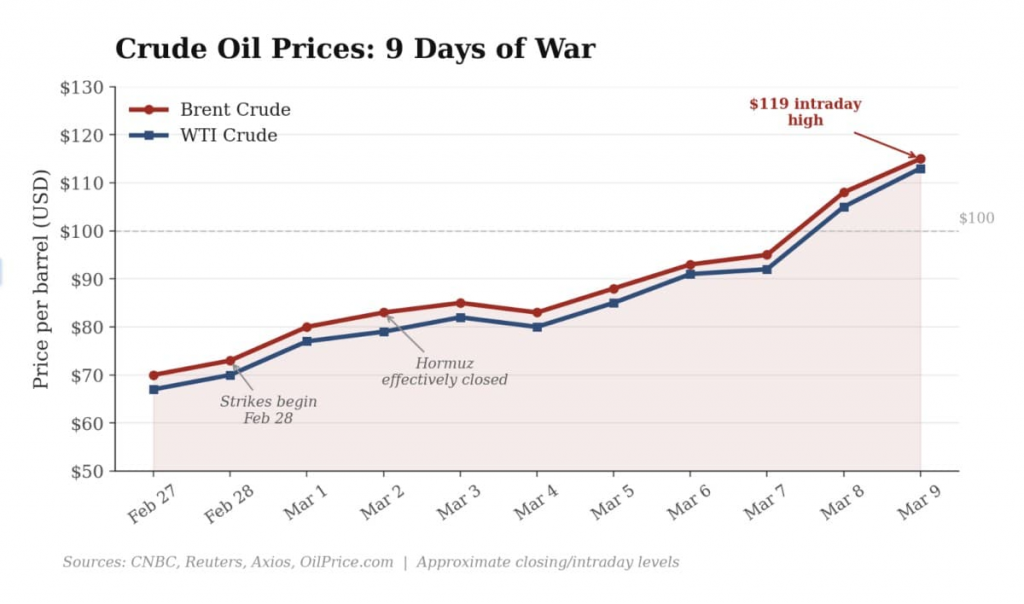
- Oil perps overtook Ethereum perps in daily volume on Hyperliquid as Middle East tensions sent WTI prices swinging from $77 to near $120 per barrel.
- Crypto commodity perps carry macro risk layers that standard BTC or ETH futures do not: geopolitical events, IEA policy, and OPEC decisions can move prices instantaneously.
What Are Crypto Commodity Perpetuals?
A crypto perpetual futures contract is a derivative that lets you take a leveraged position on an asset without owning it, with no expiry date.
Historically, these contracts tracked crypto assets: Bitcoin, Ethereum, Solana. But platforms like Hyperliquid have extended the model to real-world commodities including crude oil, gold, and silver.
A crypto commodity perpetual works identically to a crypto perp in mechanics:
- You deposit stablecoins as margin, choose a direction (long or short), set your leverage, and your position tracks the underlying commodity price in real time.
- A funding rate is periodically exchanged between longs and shorts to keep the perpetual contract price anchored to the spot price of the commodity.
The key difference is what moves the price.
Bitcoin moves on ETF flows, on-chain activity, and crypto-native sentiment.
Oil moves on wars, pipeline capacity, IEA statements, and geopolitical decisions made by governments. Traders using oil perps need to model both sets of drivers.
Hyperliquid introduced commodity perps via its HIP-3 protocol upgrade in late 2025, which enables anyone to deploy a permissionless perpetual market tied to any external price feed. Oil was the first commodity to find substantial adoption.
Why Oil Volume Exploded on Hyperliquid
In the first week of March 2026, escalating US-Israel-Iran military conflict raised fears of supply disruptions through the Strait of Hormuz, a chokepoint through which roughly 20% of global oil trade flows. WTI crude futures jumped more than 30% in a week on traditional exchanges.
The problem for traders who wanted to react to this news was timing.
Commodity markets on traditional exchanges like the CME have limited overnight hours. When news breaks at 3am or over a weekend, traditional oil futures traders cannot act until the exchange reopens.
Like any other crypto exchange, Hyperliquid runs continuously. When the first news of strikes on Iranian infrastructure broke during weekend hours, Hyperliquid’s CL-USDC oil perpetual was immediately liquid. Traders could go long or short in seconds with full exposure to price moves.
This is the core proposition of crypto commodity perps: they convert a geopolitical event into a tradeable position in real time, regardless of geography or trading session.
The result was extraordinary volume.
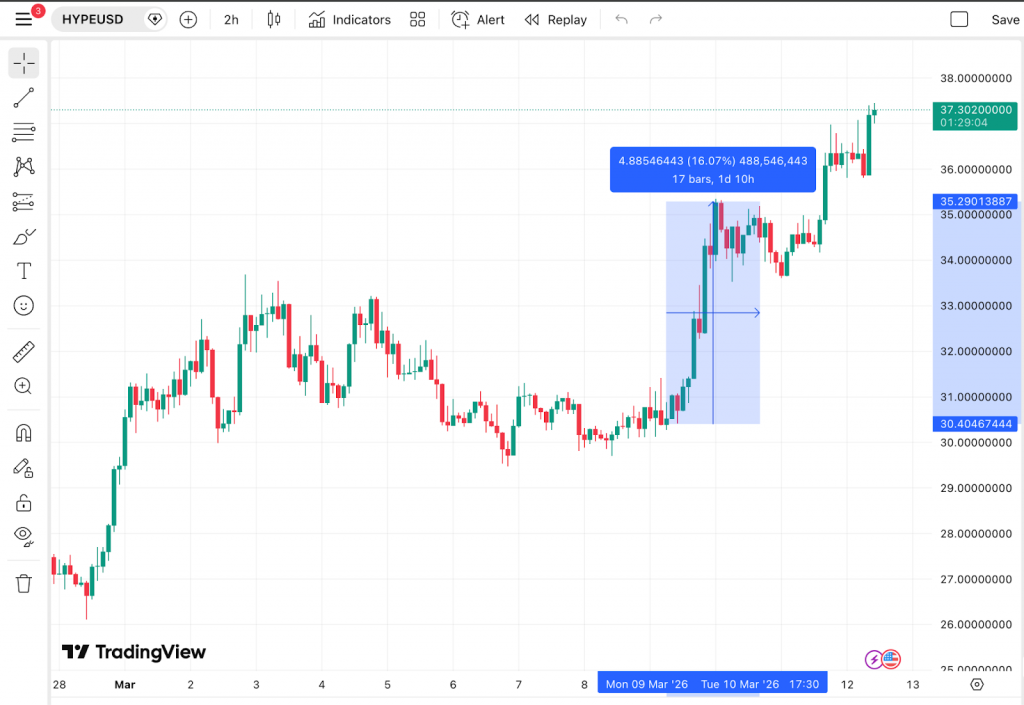
On March 9-10, 2026, the CL-USDC contract logged over $1.77 billion in 24-hour trading volume on peak days, making it the second-most traded market on Hyperliquid behind Bitcoin.
Open interest on the contract rose above $400 million. HYPE, Hyperliquid’s native token, responded by rallying approximately 35% year-to-date, outperforming virtually every large-cap crypto asset.
How the CL-USDC Oil Perp Works
- The CL-USDC contract on Hyperliquid tracks West Texas Intermediate crude oil, the benchmark US crude. Here is the mechanics breakdown:
- Underlying asset: WTI crude oil, sourced via oracle price feeds external to Hyperliquid.
- Margin and settlement: Both are in USDC, a US dollar-pegged stablecoin. You never handle physical oil. Positions are cash-settled.
- Expiry: None. This is a perpetual contract. You hold it as long as your margin supports the position.
- Funding rate: As with crypto perps, a periodic funding rate is exchanged between longs and shorts to keep the contract price close to WTI spot. When oil is rallying sharply and more traders want to go long, longs pay funding to shorts. When sentiment reverses, the direction flips.
- Leverage: Hyperliquid offers meaningful leverage on the contract. During the March rally, some traders were running 3x or 5x positions. At 5x leverage, a 20% oil move doubles your position value or wipes it entirely.
- Liquidation: Like all leveraged futures, your position is automatically closed if your margin falls below the maintenance margin requirement. At high leverage during a volatile oil news event, this can happen within minutes.
The Scale of the Shift
To understand how significant this is, consider this:
Oil perps had logged roughly $400 million in cumulative trading volume during the quiet period after Hyperliquid launched them in January 2026.
That entire figure was eclipsed in a single day during the March Middle East escalation.
In some sessions, oil and other non-crypto markets (gold, silver, equity indices) accounted for more than 30% of Hyperliquid’s total activity.
This is not speculative positioning. Bloomberg covered the story explicitly, noting that Hyperliquid has become “a round-the-clock venue for leveraged commodity bets.” Institutional and crypto-native traders are both participating.
The convergence of crypto infrastructure with traditional commodity markets is no longer theoretical.
Risks Unique to Commodity Perps
Commodity perps carry risk layers that most crypto traders have not previously modeled. If you trade BTC or ETH futures, your primary risk drivers are crypto-native: exchange flows, on-chain leverage, sentiment, and macro sentiment around risk assets.
Commodity perps introduce a separate set of drivers.
- Geopolitical news risk: Oil prices are directly affected by military actions, diplomatic statements, and infrastructure attacks. A single tweet from a head of state or a missile strike on an oil facility can move prices 5-10% in minutes. This is faster and less predictable than most crypto market moves.
- IEA and OPEC policy risk: Coordinated reserve releases by the International Energy Agency or production decisions by OPEC members can reverse a multi-day rally instantly. These decisions often happen without warning during trading hours or at scheduled meetings that are hard to track.
- Funding rate risk during extreme moves: When oil is spiking and everyone wants to go long, funding rates for longs can become very expensive. In an extreme rally, you may pay significant funding just to hold a winning position overnight.
- Liquidation during news spikes: Hyperliquid’s architecture is efficient but not immune to violent price moves. During the initial $119 spike and the subsequent pullback to $77, traders with leveraged positions on both sides were liquidated in rapid succession. At high leverage, a 10% oil reversal erases a 10x position entirely.
- Oracle dependency: Commodity perps rely on oracles for price data, just like DeFi lending protocols. If the oracle supplying WTI prices to Hyperliquid is delayed or misconfigured, traders can face the same type of erroneous liquidations that Aave users experienced with wstETH.
Conclusion
Global events are increasingly priced first in crypto markets, where trading runs continuously and reacts to news in real time. As crypto infrastructure expands beyond digital assets into broader macro narratives, access to a reliable exchange becomes essential. For Indian traders, WazirX offers FIU-registered operations along with structured INR on-ramp and off-ramp rails designed for responsible participation. Download the WazirX app to explore crypto trading and begin navigating these rapidly evolving markets.
Frequently Asked Questions
It is a perpetual futures contract that tracks the price of WTI crude oil. You deposit stablecoins as margin and take a leveraged long or short position on oil price movements, with no expiry date and no physical oil delivery.
Yes. Oil prices are driven by geopolitical events, OPEC decisions, IEA policy, and physical supply dynamics. Traders who approach oil perps using only crypto-style technical analysis without understanding commodity fundamentals are taking on significant blind-spot risk.
The core mechanics are similar, but crypto oil perps are on-chain, settle in USDC, operate 24/7, and have no expiry. CME contracts have fixed expiry dates, require USD margin, and trade during designated hours. CME also operates under CFTC regulation; crypto perps do not.
HYPE is Hyperliquid’s native token and benefits from increased protocol revenue when trading activity rises. More volume on oil perps means more fees generated by the Hyperliquid protocol, which supports the value of HYPE.
 Disclaimer: Click Here to read the Disclaimer.