

- The average public Bitcoin miner spent ~$80,000 to produce one BTC last quarter, well above the ~$70K market price.
- Unable to profit from mining, major miners are signing $70 billion in AI compute contracts instead.
- This pivot reduces new BTC sell pressure, since miners no longer need to dump coins to cover costs.
The Math of Bitcoin Mining Stopped Working?
Main guide: What is Bitcoin Mining?
Bitcoin mining used to be simple. Mine coins. Sell coins. Cover costs. Profit.
That equation broke in Q1 2026.
The average public Bitcoin miner spent approximately $79,995 to produce a single Bitcoin last quarter. With BTC trading around $70,000, every coin mined is a loss before overheads even enter the picture.
This is not a temporary dip: Halving cycles reduce miner rewards every four years, and the most recent halving made the economics structurally harder. Energy costs have not dropped. Competition for hash rate has not eased.
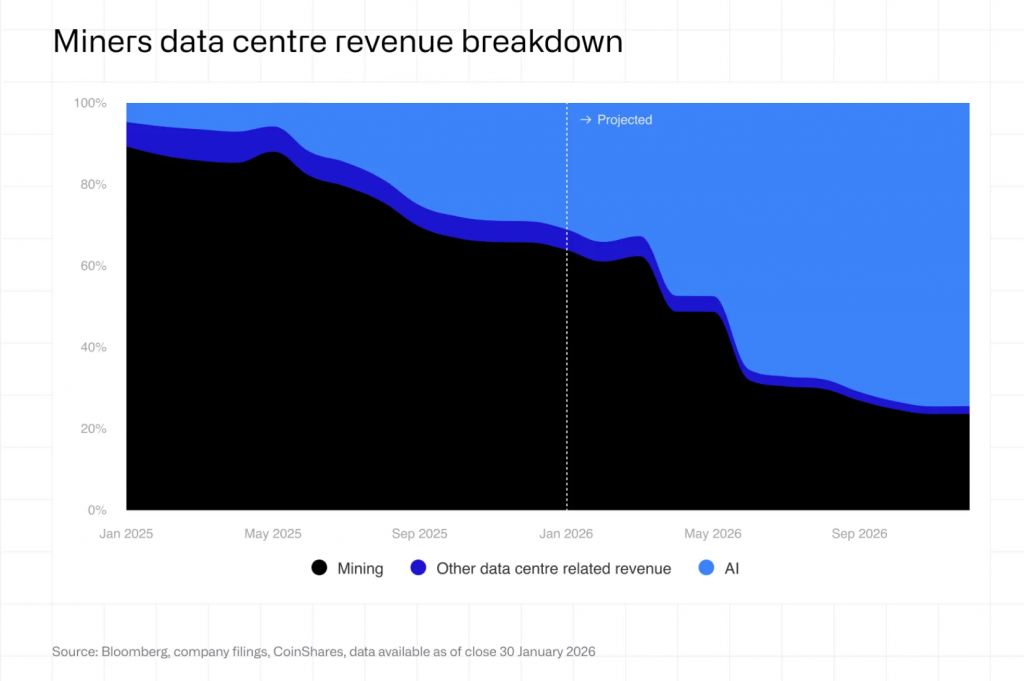
Enter the $70 Billion Pivot
BTC mining may not be profitable, but the machines still have value. Because these are powerful, energy-hungry computers sitting in large facilities with established power contracts. That infrastructure is exactly what AI companies need.
Over the past 12 months, Bitcoin miners have collectively signed an estimated $70 billion in AI compute contracts, converting their data centers into GPU and ASIC farms for large language models, inference workloads, and training runs.
Companies like Core Scientific, CleanSpark, and Bit Digital have either pivoted partially or entirely toward hosting AI workloads. The pitch to investors: stable, recurring revenue from AI clients instead of volatile BTC price exposure.
What This Does to BTC Supply
Miners have historically been the most predictable source of sell pressure in the Bitcoin market. They receive newly minted BTC daily and must sell a portion to cover operational costs: electricity, staff, debt.
When miners pivot to AI, two things happen:
- They sell less BTC:AI compute revenue is paid in fiat (USD). Miners no longer need to liquidate BTC holdings to cover costs. Some are even accumulating rather than selling.
- New BTC issuance still happens, but miners hold more of it:With operational costs covered by AI contracts, the marginal coin mined becomes a treasury asset, not an immediate sale.
This is a quiet but meaningful reduction in the daily sell-side pressure that markets have priced in for years.
Also read: Best crypto to mine
Mining vs. AI Hosting: The Revenue Model Shift
| Factor | Bitcoin Mining | AI Compute Hosting |
| Revenue source | BTC price (volatile) | AI client contracts (stable) |
| Margin pressure | High (post-halving) | Moderate (long-term deals) |
| BTC sell pressure | High (daily operational sales) | Low (fiat revenue covers costs) |
| Infrastructure overlap | High (same data centers) | High (repurposed hardware) |
| Market sensitivity | Directly tied to BTC price | Partially decoupled |
Miners who successfully pivot are transforming from price-sensitive sellers into price-indifferent accumulators.
The Risks Traders Cannot Ignore
But this narrative has its limits too.
- AI contract dependency: If hyperscalers pull back on compute spending or build their own infrastructure, miner AI revenues collapse. This is not a guaranteed long-term income stream.
- Hardware mismatch: Bitcoin mining ASICs are not ideal for all AI workloads. Some miners are repurposing GPU farms, but the transition has real technical constraints.
- Debt load: Many miners took on significant debt during the 2021 bull run. AI pivot capex adds more. A downturn in either BTC price or AI spending creates serious balance sheet risk.
- Concentration risk: If a few large miners dominate AI contracts, smaller miners are left with uneconomical BTC mining and no AI fallback.
What Traders Should Watch
You do not need to trade mining stocks to use this information. Here is what matters for crypto traders:
- Miner-to-exchange flows: If miners are holding more BTC and sending less to exchanges, that is a measurable supply reduction. CryptoQuant tracks this in real time.
- Watch hash rate: A drop in hash rate combined with lower exchange inflows from miners suggests active pivoting, not just reduced profitability.
- Watch BTC treasury announcements. Miners announcing they are holding rather than selling is a direct signal. Treat these like corporate treasury disclosures.
- Watch the AI compute market: If AI spending slows, the pivot economics reverse quickly. Monitor earnings calls from Core Scientific, Bit Digital, and Hut 8.
Understanding Bitcoin futures positioning during these miner flow shifts can also give you an early read on whether the market is pricing in the supply reduction or ignoring it.
Final thoughts
In earlier cycles, Bitcoin miners regularly sold BTC to meet operational costs, creating a steady flow of supply into the market.
This pattern is now beginning to change. With AI compute as an additional revenue source, some miners can cover costs without selling the Bitcoin they mine.
As a result, new BTC entering the market may reduce over time. If this continues, it can support stronger price conditions by limiting excess supply.
For traders, this is the kind of shift that often shows up in the data before it becomes obvious in the price. Tracking miner flows, exchange inflows, and positioning becomes more important in phases like this.
When you are ready to act on these signals, WazirX gives you everything you need in one place: seamless INR deposits, real-time Bitcoin price tracking, deep liquidity, and a smooth trading experience across spot and futures. If you are serious about trading Bitcoin, this is where you should be.
Download the app, fund your account, and start trading BTC while these shifts are still playing out.
FAQs
Yes, AI is already changing Bitcoin mining. Many miners are shifting their infrastructure to AI compute to generate stable revenue. This reduces their need to sell mined BTC, which can lower overall market sell pressure and influence Bitcoin’s supply dynamics.
Roughly 90% of Bitcoin is held by a relatively small percentage of wallets, including early adopters, institutional investors, exchanges, and long-term holders. However, ownership is distributed across millions of addresses, and large holdings are not controlled by a single entity.
The 51% rule refers to a situation where a single entity or group controls more than 50% of Bitcoin’s mining power (hash rate). This could allow them to manipulate transactions, such as reversing payments or double-spending, though such attacks are extremely difficult and expensive to execute.
No, AI cannot directly mine Bitcoin. Bitcoin mining relies on specialized hardware (ASICs) solving cryptographic puzzles. However, AI can be used to optimize mining operations, such as improving energy efficiency, cooling systems, and hardware management.
 Disclaimer: Click Here to read the Disclaimer.