

Crypto prediction markets, saw over $12 billion in volume through 2025. However, navigating binary outcomes, smart contract risks, and India’s complex legal landscape creates significant uncertainty. This guide explores whether these platforms offer a viable alternative to traditional exchanges.
- Prediction markets let you buy and sell shares in real-world outcomes like “Will Bitcoin hit $100K by June?” using crypto as collateral.
- Platforms like Polymarket and Kalshi have quietly processed billions in volume, and now Coinbase and Robinhood are building the same functionality directly into their apps.
- Traditional Crypto exchanges earn from trading fees on price speculation; prediction markets compete for that same impulse, with a different structure.
What a Prediction Market Actually Is
A prediction market is a platform where you buy shares in a yes/no outcome. If you think the US will sign a crypto market structure bill before July 2026, you buy a “Yes” contract. If that outcome happens, the contract pays out $1 USDC. If it doesn’t, it pays zero. Your profit or loss is the difference between what you paid and the final settlement value.
This is different from crypto futures trading, where you are speculating on the direction of an asset’s price at a future date. In a prediction market, the underlying question can be anything: an election, a regulatory event, a sports result, or a central bank decision. The asset is information, not a token price.
The mechanism is simple.
- A market maker or the platform itself creates a contract with two sides: Yes and No.
- Traders buy whichever side they believe in.
- As new information arrives, prices shift.
A “Yes” contract for a peace deal might trade at 30 cents when talks look stalled, then jump to 72 cents the day a ceasefire is confirmed. The market is constantly aggregating what informed traders actually believe, not what pundits say.
Why Prediction Markets are Growing Right Now
In April 2026, crypto markets are moving on geopolitical signals: Iran ceasefire talks, Fed Chair confirmation hearings, CLARITY Act timelines. Every one of these is a prediction market question, and traders who want to express a view on the event rather than its price impact have found prediction markets more precise.
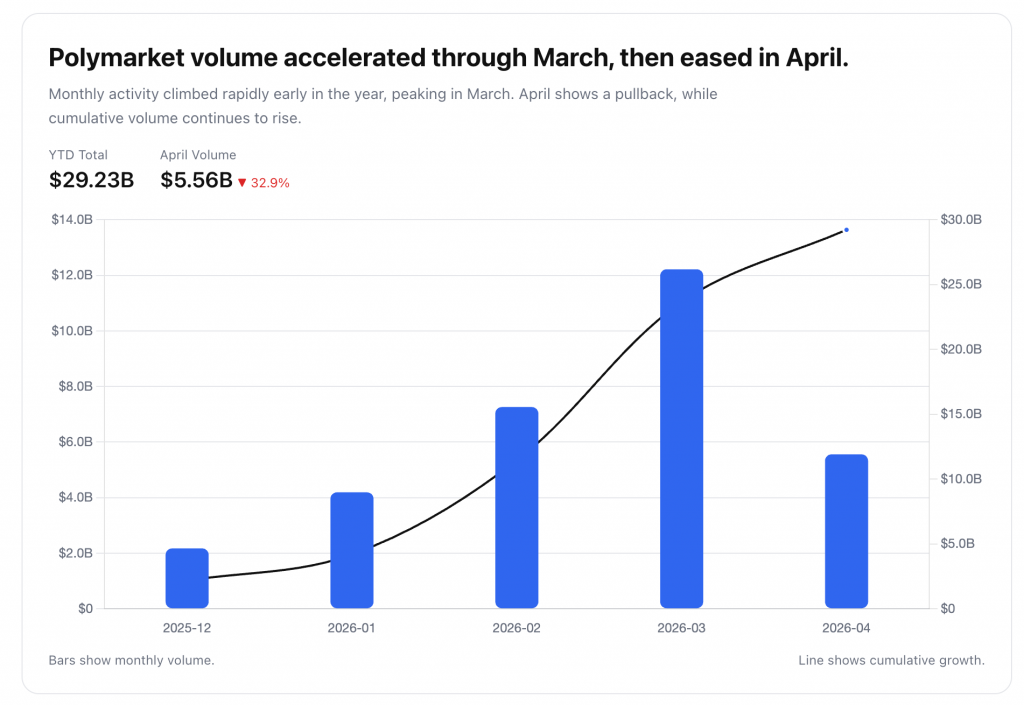
Polymarket processed over $12 billion in cumulative volume through 2025.
Kalshi, the US-regulated prediction exchange, received CFTC approval for event contracts and has since expanded into crypto-adjacent political and macro events. The user base is not retail gamblers. It skews toward people who read policy documents, follow macro closely, and want to put money where their analysis is.
Cantor Fitzgerald analysts flagged this week that Coinbase and Robinhood are treating prediction markets as their primary growth vector, not a side product. The logic: spot trading volumes are structurally compressed in a sideways-to-bearish market, but prediction market volume spikes during uncertainty, which is exactly when other trading slows.
How Crypto Exchanges Are Moving into the Prediction Market Business
Coinbase launched its own prediction market product in late 2025, letting users bet on US election outcomes and later macro events using USDC.
Robinhood followed with a similar feature. Both platforms already had the infrastructure: regulatory relationships, compliant wallets, and millions of users who understand how to fund an account and take positions.
The exchange model here is important to understand. On a standard spot vs futures platform, the exchange earns a fee every time you trade.
On a prediction market, the platform takes a spread or a small percentage of winnings. For Coinbase and Robinhood, adding prediction markets means adding a revenue stream that is uncorrelated with crypto price direction. A bear market kills spot volume. It does not kill interest in whether the Fed will cut rates this quarter.
New York’s attorney general filed suits against both Coinbase and Gemini this week, arguing that their prediction market contracts covering sports and entertainment outcomes constitute illegal gambling under state law.
This is not a death blow to the category, but it confirms regulators are paying close attention. The legal question is whether these products are commodity contracts regulated by the CFTC, insurance products, or gambling. The answer will shape how every Indian exchange eventually approaches this space too.
The Comparison Table: Prediction Markets vs Traditional Crypto Trading
| Feature | Prediction Market | Spot/Futures Trading |
| Underlying asset | Real-world outcome (Yes/No) | Token price |
| Settlement | Binary: $1 or $0 | Mark-to-market, continuous |
| Time horizon | Event-linked, defined deadline | Open-ended or expiry-based |
| Leverage | Typically none | Up to 100x on some platforms |
| Volatility profile | Driven by information events | Driven by price action |
| Regulatory status | CFTC (US), unclear globally | Well-established in most markets |
| Primary risk | Liquidity, platform settlement | Price, liquidation, funding rate |
Are They Actually Threatening Traditional Exchanges?
The honest answer: not yet in terms of volume, but yes in terms of user attention and product strategy.
Traditional crypto exchanges earn the bulk of their revenue from trading fees. When users spend time and capital in prediction markets instead of opening futures positions, that is competing revenue. Major exchanges have noticed. That is why Coinbase and Robinhood are not partnering with Polymarket. They are building their own.
The structural risk to traditional exchanges is more specific. Prediction markets appeal to the same intermediate-to-advanced user that crypto futures attract: someone who follows macro news, has a thesis, and wants to express it with money.
If a trader believes the CLARITY Act will not pass before July, they can short crypto futures (indirect expression) or buy a “No” contract on Kalshi (direct expression). The prediction market is cleaner. No liquidation risk, no funding rate drag, no basis to manage.
The missing piece for prediction markets is depth. Most markets outside of US elections and major crypto price milestones have thin liquidity. You can buy a “Yes” contract but selling it before settlement means finding a counterparty who disagrees.
That problem disappears when Coinbase’s user base sits behind the orderbook. Which is precisely why the exchange integrations are significant.
Are Crypto Prediction Markets Legal in India?
Crypto prediction markets in India sit in a legal grey area with real regulatory risk. There is no specific law that directly governs them, but how they are structured determines how they’re treated.
India regulates betting and gambling at the state level, and most states restrict or prohibit games of chance. Since prediction markets involve wagering on uncertain outcomes, they can be interpreted as a form of gambling, especially when real money or crypto is involved.
At the same time, there is no dedicated framework or regulator for prediction markets. This lack of clarity means they are neither formally permitted nor explicitly banned across the board. However, recent enforcement trends show that authorities may classify certain platforms as illegal online money games, leading to restrictions or blocks.
From a user perspective, using these platforms is not explicitly illegal, but it does come with legal and regulatory risk. There is no protection if policies tighten, and access to platforms can change quickly.
Final Thoughts
While prediction markets offer a novel way to capitalize on global events, their binary “all-or-nothing” nature and legal ambiguity in India can be a volatile path for many. If you prefer building a portfolio on the underlying assets that power these very innovations, WazirX provides a secure, regulated, and liquid environment to trade the tokens actually driving the future of decentralized finance.
Download the WazirX app now and take your first step into the world of crypto.
FAQs
Prediction markets are not clearly legal in India. If they involve staking money or crypto on uncertain outcomes, they can be treated as illegal gambling under state laws.
Globally, Polymarket (crypto-based) and Kalshi (regulated in the US) are among the most prominent platforms, representing offshore vs regulated models.
Crypto prediction markets are high-risk due to their binary nature, where incorrect predictions result in a 100% loss of capital. Investors also face liquidity constraints, smart contract vulnerabilities, and regulatory uncertainty. In jurisdictions like India, these platforms may be classified as illegal gambling, offering zero protection against platform failure or legal scrutiny.
Yes, but it’s inconsistent. Profits depend on information edge and timing, and most users tend to perform like traders, not investors. Over time, outcomes are unpredictable and volatile, making sustained profits difficult.
 Disclaimer: Click Here to read the Disclaimer.