

On June 12, 2026, SpaceX listed on Nasdaq under the ticker SPCX. The offering raised $75 billion from the sale of 555.6 million shares, making it the largest public market debut in US history. The valuation at open placed SpaceX ahead of Tesla and Meta, two companies already sitting inside the Magnificent Seven.
- SpaceX’s IPO revealed 18,712 BTC on its balance sheet, making Bitcoin part of the world’s biggest tech-company narrative.
- Bitcoin adoption is evolving from ETFs to corporate treasuries, with SpaceX and Tesla normalizing BTC on public balance sheets.
- Index inclusion could indirectly expose millions of investors to Bitcoin through SpaceX, creating long-term structural demand.
But buried inside the S-1 amendment SpaceX filed with the SEC on June 3 was a line that turned a rocket company’s debut into a crypto event: SpaceX holds 18,712 BTC on its balance sheet with a fair value of $1.293 billion as of March 31, 2026, against a cost basis of $661 million. That averages to roughly $35,300 per coin, accumulated well before Bitcoin’s current price levels.
The day after the listing, Saylor posted on X: “Congratulations @ElonMusk and $SPCX on a historic IPO. Thanks to you, 25% of the Mag8 now holds Bitcoin on the balance sheet.”
That word, Mag8, is doing a lot of work.
What Is the Mag8 and Why Does It Matter?
Saylor’s “Mag8” appears to expand the widely tracked Magnificent Seven, consisting of Apple, Microsoft, Nvidia, Alphabet, Amazon, Meta, and Tesla, by adding SpaceX as the eighth member following its IPO.
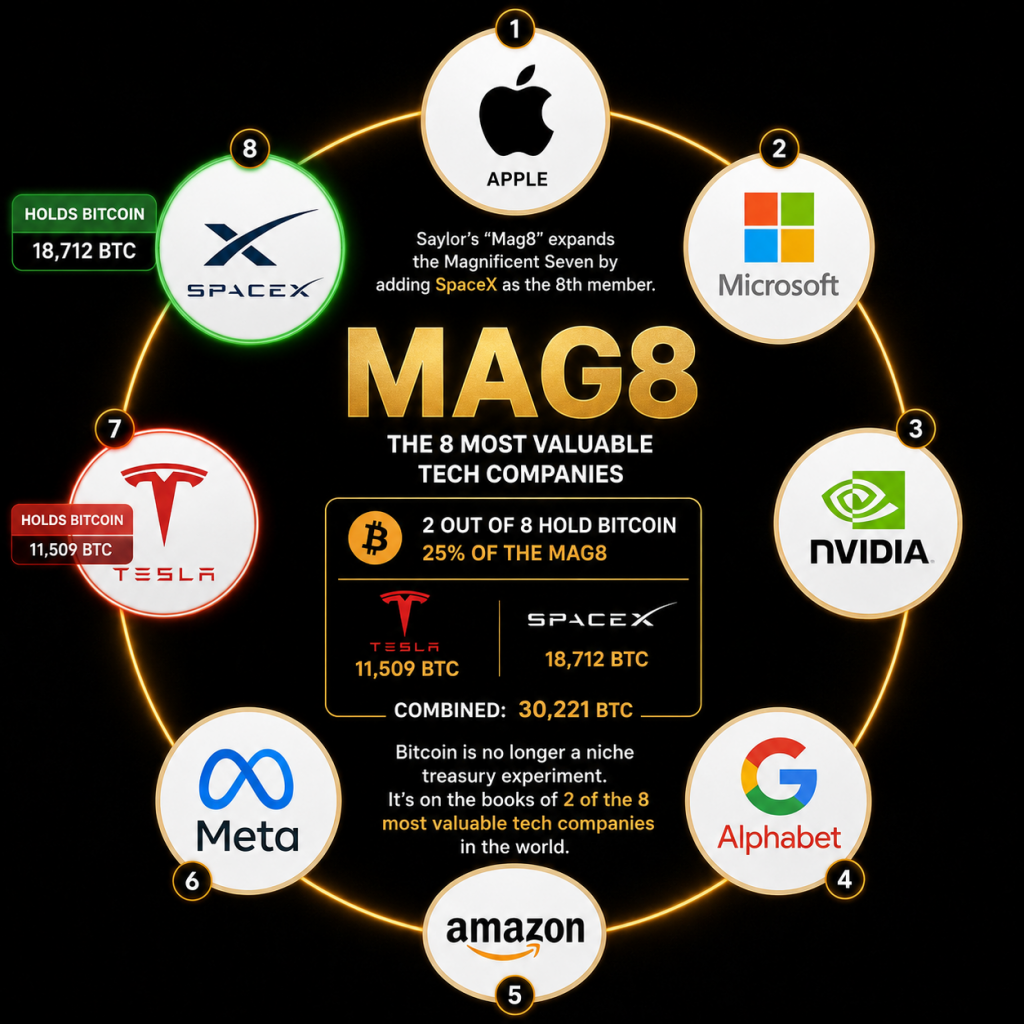
Of that group, Tesla holds 11,509 BTC and SpaceX holds 18,712 BTC. Combined, the two Musk-linked companies account for 30,221 BTC. The other six members of the Mag8 hold zero Bitcoin on their balance sheets, at least publicly.
So Saylor’s “25%” is mathematically accurate: 2 out of 8 companies. But the framing is strategic. He is making a category argument: Bitcoin is no longer a niche treasury experiment run by one company (Strategy). It is now a disclosed asset on the books of two of the eight most valuable technology companies on the planet.
That is a different signal entirely.
Three Corporate BTC Treasury Archetypes
Not all corporate Bitcoin holdings work the same way. The Mag8 data point obscures three meaningfully different approaches.
1. The All-In Accumulator: Strategy (MSTR)
Strategy remains the largest institutional Bitcoin holder, having added more than 90,000 BTC in Q1 2026 alone, surpassing BlackRock’s iShares Bitcoin Trust. The entire business model is built around BTC appreciation. Strategy raises capital, buys Bitcoin, and marks the holdings at fair market value. That accounting method causes major swings in reported profit and company valuation whenever Bitcoin’s price moves.
The payoff: if BTC rises, Strategy’s NAV rises faster than any other vehicle. The risk: leverage is central to the model. Capriole Investments founder Charles Edwards warned that Bitcoin treasury companies are “levering up at record rates,” and Grayscale separately cautioned that Strategy may face constraints on future Bitcoin purchases if market conditions weaken.
2. The Operational Hedger: Tesla and SpaceX
Tesla and SpaceX treat Bitcoin differently. Neither company’s primary revenue depends on BTC performance. Tesla generates revenue from EVs; SpaceX from launch contracts and Starlink. The Bitcoin position is closer to a treasury reserve decision, a hedge against dollar debasement and a signal of founder ideology.
SpaceX’s S-1 noted that accounting rules updated in 2024 changed how the company reports digital assets, with an adjustment that increased reported digital assets by $496 million and reduced the accumulated deficit by the same amount. This matters because FASB’s updated standard (ASU 2023-08) now requires companies to mark crypto assets at fair value each quarter, which means unrealized gains flow through the income statement. For SpaceX and Tesla, that creates earnings volatility, but it also means their BTC positions are now more visible and more regulated than before.
3. The Index-Forced Buyer: Coming Soon
This is the mechanism most retail investors miss. FTSE Russell confirmed that SpaceX will be added to the Russell 1000 and Russell Top 200 effective June 26, and MSCI will add SpaceX to its standard and large-cap indexes on June 29.
Every index fund that tracks these benchmarks will be forced to buy SPCX. That means passive capital, pension funds, ETFs, will hold indirect exposure to SpaceX’s 18,712 BTC without making any active decision to own Bitcoin. This is the structural onboarding that Saylor has been describing for years: Bitcoin gets absorbed into mainstream finance not through individual conviction, but through index mechanics.
What This Means for Bitcoin’s Next Accumulation Phase
The corporate treasury story in 2020 and 2021 was mostly about MicroStrategy (now Strategy) acting alone. The 2024 and 2025 wave was about spot Bitcoin ETFs bringing institutional capital through a fund wrapper.
The Mag8 signal represents a third and different vector: operating companies with trillion-dollar valuations disclosing Bitcoin on their SEC-regulated balance sheets. This has two downstream effects.
First, it normalises the due diligence question. Any CFO at a Fortune 500 company can now look at SpaceX’s S-1 and see exactly how they structured, accounted for, and disclosed a Bitcoin position. The template exists. The regulatory precedent is set.
Also read: Bitcoin’s Accumulation Phase Explained
Second, it creates demand floors. Once Bitcoin appears on the balance sheet of a public company, selling it has accounting, governance, and PR implications. Strategy’s only Bitcoin sale since 2022 was 32 BTC in late May 2026 to cover quarterly dividends on preferred shares, underscoring how reluctant these holders are to reduce positions. Corporate Bitcoin tends to be stickier than retail Bitcoin.
The Risk Side of the Mag8 Narrative
None of this is a price prediction. The corporate treasury wave introduces structural demand, but it also introduces structural risk.
If Bitcoin drops sharply, companies marking BTC at fair value will report earnings hits. That creates pressure from boards, analysts, and passive shareholders who never signed up for crypto volatility. A forced seller in this group, SpaceX needing liquidity, for example, would be a very different event than a retail panic.
The S&P 500 exclusion also matters. SpaceX does not meet the requirement of four consecutive quarters of GAAP profitability, pushing any S&P 500 entry to mid-2027 at the earliest. Until that happens, the largest index-linked capital pool stays on the sidelines.
Final Thoughts
The Mag8 shift is not a reason to buy Bitcoin today. It is a reason to understand why institutional Bitcoin adoption follows a longer, slower arc than retail cycles suggest.
When the CFO of a company worth $2.1 trillion discloses 18,712 BTC in an SEC filing, that Bitcoin does not move on the next tweet. It is governed by board policy, audit requirements, and index inclusion calendars. That is the version of institutional adoption that builds structural price floors over years, not weeks.
The Mag8 is a data point, not a strategy. But it is the kind of data point that, in five years, will look like an obvious inflection.
Disclaimer: This article is for informational purposes only and does not constitute financial advice. Crypto investments carry significant risk. Please do your own research before making any investment decisions.
 Disclaimer: Click Here to read the Disclaimer.