
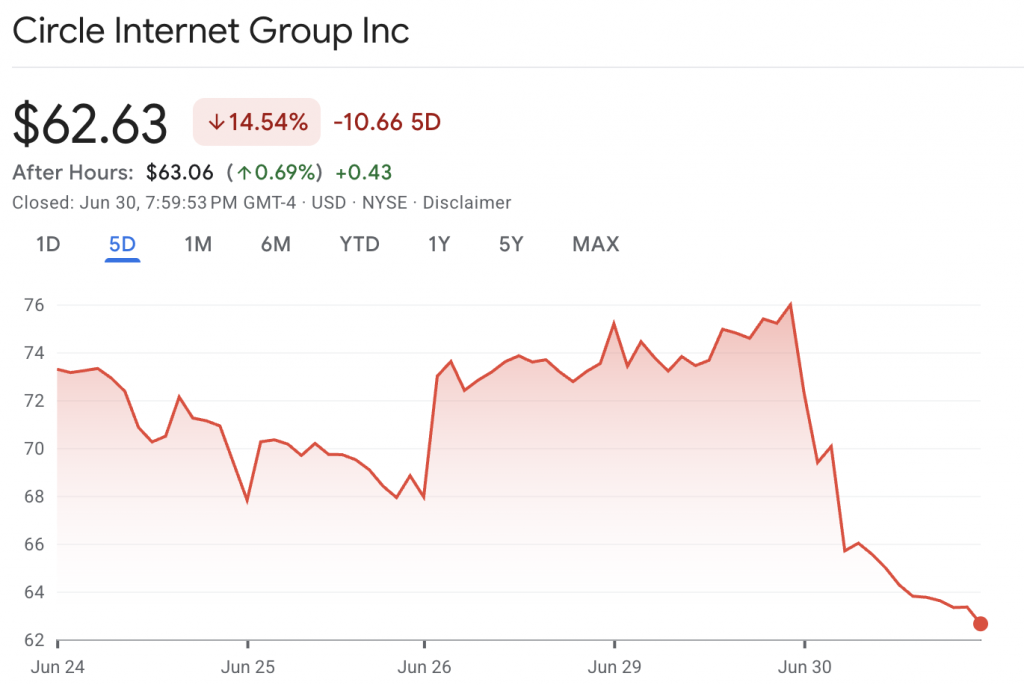
A stablecoin is a crypto token designed to hold a steady value, usually pegged one-to-one to the US dollar. On June 30, 2026, a group of more than 140 companies, including Visa, Mastercard, Stripe, Coinbase, and BlackRock, launched a new one called Open USD (OUSD). Within a day, Circle, the company behind the market’s second-largest stablecoin USDC, saw its stock drop as much as 17%.
That is not a normal market reaction to a new token launch. Here is what actually happened, and why it matters.
- Open USD (OUSD) is a new dollar-pegged stablecoin backed by a consortium of 140+ companies including Visa, Stripe, Coinbase, Mastercard, and BlackRock.
- Unlike USDC or USDT, OUSD shares the interest earned on its reserves with partner companies instead of the issuer keeping it all.
- Circle’s stock fell between 13% and 17% on the news, since the model directly undercuts how Circle makes money from USDC.
What Just Happened
Open Standard, a newly formed independent company led by Zach Abrams, co-founder of the Stripe-acquired stablecoin firm Bridge, unveiled Open USD on June 30, 2026. The backer list spans payment networks (Visa, Mastercard, American Express), banks and asset managers (BlackRock, BNY, Standard Chartered, U.S. Bank), technology platforms (Google, Shopify, Samsung), and crypto-native firms (Coinbase, Ripple, Gemini, Solana).
The stablecoin is designed to be minted and redeemed for free, with no volume caps, and is scheduled to launch across multiple chains, including Solana, Stellar, Base, and Polygon, later in 2026.
Why Circle’s Stock Fell
To understand why this rattled markets, you need to understand how stablecoin issuers actually make money. Circle takes in dollars, invests the reserves backing USDC in short-term US Treasuries, and keeps most of the interest earned. That interest income is Circle’s core business, not transaction fees.
Open USD flips that model. Partner companies, not the issuer, collect the reserve earnings, minus a small management fee retained by Open Standard. For a company like Stripe or Coinbase, that turns a stablecoin from a cost center into a revenue stream.
Coinbase’s involvement stung the most, since Coinbase earns a share of USDC’s reserve revenue under its existing distribution deal with Circle, reportedly worth over $900 million in 2024 alone. Coinbase backing a direct competitor to that arrangement was the clearest signal to markets that the economics of stablecoin distribution are shifting.
How OUSD’s Model Differs From USDC And USDT
| Stablecoin | Issuer model | Who keeps reserve yield | Chains at launch |
| USDC (Circle) | Single corporate issuer | Circle | Ethereum, Solana, and others |
| USDT (Tether) | Single corporate issuer | Tether | Ethereum, Tron, and others |
| USDG (Paxos) | Consortium, partner-owned | Shared with partners | Ethereum, Solana |
| Open USD (Open Standard) | Consortium, partner-owned | Shared with partners | Solana, Stellar, Base, Polygon at launch |
If you already understand how Tether’s USDT works as a single-issuer stablecoin, OUSD is easiest to understand as the opposite structure: governance and profit sit with a board drawn from partner companies rather than one parent firm.
This Has Been Tried Before: The USDG Comparison
Open USD is not the first attempt at a revenue-sharing stablecoin. Paxos already runs the Global Dollar Network (USDG) on the same principle, backed by Robinhood, Kraken, and Galaxy Digital. USDG has grown to roughly $3 billion in supply since its 2024 launch, a fraction of USDC’s roughly $73 billion and USDT’s $145 billion.
That gap is the reason analysts are split on whether OUSD is a real threat or an overreaction. One view is that a 140-company partner list is a genuine structural threat because it includes Circle’s own biggest distribution partner. The other view, echoed by analysts like Clear Street’s Owen Lau, is that consortiums with dozens of companies rarely stay aligned, and a big logo list does not guarantee adoption.
What It Means For Traders
Nothing changes immediately for traders. OUSD is not live yet, and its first deployments are on Solana, Stellar, Base, and Polygon rather than as a widely available trading pair. What is worth tracking:
- Whether Circle responds by changing USDC’s own revenue-sharing terms with exchanges and distributors.
- Whether OUSD actually gains transaction volume after launch, since prior consortium stablecoins like USDG have struggled to scale.
- Whether other exchanges or wallets begin listing OUSD once it is live, which would be the real signal of adoption versus a partner-logo announcement.
Frequently Asked Questions
Open USD is a new dollar-pegged stablecoin launched on June 30, 2026, by a consortium of 140+ companies including Visa, Stripe, Coinbase, Mastercard, and BlackRock, structured to share reserve interest income with its partner companies.
Circle’s core business relies on keeping the interest earned on USDC’s reserves. OUSD shares that income with partners instead, which threatens Circle’s existing revenue model and its distribution relationship with Coinbase.
No. OUSD is expected to launch later in 2026 on Solana, Stellar, Base, and Polygon. It was not immediately tradable at announcement.
USDT and USDC are each controlled by a single issuer (Tether and Circle respectively) that keeps the reserve interest. OUSD is governed by a board of partner companies who share that interest instead.
 Disclaimer: Click Here to read the Disclaimer.