

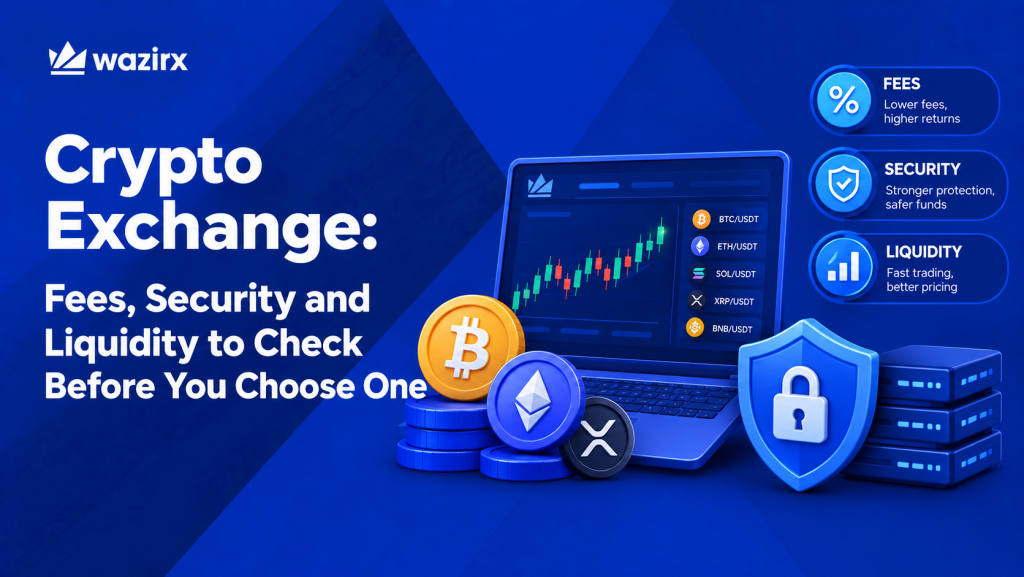
Every crypto exchange in India claims to be the best one to trade on. None of them are lying exactly, they’re just highlighting the metrics that flatter them and quietly leaving out the ones that don’t. If you’re trying to figure out how to choose a crypto exchange without falling for marketing copy, there are really only three things worth digging into properly: what it costs you to trade, how seriously the platform treats security, and whether there’s enough depth in the order book to actually get your orders filled at a fair price.
Start With The Fee Structure, Not The Headline Number
A crypto exchange fees comparison shouldn’t stop at the headline trading fee. WazirX offers two ways to pay: WazirX ZERO costs ₹99 per month plus applicable taxes and comes with unlimited trading at zero trading fees. The Pay Per Trade option charges a dynamic fee on INR trades based on your last 30 days of trading volume and WRX holdings, while USDT trades currently carry zero trading fees.
What trips people up is everything outside that headline percentage. Withdrawal fees, INR deposit charges, and the 1% TDS deducted on crypto trades under Indian tax rules all add up, and none of them show up if you’re only comparing the maker-taker number across platforms. Some exchanges have also started offering flat-fee subscription models as an alternative to per-trade charges, which can work out cheaper for someone trading frequently versus someone who buys occasionally and holds.
Before committing to a platform, it’s worth actually running your expected trade size and frequency through a fee checker rather than trusting the exchange’s own summary page.
Security is Less About Promises, More About What’s Verifiable
This is the part of any best crypto exchange comparison that gets the least scrutiny, mostly because it’s hard to verify from the outside. Instead of relying on security claims, look at what you can actually verify:
- FIU-IND registration: Check whether the exchange is registered with India’s Financial Intelligence Unit (FIU-IND), which oversees KYC and Anti-Money Laundering (AML) compliance for crypto platforms operating in the country.
- Cold storage: Look at whether user funds are largely held in cold storage rather than sitting in internet-connected hot wallets.
- Third-party custody: Check whether the exchange uses a third-party institutional custodian for cold storage instead of managing all custody entirely in-house.
- Two-factor authentication: 2FA should be a baseline security feature, not something presented as a major selling point.
- Past security incidents: Look at how the exchange has handled security incidents in the past, rather than simply accepting claims that it has never had one.
- Transparency: Pay attention to how clearly the platform communicated what happened, what was affected, and what changed afterward.
- Security upgrades: An exchange that has upgraded its custody partners or added insured cold storage after a real-world security event has usually thought harder about the problem than one that has simply never published an incident report.
Liquidity Decides What Price You Actually Get
Exchange liquidity crypto discussions tend to get skipped entirely, which is a mistake, because it directly affects your execution price. A thin order book means your buy or sell order has to eat through several price levels to get filled, and the price you see on screen isn’t the price you actually pay once your order goes through. This matters more the larger your trade size gets. Someone buying ₹2,000 of BTC won’t notice much slippage anywhere. Someone moving a few lakh worth of crypto in one order will feel the difference between a liquid exchange and a thin one immediately.
A quick way to get a feel for this yourself is to check the live order book depth on a BTC to INR pair before placing a large order, rather than assuming every exchange handles size the same way. Tighter bid-ask spreads and consistent trading volume across the day are both signs of healthy liquidity, while wide spreads or volume that spikes only during specific hours usually mean you’re trading somewhere thinner than it looks.
Putting It Together
No single metric tells the full story. A crypto exchange with rock-bottom fees but poor liquidity can end up costing you more through slippage than a platform with a slightly higher fee and a deeper order book. Similarly, the cheapest exchange to trade on isn’t worth much if you’re not confident in how it stores your funds. If you’re comparing crypto exchanges in India, it’s worth actually reading through how each platform explains its own cold storage and custody practices rather than relying on star ratings from review sites. Fees, security, and liquidity work together, and the right exchange is the one where all three hold up, not just the one advertising the lowest number on its homepage.
 Disclaimer: Click Here to read the Disclaimer.