

Brent crude is trading above $100 a barrel again, last near $102.59, up over 23% in the past month and 63.65% year-over-year. That’s not a slow move: Oil doesn’t move 23% in a month on its own, it moves that fast when something specific breaks.
-
Brent crude crossed $100 as Strait of Hormuz tensions increased risks to global oil supply and shipping.
-
Sustained Hormuz disruption could push Brent higher, while normalized shipping, increased supply or weaker demand could pull prices lower.
-
Higher oil prices can increase inflation and import costs, hurting oil-importing economies like India while benefiting oil producers.
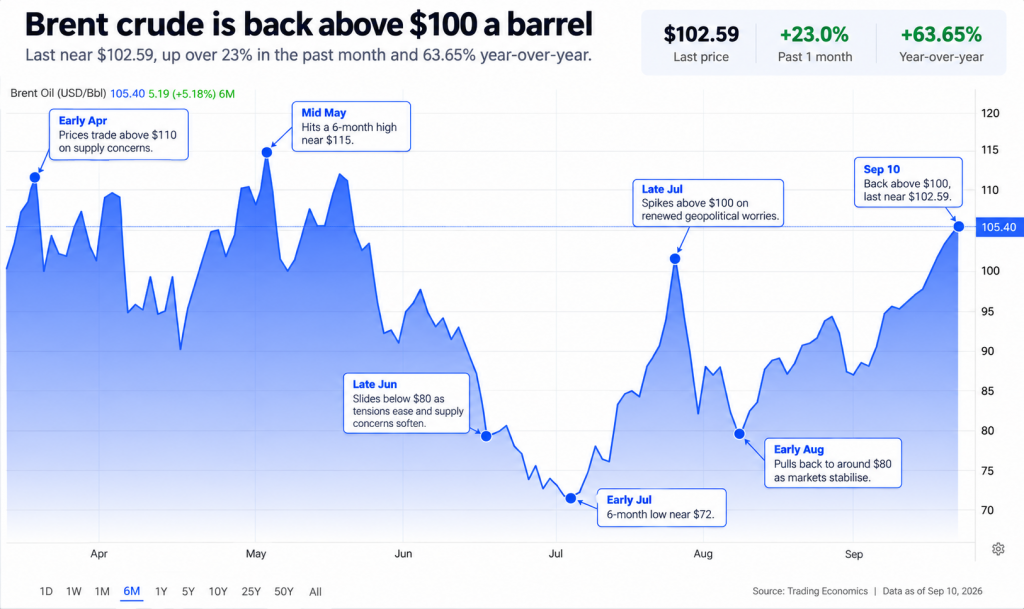
What broke was the Strait of Hormuz corridor. The US military destroyed several Iranian oil tankers after Iran attempted to strike a US Navy warship with ballistic missiles. Iran responded by claiming attacks on American vessels and multiple oil tankers in the Gulf, and warned shipping crews near Kuwaiti and Bahraini ports to abandon their vessels.
That warning forces immediate rerouting by insurers and shippers, creating a supply shock before any oil is lost.
Recap: What’s Brent Crude
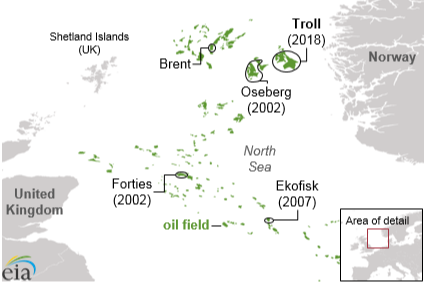
Brent crude began as oil from the Brent field in the North Sea. As that field declined, Brent became a basket of North Sea crude oils.
Today, Brent crude refers to the global oil benchmark built around that basket.
So when traders say “Brent is at $100 a barrel,” they mean the market price linked to this benchmark, which is widely used to price physical oil, futures and other derivatives.
Why This Isn’t Just An Oil Story
Oil at $100 doesn’t stay contained to oil. It feeds directly into two things that matter more broadly: borrowing costs and consumer prices.
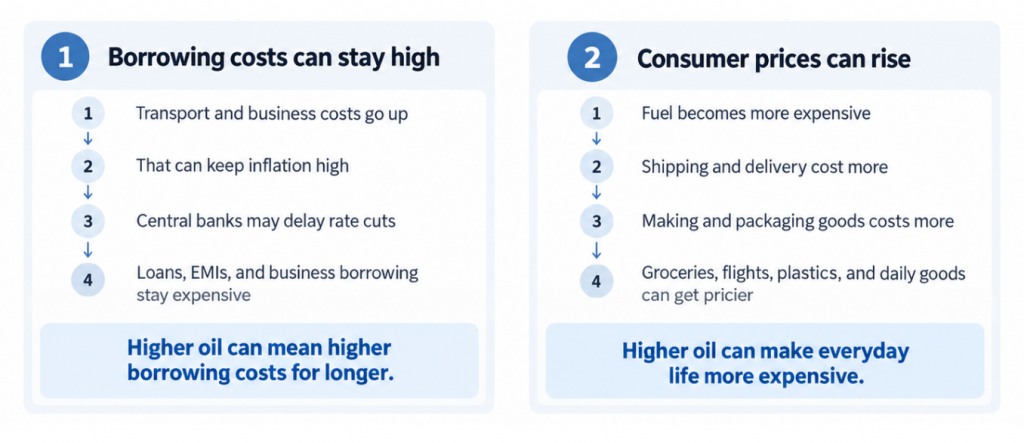
- Borrowing costs: Expensive oil raises costs across the economy, from transport and manufacturing to food delivery. That can keep inflation high, which makes central banks less willing to cut interest rates. Loans, EMIs, and business borrowing can therefore stay expensive for longer.
- Consumer prices: Oil is used directly or indirectly in moving, making, and packaging almost everything. Higher fuel costs can raise the price of groceries, flights, deliveries, plastics, and other everyday goods.
Why The Strait of Hormuz Matters So Much
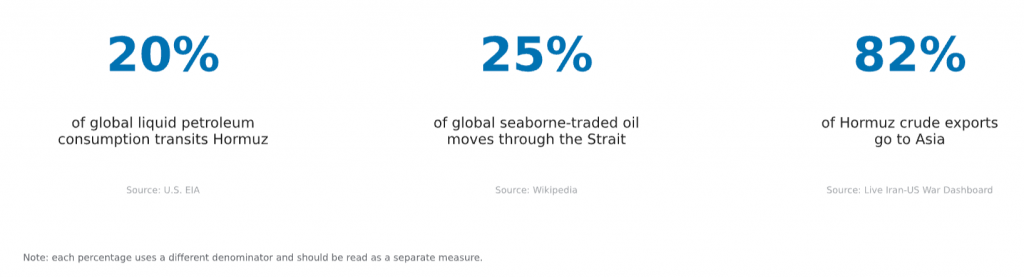
An average of 20 million to 21 million barrels per day (bpd) of crude oil, condensate, and refined petroleum products transit through the Strait of Hormuz.
Who Gets Hurt and Who Benefits From $100 Oil?
Higher oil prices do not hit everyone the same way. They broadly transfer income from countries and businesses that buy a lot of oil to those that produce and sell it.
| Gets hurt | Can benefit |
| Oil-importing countries such as India, Japan and South Korea face a larger import bill and greater inflation pressure. | Oil-exporting economies such as Saudi Arabia, the UAE and Kuwait can earn more revenue for every barrel they export. |
| Airlines face higher jet-fuel costs, one of their biggest operating expenses. Unless fares rise enough to compensate, margins can shrink. | Oil producers can earn more on each barrel sold, especially when production costs do not rise as quickly as crude prices. |
| Transport and logistics companies pay more for diesel and marine fuel, increasing the cost of moving goods. | Energy companies with upstream oil exposure can see revenue and cash flow improve as crude prices rise. |
| Consumers can eventually pay more for fuel, flights, deliveries and other oil-sensitive goods and services. | Oil-exporting governments can receive higher tax, royalty and export income, improving fiscal revenues. |
| India is particularly exposed because it imports most of the crude oil it consumes. A higher crude bill can pressure the rupee, inflation and the trade balance. | Gulf producers are generally on the other side of that trade: higher export prices can increase oil revenues, although disruptions to their own shipping routes can offset part of the benefit. |
High Oil Prices And Disrupted Oil Flows Are Not The Same Thing.
An exporter may benefit from a higher price if it can keep selling its barrels. But if the Strait of Hormuz disruption prevents those barrels from reaching buyers, even Gulf producers can lose. That is why the current situation is more complicated than simply saying “high oil is good for exporters.”
Can Brent Go Higher From Here?
| Scenario | What it could mean for Brent |
| Hormuz disruption worsens | A meaningful fall in tanker traffic or damage to oil infrastructure could push Brent toward $110-$120+. |
| Conflict stays tense but contained | Risk premiums remain elevated, keeping Brent around or above $100. |
| OPEC+ adds supply | Extra barrels could soften the shortage risk and pull prices lower. |
| Shipping normalizes | Lower insurance and freight risk could remove part of the geopolitical premium. |
| Global demand weakens | Slower growth and weaker fuel demand could drag Brent back below $100. |
| Ceasefire or diplomatic breakthrough | A sharp drop in regional risk could trigger a faster price reversal. |
The biggest swing factor is still Hormuz. If physical supply starts getting blocked, $110-$120 becomes easier to justify. If the disruption remains mostly a risk premium and flows normalize, Brent can fall back below $100.
What to Watch Next?
The oil market is now trading headlines as much as barrels. Five things matter most:
| Watch | Why it matters |
| Tanker traffic through Hormuz | Any meaningful drop in vessel movement points to a real supply disruption, not just geopolitical risk. |
| Iranian oil exports | Lower exports would tighten available supply further. |
| OPEC+ response | Additional production could offset part of the disruption. |
| US crude inventories | Falling inventories would reinforce the shortage narrative; rising stocks could ease it. |
| Ceasefire or shipping-security deal | Any de-escalation could quickly remove part of Brent’s geopolitical premium. |
If tanker flows fall and stay low, the market is dealing with a physical supply problem. If flows normalize, part of the $100+ move can unwind quickly.
Final Thoughts
Brent above $100 is not, by itself, a reason to expect oil to keep rising. Before taking a view, watch whether tanker traffic through Hormuz remains constrained, physical exports fall, OPEC+ responds, and geopolitical tensions escalate or ease. Those signals help separate a lasting supply shock from a temporary risk premium.
Once you have a view, the next challenge is acting on it without needing to buy physical oil or open a traditional commodity brokerage account. This is where WazirX Futures come in.
With WazirX, you can:
- Trade Brent Crude (BZ) perpetual futures, alongside other Energy, Metals and Global Markets and take a long or short position depending on your market view using Indian currency.
- Use limit, market, stop-loss and take-profit orders to define how you enter and manage a position.
Together, these features give you a way to take a view on Brent while managing how they enter, exit and control risk from the same platform. WazirX is an FIU-IND registered crypto exchange built for Indian users, with INR-based access to crypto and tokenized asset futures, making it easier to access global markets without relying on an international brokerage account.
FAQs About Brent Crude
India does not mainly import the exact Brent blend from the North Sea, but a large share of India’s crude imports is priced with reference to Brent crude. That is why Brent matters so much in India. When Brent rises, India’s oil import bill, fuel-related inflation pressure, and broader cost pressures can rise too.
Crude oil is the broad term for unrefined petroleum. Brent crude is a specific global oil benchmark made up of North Sea crude streams. In simple terms, crude is the category, while Brent is one important type and pricing benchmark within that category.
Brent crude is the global oil benchmark widely used to price physical crude, futures, and energy contracts around the world. It is based on a basket of North Sea crude oils and is one of the most closely watched reference prices in the oil market.
Neither is simply “better” in every situation. WTI is lighter and sweeter, which often makes it easier and cheaper to refine, while Brent is the more widely used global benchmark and is more relevant for international oil pricing.
 Disclaimer: Click Here to read the Disclaimer.