

The U.S. effort to create a comprehensive regulatory framework for crypto has hit another roadblock. On September 15, 2026, the Senate failed to advance the CLARITY Act after a 49-50 procedural vote.
But the vote matters beyond one bill. Here is what happened, how the legislation reached this point, and three things the setback may tell us about the next phase of U.S. crypto regulation.
The CLARITY Act: What Exactly Happened?
On September 15, the U.S. Senate held a procedural vote on H.R. 3633, the Digital Asset Market Clarity Act of 2025, better known as the CLARITY Act.
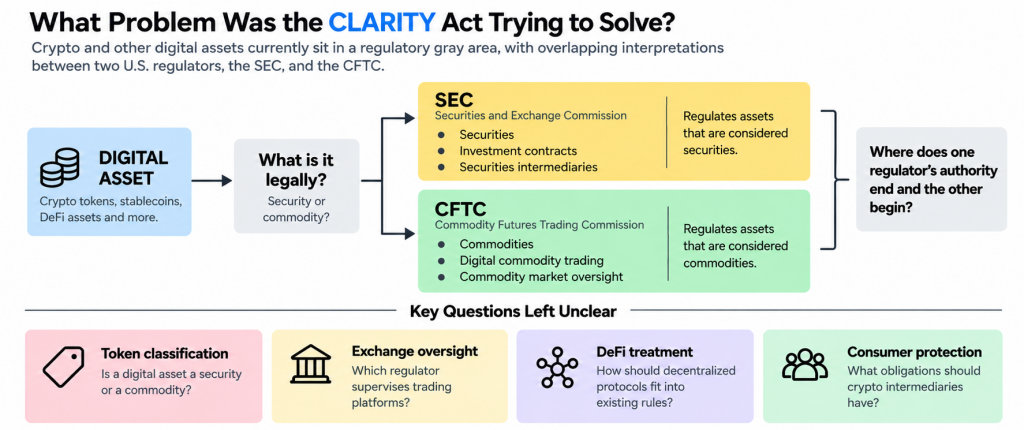
The Senate was not voting on whether to finally approve or reject the legislation: Instead, it was voting on whether to move past a procedural hurdle and begin formal consideration of the bill on the Senate floor (aka cloture on the motion to proceed).
That required support from three-fifths of the Senate. The result was: 49 senators voted in favor. 50 voted against. The motion therefore failed.

This is important because the CLARITY Act had already traveled considerably further than many previous attempts at comprehensive U.S. crypto legislation.
The House passed it in July 2025 by 294-134, including votes from both Republicans and Democrats.
Then, in May 2026, the Senate Banking Committee advanced the legislation by 15-9, again with bipartisan support.
The September vote therefore represents a significant setback, although technically it does not mean the CLARITY Act itself received a final rejection vote.
It means the Senate could not assemble enough votes to move the legislation forward.
The CLARITY Act Timeline
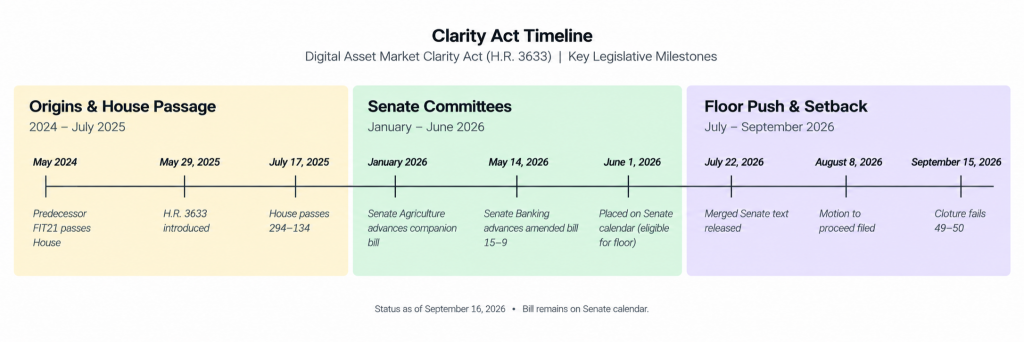
| Date | What happened | Why it mattered |
| May 29, 2025 | H.R. 3633, the Digital Asset Market Clarity Act, was introduced in the House | Began a new congressional attempt to establish a federal crypto market-structure framework |
| July 17, 2025 | The House passed the CLARITY Act 294-134 | Demonstrated substantial bipartisan House support for crypto market-structure legislation |
| 2025-26 | Senate lawmakers negotiated changes to the framework | The debate expanded beyond asset classification into consumer protection, illicit finance, DeFi, and ethics questions |
| May 14, 2026 | Senate Banking Committee advanced the legislation 15-9 | Put the bill in position to move toward consideration by the full Senate |
| September 15, 2026 | Senate voted on cloture on the motion to proceed to H.R. 3633 | The bill needed 60 votes to clear the procedural hurdle |
| September 15, 2026 | Cloture failed 49-50 | The Senate did not proceed to full consideration of the bill |
| What comes next | Lawmakers could try to revive negotiations or pursue another legislative route | But the remaining congressional calendar makes the path considerably more difficult |
The striking part of this timeline is how close the legislation came to becoming a serious Senate-floor issue.
The problem was no longer simply getting lawmakers interested in crypto regulation.
It was getting enough lawmakers to agree on what that regulation should actually look like.
3 Takeaways from the CLARITY Act Setback
1. The problem is no longer “Should crypto be regulated?”
At a basic level, CLARITY was trying to answer a simple question: which U.S. regulator is responsible for which part of the crypto market? The House had already passed the bill, and the Senate Banking Committee had advanced it, so there was meaningful support for creating clearer rules.
The breakdown happened over the details, including DeFi, consumer protection, and financial-crime rules. That suggests future negotiations are more likely to focus on how crypto should be regulated, rather than restarting the debate over whether a framework is needed at all.
2. Without a law, regulators keep filling in the gaps
Think of Congress as writing the rulebook and agencies such as the SEC and CFTC as enforcing it. CLARITY was meant to make that rulebook clearer by formally dividing responsibilities between the two regulators.
Because the bill did not advance, those agencies will continue making many practical decisions using existing laws, regulatory rules, and enforcement powers. That keeps the system functioning, but it also means the rules can remain less settled and more dependent on regulatory interpretation than they would be under a dedicated federal law.
3. Passing a crypto law now requires a much broader deal
The Senate vote failed 49-50, well below the three-fifths threshold required to advance the bill. That tells us something important: technical agreement on crypto market structure is not enough.
By the final stages, negotiations also covered issues such as DeFi registration and anti-money-laundering obligations. Any future version will therefore probably need to satisfy lawmakers concerned not just with crypto innovation, but also with financial crime, investor safeguards, and regulatory enforcement. In practical terms, the next successful bill may need to be politically broader than CLARITY itself.
Final Thoughts
The CLARITY Act may be stuck, but the need for clear crypto rules remains. Any new attempt will require agreement on who regulates what, the rules DeFi must follow and how the law protects users. Until Congress reaches a deal, regulators and courts will shape crypto policy case by case, leaving businesses and users uncertain.
FAQs
Lawmakers can restart negotiations, revise disputed provisions or pursue another bill. Until then, federal agencies and courts will continue applying existing laws.
Fifty senators opposed advancing the bill in the procedural vote. Key concerns included DeFi rules, financial-crime controls, consumer protection and regulatory enforcement.
Bitcoin would gain a clearer regulatory framework, including which agency oversees parts of its market. Passage would not guarantee a price rise or remove market risk.
Possibly, but the path is difficult. Senators could reopen negotiations, revise the bill or pursue another route, depending on the remaining congressional calendar.
Existing laws remain in place. The SEC, CFTC and courts will continue shaping crypto oversight without a dedicated federal market-structure law.
The Senate failed to clear the 60-vote procedural threshold. The 49-50 vote blocked debate from starting but did not reject the bill itself.
 Disclaimer: Click Here to read the Disclaimer.