

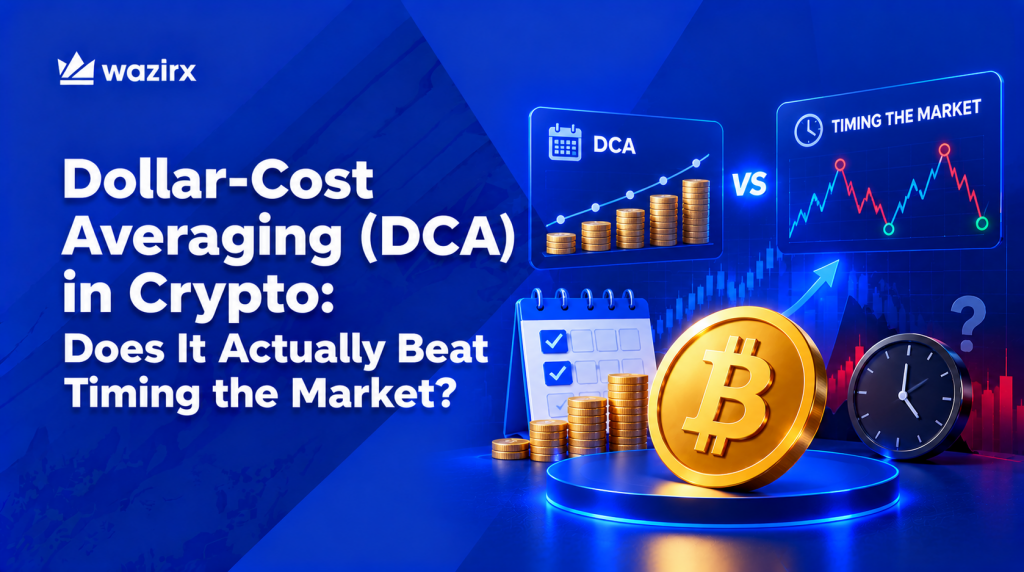
Everyone who has ever watched Bitcoin move 10% in a day has had the same thought. If only I had bought yesterday. Sold last week. Waited one more day before entering. Timing the market sounds simple in hindsight and turns out to be nearly impossible in real time, which is exactly the gap dollar-cost averaging is built to close.
TL;DR
- Dollar-cost averaging (DCA) means investing a fixed amount at regular intervals regardless of price, buying more units when prices fall and fewer when they rise.
- DCA does not guarantee the best possible entry price. It guarantees you stop needing one.
- The real cost of DCA is smaller, more frequent investments, which can mean fees eat a larger share of each purchase.
- DCA suits people investing from ongoing income and wanting to remove the emotional weight of deciding when to buy.
What DCA Actually Is
Dollar-cost averaging means investing a fixed amount of money in crypto at regular intervals, weekly or monthly, irrespective of the current price. You are not trying to predict whether today is a good day to buy. You are committing to a schedule and letting the schedule do the deciding.
The mechanism is straightforward. When the price falls, your fixed amount buys more units. When the price rises, it buys fewer. Over enough cycles, this evens out your average acquisition cost rather than locking in whatever the price happened to be on one specific day.
Bitcoin DCA works the same way as traditional DCA in stocks, just applied to a fixed amount of BTC bought at consistent intervals regardless of where the price sits that day.
Why “Timing The Market” is Harder Than It Sounds
Timing the market means trying to buy at the bottom and sell at the top. The appeal is obvious. The execution is where it falls apart.
Crypto’s volatility is the whole problem. Bitcoin can move double digits in a single session, which means the “right” entry point is often only visible after it has already passed. Waiting for a dip can mean missing the move entirely if the dip does not arrive on schedule, and buying into what looks like a dip can mean buying into the start of a longer decline. Nobody gets this right consistently, including people who do it for a living.
DCA does not solve this problem so much as it sidesteps it. You stop needing to know whether today is the right day, because your schedule was never trying to answer that question in the first place.
What DCA Actually Costs You
DCA is not free of trade-offs, and the honest version of this conversation includes them.
Each DCA purchase is typically smaller than a lump-sum investment would be, which means fees can make up a larger proportion of that individual purchase. Spreading capital out over time also means some of it sits uninvested for longer than a lump-sum approach would allow, which can reduce the value of funds that could have been deployed earlier if the market moves upward during that stretch.
Neither of these makes DCA the wrong choice. They make it a deliberate trade-off between certainty of process and potential upside, not a strategy with no downside at all. If you have not bought crypto before, the guide to buying Bitcoin in India covers account setup and KYC, the same starting point whether you plan to DCA or invest as a lump sum.
Who DCA Actually Suits
DCA works best for a specific kind of investor, and it is worth being honest about who that is rather than presenting it as universally optimal.
| DCA tends to suit | DCA tends to suit less |
| Someone investing from regular income rather than a single windfall | Someone with a lump sum sitting idle and a long time horizon ahead |
| Someone who checks prices constantly and finds it stressful | Someone with strong conviction and the temperament to hold through drawdowns |
| A first-time crypto investor prone to analysis paralysis | An experienced trader comfortable acting on a specific market read |
DCA is a good fit for beginners or anyone who does not want to sit in front of a screen constantly, deciding whether this particular moment is the right one. If watching the price is what stops you from investing at all, DCA removes that obstacle by design.
Deciding Your Schedule, Not Your Entry Point
Start by deciding the amount and the interval before you place a single order, weekly or monthly, whatever matches how often you actually get paid or set money aside. Before committing to a schedule, it helps to look at where Bitcoin’s price actually stands right now, not to time your first purchase around it, but to understand the range you are entering into. WazirX supports spot trading across 300+ crypto assets, so the same DCA discipline can extend beyond a single asset if that fits your plan.
What DCA Does Not Change At Tax Time
Whatever schedule you settle on, remember that India’s tax treatment does not change based on how you invested. Every crypto transfer is taxed the same way regardless of whether it came from a single lump sum or a year of small recurring buys, so it is worth understanding the crypto tax rules in India before your first purchase, not after your tenth.
FAQs
Does dollar-cost averaging actually beat timing the market?
It does not guarantee a better price than perfect timing would. It removes the need to achieve perfect timing at all, which is the part most investors actually fail at in practice.
Is DCA better than investing a lump sum in crypto?
Neither is universally better. DCA suits investors building from regular income who want to remove timing stress. A lump sum can outperform if invested when the market subsequently rises, but that depends on a call about market direction that is hard to make reliably.
Does DCA eliminate risk in crypto?
No. It smooths out entry price and reduces the emotional weight of deciding when to buy, but it does not protect against a sustained decline across the period you are investing in.
How often should a Crypto DCA schedule run?
Weekly or monthly are the most common intervals, and the right choice usually matches how often you receive income or want to set aside a fixed amount.
 Disclaimer: Click Here to read the Disclaimer.