

Crypto research has an information problem. With 100+ crypto exchanges and thousands of digital assets, market data is spread across many sources.
To understand what is moving the market, traders need to check prices, trading activity, on-chain data, news, and market events. Often at the same time. AI can make all this faster. But good research still depends on what you ask, what data you use, and what you verify. Here is how to get all three right.
What Can AI Actually Do for Crypto Research?
Using AI for crypto research can mean many things. Traders use it to summarize news, study the market, find trading ideas, and understand new concepts.
But its biggest value comes before the trade.
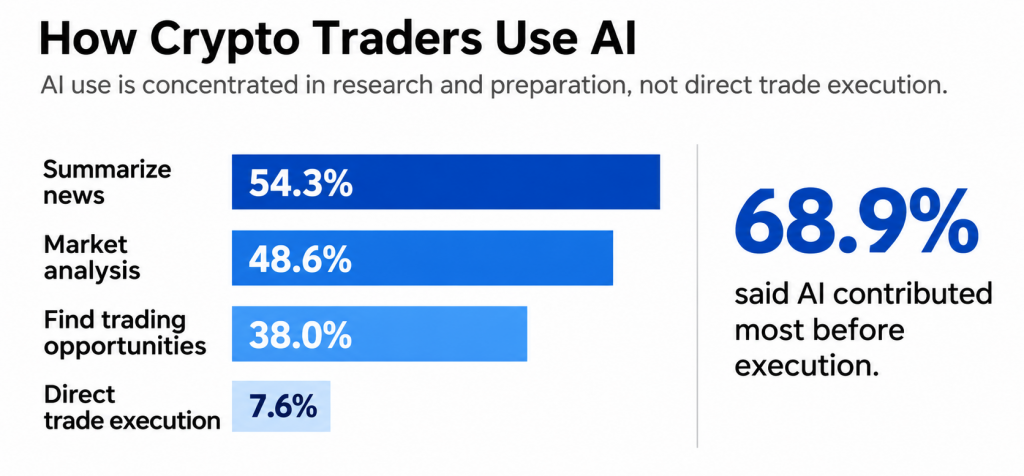
54.3% of AI users used it frequently to summarize news, 48.6% for market analysis, and 38% to find trading opportunities. Only 7.6% listed direct trade execution among their most-used AI tasks.
The data shows that traders already use AI for research. But using AI and using it well are two different things.
How to Use AI for Crypto Market Research
A good place to start is with the question you ask.
1. Ask AI a Specific Question
A broad question gives AI too much room to guess.
Instead of: “Analyze Bitcoin.”
Try:
✓ “Bitcoin fell 8% this week. What changed in trading volume, ETF flows, and Futures open interest during the same period?”
The second prompt gives AI an asset, a time period, and the data points to check. This makes the answer easier to test.
The rule is simple: ask a clear question before asking for an answer.
2. Give AI the Right Data
AI also needs the right information to work with.
If you are studying today’s market, give it current data. This could include prices, trading volume, open interest, funding rates, on-chain activity, ETF flows, or recent news.
| If you want to understand… | Give AI… |
| Why a price moved | Price, volume, and relevant news |
| Futures activity | Open interest, funding rates, and liquidations |
| Blockchain activity | Transactions, fees, and active addresses |
| ETF demand | ETF inflows/outflows and price data |
| Token developments | Official announcements and market data |
AI can analyze the data you give it. It cannot make missing data appear.
3. Check the Answer
This is the step that matters most.
AI can give you an answer that sounds right but uses an old number, a weak source, or a link between two events that the data does not support.
Check three things:
NUMBER → DATE → SOURCE
- Is the number correct?
- Is it current?
- Does the source support the claim?
Then go one step further. Ask AI:
“What evidence would show that this explanation is wrong?”
A good research process does not only look for evidence that supports an idea. It also looks for evidence that could prove it wrong.
Example: How to Research a Crypto Futures Market With AI
Suppose Bitcoin is rising. You want to know whether activity in the Futures market supports the move, or whether the price is moving without the same strength in Futures data.
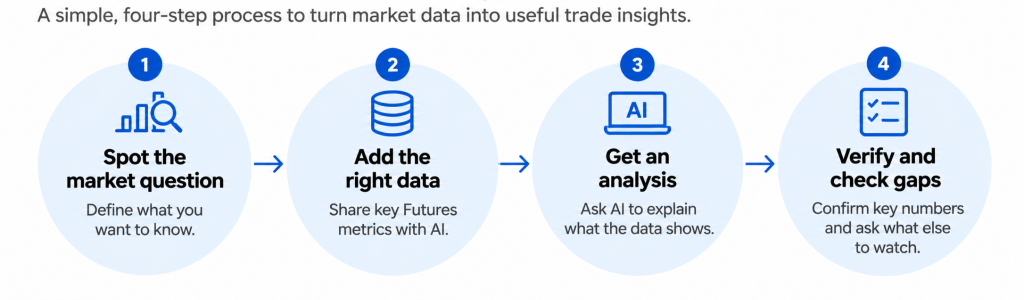
Step 1: Start With a Market Question
Do not ask:
❌ “Should I go long on Bitcoin?”
Start with something you can check:
✓ “Bitcoin has risen 6% over the past five days. Is activity in the Futures market supporting this move?”
This changes the job you give AI. Instead of asking it to make a trading decision, you are asking it to study the market.
Step 2: Add the Right Futures Data
Now give AI the data it needs.
For this question, that could include:
- Bitcoin price
- Futures trading volume
- Open interest
- Funding rate
- Long and short liquidations
Each tells you something different. Open interest shows how much Futures exposure is still open. Funding rates can show which side of the market is more crowded. Liquidations show where leveraged positions have been forced to close.
Together, they give AI more to work with than price alone.
Step 3: Ask AI to Compare the Data
Now make the prompt specific:
“Bitcoin has risen 6% over the past five days. Compare its price with Futures volume, open interest, funding rates, and liquidations over the same period. Does the Futures data support the price move? Also point out any data that does not support this view.”
The last sentence matters.
You are not only asking AI to find evidence for an idea. You are also asking it to find evidence against it.
For example, rising price and rising open interest could show that more Futures positions are entering the market. But if funding rates rise sharply at the same time, positioning may be becoming more one-sided.
That changes how you read the move.
Step 4: Verify the Answer and Find the Gaps
Do not stop at the AI response.
Check the price, open interest, funding rate, and liquidation numbers against the sources they came from. Then ask:
“What other data would you need before you could be more confident in this explanation?”
AI may point you toward Spot volume, ETF flows, order-book data, news, or another signal you have not checked.
That is where AI becomes more useful for research. It does not decide the trade. It helps you find what to check next.
What Are the Limits of Using AI for Crypto Research?
AI can make research faster. It can also be wrong.
The problem is that a wrong answer can still sound clear and confident. This matters in crypto, where prices, market data, and news can change within hours.
| AI can get wrong | What you should do |
| Old market data | Check the date and latest value |
| Wrong facts or sources | Open and check the original source |
| Cause and effect | Check whether the data supports the link |
| Missing market context | Ask what other data may be needed |
| Overconfident answers | Ask what could prove the answer wrong |
The rule is simple: use AI to find, compare, and question information. Use the original data to check whether the answer holds up.
How Can WazirX AI Help With Crypto Research?
General AI can help with crypto research. But you may still need to find market data, add context, and move between different tools.
WazirX AI is built to bring more of that research into one place.
1. Research the Market With Live Crypto Data
Stop copying market data into a chatbot before you can ask a question. WazirX AI lets you research live crypto prices and market moves directly, so you can start with what is happening now.
2. Turn Market News Into Research
A headline tells you what happened. You still need to know why it matters. Use WazirX AI to explore crypto news and market developments, then ask follow-up questions to understand their possible impact.
3. Keep Asking Until the Picture Gets Clearer
Crypto research rarely ends with one question. WazirX AI lets you continue the conversation, compare what you find, challenge an idea, and dig deeper without starting your research again.
4. Take an Idea From Research to Paper Trading
Research becomes more useful when you can test the idea. With WazirX AI and Paper Trading, you can move from studying a market to testing a trade without putting real funds at risk.
WazirX AI can make the path from ask → understand → decide shorter. You still decide what the data means and whether you want to act on it.
Final Thoughts
General AI can help you research crypto. WazirX AI lets you take that research further by testing your ideas before putting real money behind them.
With Paper Trading, you get:
- ₹1 lakh virtual balance (₹50,000 for Spot + ₹50,000 for Futures)
- Live market data to test your ideas
- A way to practice without risking real funds
Open WazirX AI, research a market idea, and test it with Paper Trading. Once you are confident with the process, you can move to real trading on WazirX.
 Disclaimer: Click Here to read the Disclaimer.