
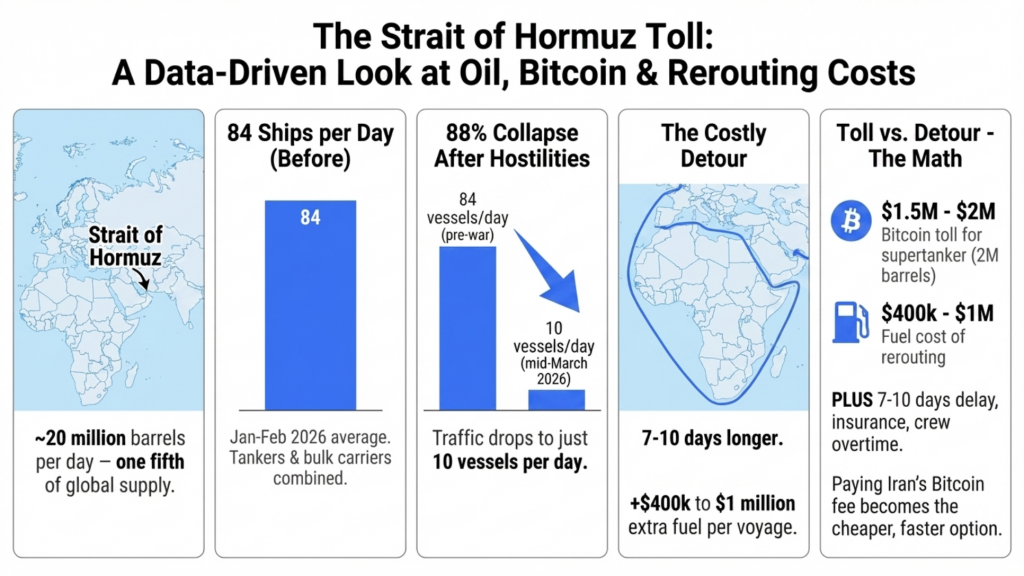
- Iran is demanding $1 per barrel in Bitcoin from oil tankers seeking passage through the Strait of Hormuz during the two-week US-Iran ceasefire.
- A fully loaded supertanker carrying 2 million barrels faces a toll bill approaching $2 million, payable in seconds via Bitcoin.
- Iran chose Bitcoin over USDT and USDC because both stablecoins have built-in freeze functions that make them vulnerable to US seizure.
- This is the first time a sovereign state has formally required crypto as payment for access to a critical global shipping lane.
The long-held belief that Bitcoin (BTC) is the ultimate neutral settlement asset was tested on April 8, 2026, when Iran announced it would accept BTC for oil tanker passage through the Strait of Hormuz. The system, confirmed by Iran’s Oil, Gas and Petrochemical Products Exporters’ Union, requires tankers to email cargo details, receive a $1 per barrel toll calculation, and pay the digital asset promptly.
For a fully loaded Very Large Crude Carrier carrying 2 million barrels of oil, that is a toll bill approaching $2 million. Paid in Bitcoin. On a sanctions-hit country’s terms.
Why Iran Picked Bitcoin Over Stablecoins
The choice of Bitcoin over dollar-pegged stablecoins is not incidental. It is a deliberate technical and political decision, and it tells you a lot about how crypto infrastructure actually works under geopolitical pressure.
Tether’s USDT and Circle’s USDC, the two dominant stablecoins, both include a built-in freeze mechanism.
Both issuers can blacklist wallet addresses and block transactions on demand, typically in response to requests from US law enforcement or OFAC.
USDT has frozen hundreds of millions of dollars in sanctions-related wallets. For Iran, accepting a stablecoin is not meaningfully different from accepting dollars: the funds can be seized before they are spent.
Bitcoin on the other hand has no issuer.
There is no CEO at a company that can receive a court order and freeze a wallet. Once a Bitcoin transaction is confirmed on-chain, it is final. Iranian authorities confirmed this directly, stating that vessels are given seconds to pay “ensuring they can’t be traced or confiscated due to sanctions”.
Iran’s total crypto ecosystem was valued at $7.8 billion before this conflict began. The IRGC had already routed approximately $1 billion through offshore stablecoin infrastructure in prior years, but those rails carried freeze risk.
The Hormuz toll system is the first time Iran has deployed Bitcoin specifically as a sovereign revenue mechanism, not just a sanctions bypass.
Also read: Top 5 Stablecoins to buy in India
How the Toll System Actually Works
The mechanics are straightforward and worth understanding because they reflect a level of operational sophistication beyond what most casual observers expect from a sanctioned state.
- Ship operators contact Iranian authorities by email with cargo details: vessel ownership, flag registration, cargo manifest, destination port, crew list, and AIS tracking data.
- Iran applies a five-tier nationality ranking.
- Ships linked to the US or Israel are denied transit entirely.
- Vessels from “friendlier” nations receive lower rates.
- Empty tankers cross for free.
Once Iran processes the email, the ship operator receives a crypto payment instruction and has seconds to complete the transfer.
The speed requirement is deliberate: it minimises the window for any interception or reversal by a third party. A supertanker carrying crude at current oil prices could be paying between $1.5 million and $2 million just to make it through a 21-mile-wide strait.
Before the conflict, between 100 and 120 commercial vessels transited the Hormuz lane daily. At $2 million per loaded tanker, the potential daily toll revenue for Iran exceeds $20 million.
Monthly, if the system extends to LNG vessels, estimates run as high as $800 million.
What This Means for the Bitcoin “Neutral Asset” Thesis
A sovereign nation is now billing international trade in Bitcoin.
The Strait of Hormuz toll is the most significant real-world validation of Bitcoin’s neutral settlement thesis in years.
Bitcoin supporters have long argued that BTC can function as a global reserve asset precisely because no nation-state controls it. Gold held that role for most of the 20th century. Bitcoin proponents argue it can hold that role for the 21st.
Critics pushed back hard on that thesis earlier this year when Bitcoin underperformed gold during the initial escalation of the Iran conflict. But over the course of the war, BTC has broadly held up, and the Hormuz development shifts the conversation.
Ships from nations that have nothing to do with the US-Iran conflict are paying in BTC to move oil that powers the global economy. That is not a speculative use case. That is a live, functioning example of Bitcoin as neutral trade infrastructure.
Also read: Bitcoin Price Outlook 2026
This also highlights a structural limitation of the stablecoin model that Indian traders should understand.
USDT and USDC dominate trading volumes because they are stable, liquid, and easy to use.
But stablecoins are not censorship-resistant.
Any government with jurisdiction over Circle or Tether can freeze your wallet. Bitcoin cannot be frozen by any single party.
The Risk Side: This Is Still Iran
Iran is heavily sanctioned; entities facilitating sanctions evasion face severe US legal exposure. Shipping companies using the toll system are risking secondary sanctions for safe passage, with some taking the bet and others rerouting.
The ceasefire is fragile; Iranian officials reported three breaches hours after the deal, and talks to make it permanent began on April 10.
If the ceasefire collapses, the Hormuz toll system becomes irrelevant and the risk-off selldown that follows will not be kind to Bitcoin’s short-term price.
What this week has confirmed is that Bitcoin functions as designed under extreme geopolitical pressure. Whether that makes it more attractive to traders or more complicated for regulators is the debate that will define the next chapter of crypto’s role in global trade.
Want to trade Bitcoin or track its price movements on a regulated Indian platform? WazirX offers spot trading for BTC/INR with real-time order books and transparent fee structures.
This article is for informational purposes only and does not constitute financial advice. Crypto trading involves risk. Please conduct your own research before making investment decisions.
FAQs
There is no exact public figure for Iran’s Bitcoin reserves, but its broader crypto ecosystem is estimated at around $7.8 billion, with government-linked entities controlling a significant share of flows.
Several countries have imposed strict bans. Nations like China, Algeria, Bangladesh, Egypt, and Morocco have historically enforced strong restrictions or outright bans on cryptocurrency use and trading.
Yes, but at sharply reduced levels due to geopolitical tensions. Traffic through the Strait of Hormuz has dropped to a fraction of normal volumes, with stricter controls and new toll requirements impacting transit.
 Disclaimer: Click Here to read the Disclaimer.