

Bitcoin’s recent price action has left many crypto traders confused. Sharp drops, failed rallies, sudden bounces, yet no clear trend. While it may look chaotic on the surface, this kind of behaviour often fits a well-known market framework: Wyckoff Accumulation.
As of February 1, 2026, Bitcoin is trading below key resistance levels and volatility remains elevated, crypto stakeholders and market participants are asking the same question: Is this just more downside, or are we witnessing a classic accumulation phase?
In this article, let’s break it down in simple terms.
Understanding Wyckoff Accumulation
The Wyckoff Accumulation model is a market structure framework that explains how large markets often behave during periods of consolidation.
Get WazirX News First
Wyckoff Accumulation helps traders identify when a downtrend is exhausted and when large institutional players are positioning for a reversal, providing a high-probability entry point before a major breakout.
In an accumulation phase:
- Price moves sideways within a defined range
- Strong buying appears near support
- Selling pressure caps rallies near resistance
- Volatility remains high, but directional progress stays limited
This is exactly what Bitcoin has been displaying recently, repeated moves up and down within a range, frustrating short-term traders and liquidating leveraged positions.
What’s Actually Happening With Bitcoin’s Price?
During accumulation, the market remains active, even though price goes nowhere. Buyers and sellers keep stepping in at key levels, short-term traders get trapped on both sides, and leveraged positions are slowly flushed out. All of this activity creates the liquidity the market needs without pushing price into a clear trend.
That’s why Bitcoin’s current moves feel exaggerated:
- Sudden drops below support that quickly reverse
- Short-lived breakouts above resistance
- Strong intraday volatility without follow-through
These “shakeouts” are a natural outcome of range-bound markets and are commonly misinterpreted as trend changes.
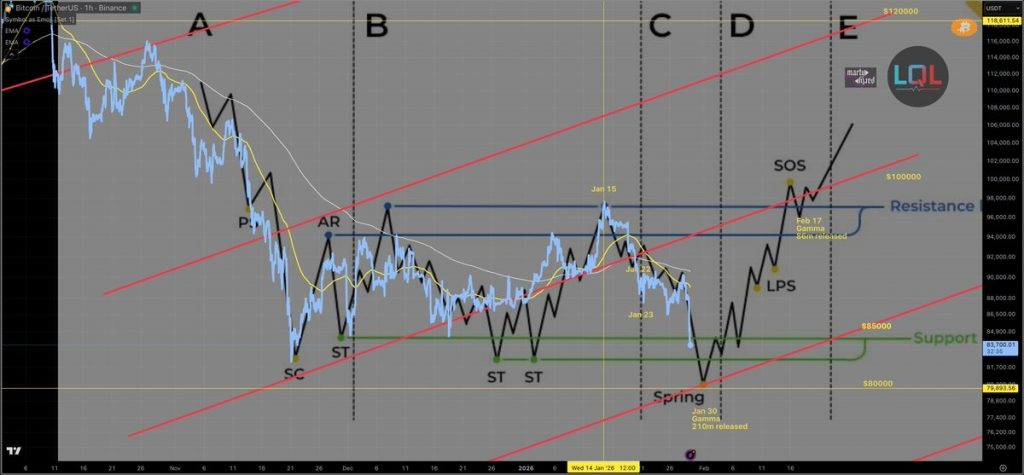
For crypto traders tracking Bitcoin’s price today in India, this can feel especially confusing, as global volatility is reflected in INR-denominated charts instantly.
Bitcoin’s Key Levels Currently in Focus
According to recent market observations:
- $85,200 – $86,200 has emerged as a critical resistance zone
- Bitcoin remains below this level, keeping short-term bearish pressure intact
- A sustained reclaim above this range would be the first sign of stabilisation
Failure to reclaim resistance could shift attention to deeper support zones around $72,300-$75,300, which hold historical significance.
From a Wyckoff perspective, dips into lower ranges may still be part of accumulation rather than a breakdown, as long as support continues to attract buyers.
CME Gap and Short-Term Volatility
Recent analysis also points to a CME gap that markets often revisit. This opens the door for short-term volatility.
Possible scenarios include:
- A final liquidation sweep toward lower leverage levels
- A retest of intermediate support zones
- Sideways movement before attempting another push toward resistance
Such behaviour aligns with the later stages of a Wyckoff accumulation range, where price continues to fluctuate before a decisive move.
What This Means for Bitcoin Price in India
For Indian crypto users, it’s important to understand that short-term volatility doesn’t always reflect long-term market direction.
When Bitcoin is in accumulation, Bitcoin price in India movements may appear sharp and unpredictable, even though the broader structure remains range-bound. This phase often rewards patience rather than aggressive trading.
What Typically Comes After Accumulation?
In the Wyckoff framework, accumulation ends when selling pressure within the range is exhausted.
If demand outweighs supply:
- Price can break above the resistance
- The market may enter a markup phase, where sustained upward movement begins
However, it’s important to remember that Wyckoff is a framework, not a guarantee. Markets can also break down from ranges, especially if macro or liquidity conditions shift.
Key Takeaway For Crypto Traders
Sideways markets are uncomfortable by design. They tend to:
- Punish over-trading and excessive leverage
- Reward discipline, patience, and risk awareness
Understanding accumulation helps separate noise from structure, especially when tracking Bitcoin’s value in INR during volatile periods.
For now, Bitcoin’s price action continues to reflect a market searching for balance, one where volatility is high, but direction is still being decided.
 Disclaimer: Click Here to read the Disclaimer.