

Bitcoin Is About to Mine Its 20 Millionth Coin: What the Scarcity Milestone Means for Every Holder
Bitcoin is about to mine its 20 millionth coin. That leaves only 1 million BTC left to ever exist. For an asset whose entire value proposition rests on mathematical scarcity, this is worth pausing to understand properly.
TL;DR
- Bitcoin’s protocol caps total supply at exactly 21 million coins. The 20 millionth coin will be mined in March 2026, leaving only 1 million BTC left to ever be created.
- New supply issuance after the 2024 halving has dropped to 3.125 BTC per block, roughly 450 BTC per day globally. Only around 1 million coins remain unmined.
- Scarcity alone does not determine price, but the combination of shrinking supply issuance and growing institutional demand creates a structural imbalance that historically precedes extended upward moves.
Bitcoin’s supply cap is not a policy decision that can be reversed by a central bank, a government, or a majority vote. It is encoded in the protocol itself, enforced by every node on the network independently.
When the 20 millionth coin is mined in March 2026, more than 95% of all Bitcoin that will ever exist will already be in circulation.
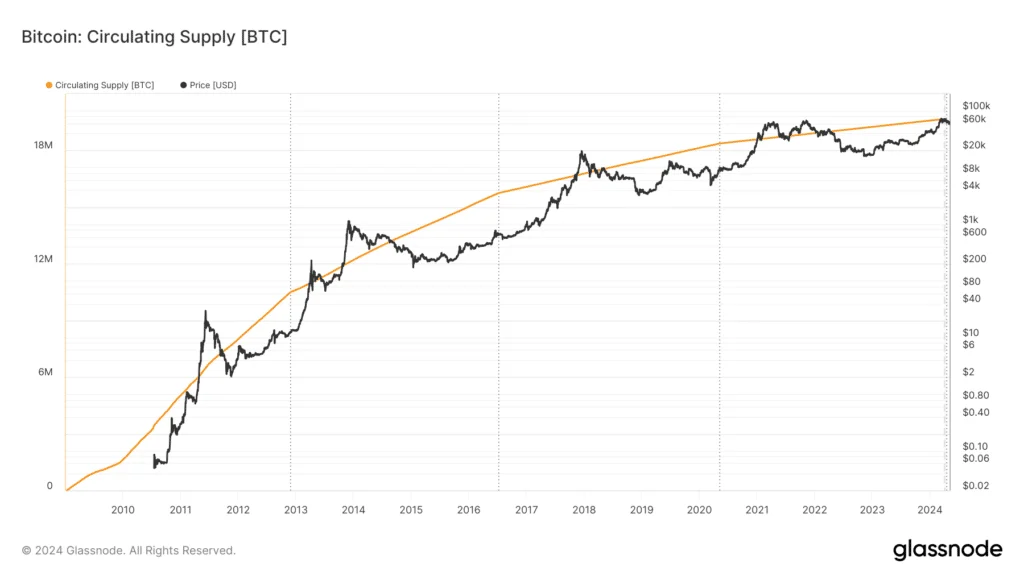
Source: Glassnode
Get WazirX News First
The 21 Million Cap: How It Actually Works
The Bitcoin protocol enforces its supply cap through a mechanism called the block subsidy schedule. When Bitcoin launched in 2009, miners received 50 BTC for every block they validated. Approximately every four years, or every 210,000 blocks, that reward halves. This event is called the halving.
After the April 2024 halving, the block reward dropped to 3.125 BTC. At the current rate of one block roughly every 10 minutes, approximately 450 new BTC enter circulation every day. By the time the 20 millionth coin is mined, only 1 million BTC remain to be issued.
Here is the math that matters: those final 1 million coins will not arrive in a rush. Each successive halving reduces the issuance rate by half again. The 21st million Bitcoin will not be mined until approximately the year 2140. In practical terms, Bitcoin issuance for current investors is already approaching the end of its meaningful supply curve.
| Halving Event | Block Reward | Approximate Year |
| Genesis | 50 BTC | 2009 |
| First Halving | 25 BTC | 2012 |
| Second Halving | 12.5 BTC | 2016 |
| Third Halving | 6.25 BTC | 2020 |
| Fourth Halving | 3.125 BTC | 2024 |
| Fifth Halving (upcoming) | 1.5625 BTC | ~2028 |
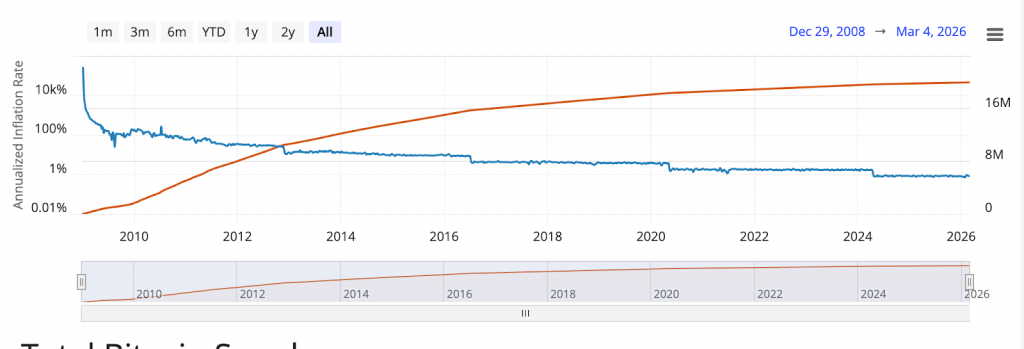
Bitcoin supply issuance schedule and halving history source: Bitcoin Visuals
Why 95% Mined Does Not Mean 95% Circulating
There is an important distinction between Bitcoin mined and Bitcoin available. Researchers estimate that between 3 million and 4 million Bitcoin are permanently lost: coins held in wallets whose private keys no longer exist, coins sent to incorrect addresses, and approximately 1 million BTC attributed to Satoshi Nakamoto that have never moved.
If those estimates are accurate, the effective circulating supply of Bitcoin is closer to 16 million coins rather than 20 million. Against global demand from spot ETF holders, corporate treasuries like Strategy (formerly MicroStrategy), sovereign wealth funds, and retail investors across 180 countries, that available float is extremely thin.
The stock-to-flow model, which compares Bitcoin’s existing supply to its annual new issuance, is one framework analysts use to understand this dynamic. After the 2024 halving, Bitcoin’s stock-to-flow ratio roughly doubled, making it more scarce by that measure than gold. Reaching the 20 millionth coin marks a further progression along that scarcity curve.
The Demand Side of the Equation
Scarcity without demand is just a number. What makes the 20 millionth coin milestone significant in March 2026 is that it coincides with a structural expansion in institutional demand that has no precedent in prior cycles.
US spot Bitcoin ETFs now hold approximately 7% of global Bitcoin supply. These products purchased Bitcoin during every week of Q1 2024 through most of 2025, with net outflows occurring only during the most extreme phases of the recent correction. The early March 2026 inflow streak of $1.1 billion over three days signals that institutional re-entry is already underway.
Corporate treasury adoption has also matured. Strategy, formerly MicroStrategy, holds over 400,000 BTC as a reserve asset. Smaller companies following its model have collectively added tens of thousands of additional coins to corporate treasuries. Unlike exchange-held Bitcoin, treasury Bitcoin is typically held in cold storage without intent to sell on short notice. Each coin absorbed by a treasury effectively removes it from the liquid float.
Bitcoin held by ETFs and corporate treasuries, 2024-2026 – BitcoinTreasuries
Grayscale’s 2026 institutional outlook estimated that less than 0.5% of US advised wealth is currently allocated to Bitcoin.
If that allocation grows to even 1 or 2% over the next two to three years, the incremental demand would absorb multiple years of new Bitcoin issuance at current rates. Against a background of 450 BTC per day entering circulation, institutional demand at scale creates a structural imbalance.
Common Misconceptions About Bitcoin’s Supply Cap
- “The 21 million cap can be changed by miners.” This is false. The 21 million cap is enforced by all full nodes on the Bitcoin network, not just miners. Any miner who tried to issue more than the protocol allows would have their blocks rejected by the rest of the network. Changing the cap would require consensus from the vast majority of nodes, an event with no realistic political path.
- “Lost coins make Bitcoin more scarce but also more fragile.” Lost coins do reduce the effective circulating supply, which is structurally bullish for price assuming demand holds. They do not make Bitcoin fragile. The protocol does not require all coins to be in circulation to function correctly.
- “Once all Bitcoin is mined, miners have no incentive to secure the network.” This concern applies to the year 2140, not to the current decade. By then, Bitcoin is expected to generate sufficient transaction fee revenue to sustain mining economically. The transition from block subsidy to fee revenue is a long-term structural question that is monitored actively by protocol researchers.
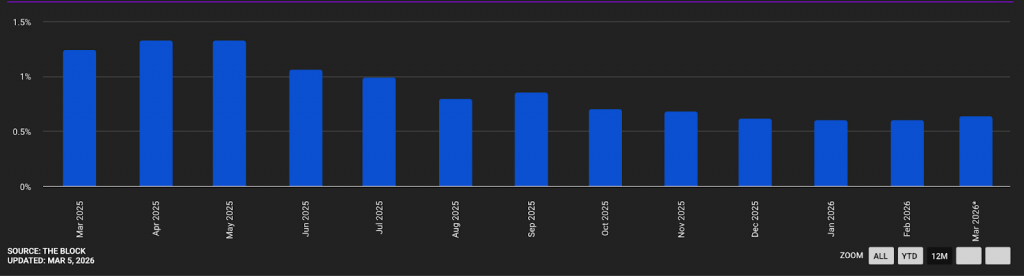
Bitcoin miner revenue split between block subsidy and fees, 2020-2026 source: the block
Final Thoughts:
For Indian investors, the 20 million milestone is a reminder to review strategy. If you believe in Bitcoin’s long term scarcity thesis, focus on disciplined allocation and long term secure storage rather than short term speculation.
Decide your portfolio percentage, use systematic accumulation if needed, and align your holding horizon with your conviction about Bitcoin’s fixed supply dynamics.
If you are acting on that plan, choose an exchange that prioritises compliance, transparency, and reliable INR liquidity.
On WazirX, you can start accumulating Bitcoin in minutes with secure custody infrastructure and clear pricing, so your long term strategy rests on execution you can verify.
Frequently Asked Questions
The 20 millionth Bitcoin is expected to be mined in March 2026, based on the current block production rate of approximately one block every 10 minutes. The exact date depends on the total network hash rate, which can cause blocks to arrive slightly faster or slower than the 10-minute target. The milestone is certain to occur in the near term; only the precise date varies.
Estimates from on-chain analysts including Glassnode suggest that between 3 million and 4 million Bitcoin are permanently inaccessible due to lost private keys, forgotten wallets, and provably unspendable coins. These are not formally removed from the supply cap but are functionally removed from the circulating float. If accurate, effective circulating supply is significantly lower than the headline figure of 20 million, which strengthens the scarcity argument for existing holders.
No. Supply scarcity is a necessary but not sufficient condition for price appreciation. Demand must also grow for scarcity to translate into price. Bitcoin has experienced 50 to 90% drawdowns in prior cycles despite its fixed supply cap. The scarcity argument is a long-term structural argument about value preservation and purchasing power, not a short-term price prediction.
The fifth halving, expected around 2028, will reduce the block reward from 3.125 BTC to 1.5625 BTC. After that halving, annual new Bitcoin issuance will drop to approximately 82,000 BTC per year globally. For context, US spot Bitcoin ETFs absorbed more than that amount in a single week during peak inflow periods in 2025. The supply and demand dynamics at each halving have historically preceded the strongest price appreciation phases of each market cycle.
This is a personal financial decision that depends on individual circumstances, risk tolerance, and financial goals. The 30% flat tax on crypto gains without loss set-off provisions creates a high barrier to active trading profitability. For long-term holders who believe in Bitcoin’s scarcity-driven value proposition, the tax structure is less punitive because gains are only crystallised at point of sale. Consult a qualified tax advisor for guidance specific to your situation.
 Disclaimer: Click Here to read the Disclaimer.