

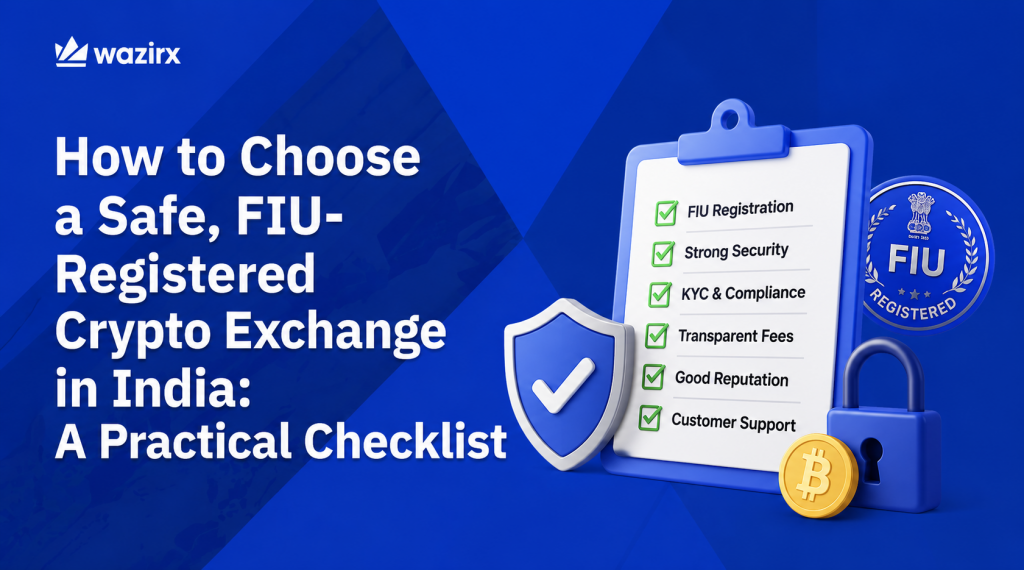
Every crypto exchange in India will tell you it’s the safe choice. Most of them are technically telling the truth, and a few of them aren’t, and the gap between those two groups isn’t always obvious from a homepage. There’s a real regulatory framework behind this now, though, and knowing what to actually check cuts through most of the guesswork.
The Regulatory Backdrop
On 7th March 2023, the Ministry of Finance issued a gazette notification bringing virtual digital asset service providers under the Prevention of Money Laundering Act. In practice, this means any exchange, wallet provider, or platform handling crypto transactions for Indian users is required to register with the Financial Intelligence Unit, India, known as FIU-IND, as a Reporting Entity. That registration comes with real obligations, including KYC verification, transaction monitoring, and filing suspicious transaction reports when something looks off.
As of the most recent government disclosure, 49 virtual digital asset service providers are registered with FIU-IND, a mix of domestic and offshore platforms. This is where “is my crypto exchange legal in India” gets a straightforward answer. Crypto itself is legal to buy, sell, and hold in India. It’s not legal tender, and there’s still no dedicated crypto law, but there’s no ban either. The compliance layer is what determines whether a specific platform is operating within that framework, and that’s exactly what this checklist is meant to help you verify. For a wider look at how this framework has developed, WazirX’s rundown of India’s crypto regulation roadmap is worth reading if you want the full picture.
1. Confirm FIU-IND Registration Directly
Don’t take a homepage badge at face value. The government has published lists of registered VDA service providers through parliamentary disclosures, and it’s a five-minute check to confirm a platform is actually on it rather than just claiming compliance. Worth knowing too, several well-known offshore platforms have received non-compliance notices in the past for serving Indian users without registering, which led to their apps being pulled from Indian app stores until they came into compliance. Registration status can change, so it’s worth verifying rather than assuming.
2. Check Whether KYC is Actually Enforced, Not Just Mentioned
A crypto exchange checklist item that’s easy to skip: does the platform require PAN and address verification before you can trade, or does it let you deposit and trade first and verify later? FIU-IND compliant exchanges shouldn’t let meaningful trading happen without completed KYC. If a platform is loose about this upfront, that’s usually a sign it’s loose about compliance generally.
3. Look at Custody and Security Practices
This is where a lot of platforms get vague on purpose. A crypto exchange should be reasonably transparent about how user funds are stored, whether that’s cold storage percentages, use of an institutional custody partner, or insurance coverage on held assets. Two-factor authentication should be standard, not a premium feature.
4. Verify Tax Handling is Built In, Not Left To You
Crypto gains in India are taxed at a flat 30% under Section 115BBH, with 1% TDS deducted under Section 194S on most transfers. A compliant exchange handles this deduction automatically and gives you access to transaction statements for filing your return. If a platform doesn’t deduct TDS or makes it hard to find your trade history, that’s a compliance gap you’ll end up dealing with at tax time.
5. Check INR Support and Liquidity
A genuinely India-focused exchange should support direct INR deposits and withdrawals through UPI, IMPS, RTGS, or NEFT, rather than routing you through a foreign currency first. Beyond convenience, this also tends to correlate with better liquidity on INR trading pairs, since the platform is actually built around Indian banking rails rather than treating India as an afterthought market.
Putting the Checklist to Work
None of these checks takes more than a few minutes individually, but together they separate a platform that’s genuinely built for compliance from one that’s just using the right words. If you’re comparing exchange types more broadly before settling on a platform, it’s also worth understanding the tradeoffs between centralized and decentralized exchanges, since custody and compliance work differently across the two. Choosing where to trade isn’t a decision to rush, and a platform that makes its compliance status easy to verify is usually one that takes it seriously in the first place.
 Disclaimer: Click Here to read the Disclaimer.