

India had close to 119 million crypto users by late 2025. That places the country at the top of global adoption rankings, ahead of the United States and well ahead of most of Europe. And yet a dedicated crypto law is still in progress. A formal licensing framework is being worked out, and clarity on how different tokens are classified is expected to follow as the regulatory picture matures.
This gap, between how many people are actually trading and how little formal structure governs that trading, is what makes India’s regulatory story worth following closely right now.
Where India Stands: Legal but Not Legal Tender
Crypto is legal in India. It is not, however, a legal tender. Buying, holding, selling, and trading cryptos through registered exchanges is permitted. Using Bitcoin to pay for groceries or settle a bill, in a way that carries legal protection, is not. The government recognizes these assets as Virtual Digital Assets, or VDAs, under the Income Tax Act, a classification that arrived through the Finance Act of 2022. That gave crypto a formal definition for the first time. It also came bundled with one of the heaviest tax regimes anywhere in the world.
Comprehensive legislation is still in the works. The Cryptocurrency and Regulation of Official Digital Currency Bill, listed for Parliament in 2021, is yet to come up for a vote, and the broader framework continues to evolve as policymakers assess the right approach.
How Oversight Is Actually Structured
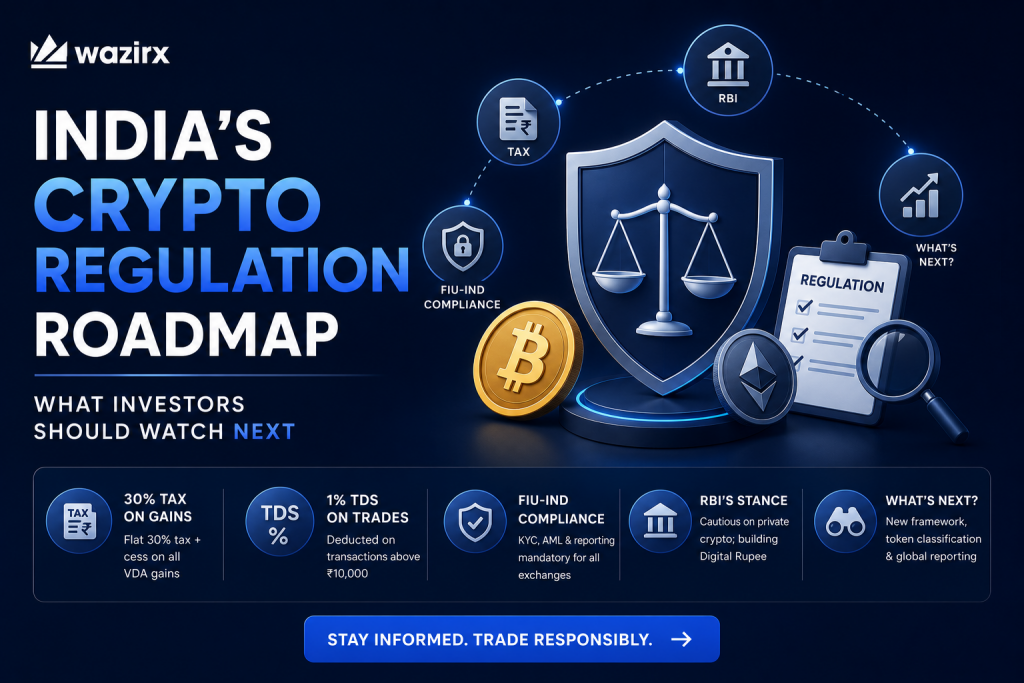
Crypto oversight in India is currently shared across multiple bodies, each handling a distinct part of the picture. Oversight is spread across several bodies instead, each handling a different slice of the picture. The Ministry of Finance keeps control of policy and taxation, while the RBI focuses on monetary policy and its own Digital Rupee project. FIU-IND, meanwhile, handles anti-money laundering compliance under PMLA, and the CBDT is the one actually enforcing tax obligations on the ground.
India may eventually need clearer coordination between regulators such as the Ministry of Finance, FIU-IND, RBI, CBDT, and SEBI, especially if some tokens begin to resemble securities or investment contracts. However, India does not yet have a dedicated crypto classification framework that formally separates tokens into categories such as commodities, securities, or payment assets.
Bitcoin, Ethereum, and other crypto assets are currently covered under India’s broad VDA tax framework. However, India has not yet introduced a dedicated law that classifies different tokens as commodities, securities, payment tokens, or utility tokens.
The Tax Rules, Plainly Stated
All gains from VDA transfers are taxed at a flat 30% under Section 115BBH of the Income Tax Act, regardless of how long the asset was held. The only deduction permitted is the cost of acquisition. Losses from one crypto asset cannot be set off against gains from another, which is worth keeping in mind when filing. A 4% health and education cess applies on top, bringing the effective rate to roughly 31.2%, calculated on the tax amount itself rather than the total gains.
A 1% TDS is deducted on transactions above ₹10,000 in a financial year, with a higher ₹50,000 threshold for certain specified individuals. Exchanges handle this deduction automatically at the point of sale. Crypto gifts above ₹50,000 are taxable too, though the liability lands on whoever receives the gift rather than the person sending it.
Enforcement got noticeably stricter from April 1, 2026, when new penalty provisions brought in a daily fine of ₹200 for entities that fail to file crypto transaction statements accurately. The Income Tax Department has sent more than 44,000 communications to taxpayers flagged for potential non-disclosure, with AI-driven analytics identifying close to ₹889 crore in unreported transactions tied to the 2021-22 financial year.
Checking the Bitcoin price in India and placing trades is the easy part. Staying compliant with this tax structure is the part that actually requires attention.
FIU-IND Compliance and What It Means for Crypto Exchanges
Every crypto exchange and wallet provider operating in India must register with FIU-IND under PMLA. Registered entities run full KYC checks, keep transaction records on file, and submit Suspicious Transaction Reports whenever something warrants it.
Forty-nine exchanges, both domestic and offshore, currently operate as registered reporting entities under this framework. Using a crypto exchange in India like WazirX to buy crypto or track BTC price in INR means that a compliance layer is already built into the platform, not something the user has to assemble separately.
The RBI’s Position and the Digital Rupee
The RBI has continued to take a cautious stance on private crypto assets, repeatedly flagging risks around financial stability, consumer protection, money laundering, and the use of private digital assets outside the regulated financial system.
The RBI continues to develop its own CBDC alongside this. Retail digital rupee adoption is still in its early stages relative to UPI, and the ecosystem around it continues to be built out. The government’s broader direction points toward a structured digital payments future, with the Digital Rupee playing a central role in that vision.
What to Watch Over the Next 12 to 24 Months
The next 12 to 24 months could be important for India’s crypto policy direction.
Various media reports have suggested that policymakers are evaluating a broader regulatory framework for virtual digital assets. However, no comprehensive crypto legislation has been introduced or passed by Parliament yet.
A multi-regulator framework is also under discussion, splitting oversight along clearer lines: SEBI for exchanges and security-like tokens, the RBI for cross-border flows, and the Finance Ministry retaining policy and tax control.
India is also expected to move toward cross-border crypto reporting under the OECD’s Crypto-Asset Reporting Framework, with data exchange expected from April 1, 2027. This could increase visibility into offshore crypto holdings and transactions by Indian residents.
DeFi and staking rules are expected to surface in a government discussion paper sometime later in 2026. Right now, both areas operate with effectively zero specific guidance.
Trading Under the Current Rules
Regulatory uncertainty does not make trading crypto in India impossible. It simply makes compliance the priority, ahead of strategy.
For anyone tracking the Bitcoin price today in India, calculating 1 BTC to INR, or watching the BTC price in INR move across sessions, platforms like WazirX provide live data on registered trading infrastructure. Logging into WazirX gives access to the full range of VDA assets, alongside KYC and AML compliance that is already built in rather than bolted on.
Understanding how to buy crypto in India starts with choosing a registered platform. Beyond that, the responsibility is fairly straightforward: keep records of acquisition costs, file VDA disclosures in the ITR, and stay current with tax obligations as they shift.
The rules are still being written. That, if anything, makes this a good time to understand the ones already in place.
 Disclaimer: Click Here to read the Disclaimer.