

Nvidia helped power the crypto mining boom. Yet its financial filings tell a different story about the company’s relationship with Bitcoin. As of its July 26, 2026 financial statements, Nvidia had no separately disclosed Bitcoin holdings. Its business was increasingly driven by artificial intelligence, not crypto mining.
So why does Nvidia still matter to crypto investors? The answer lies in how the company earns money, rather than which digital assets it owns.
Does Nvidia Own Bitcoin?
There is no publicly disclosed Bitcoin treasury at Nvidia. Its latest available quarterly filing, covering the period ended July 26, 2026, lists cash, securities, and other investments, but does not identify Bitcoin as a separate asset.
But an absence of disclosed holdings is not proof that Nvidia owns exactly zero Bitcoin. It means investors have no verified basis for treating NVDA as a Bitcoin-holding company.
Compare that with Strategy, which explicitly reports its Bitcoin holdings, purchase costs, and treasury strategy.
| Question | Nvidia (NVDA) |
| Publicly disclosed BTC treasury? | No |
| Disclosed Bitcoin holdings? | None identified separately |
| Historical crypto mining exposure? | Yes |
| Main business driver in 2026? | AI and data center computing |
This raises another question. If Nvidia does not publicly hold Bitcoin, where does its crypto connection come from?
Nvidia’s Crypto Connection Started With Mining
During earlier crypto booms, miners bought Nvidia graphics processing units (GPUs) to run the calculations needed to secure certain blockchain networks. Ethereum was particularly important because its former mining system could use GPUs.
That demand helped Nvidia sell hardware. But it also created a problem: when mining became less profitable, demand could fall, leaving excess graphics cards in the market.
Ethereum’s move to proof-of-stake in September 2022 removed the need for GPU mining on its main network.
Bitcoin is different. Its mining industry relies primarily on specialized machines called ASICs, rather than Nvidia’s general-purpose GPUs.
Nvidia still acknowledges crypto mining as a possible source of GPU demand and market volatility in its annual report. However, it does not separately report a current crypto mining revenue figure.
The truth is that Nvidia’s growth engine has moved elsewhere since September 2022
AI, Not Crypto, Now Drives Nvidia’s Revenue
The scale of this shift is visible in Nvidia’s financial results.
In the quarter ended July 26, 2026, the company reported $96.2 billion in revenue. Data centers accounted for $89 billion, or approximately 92.5%.
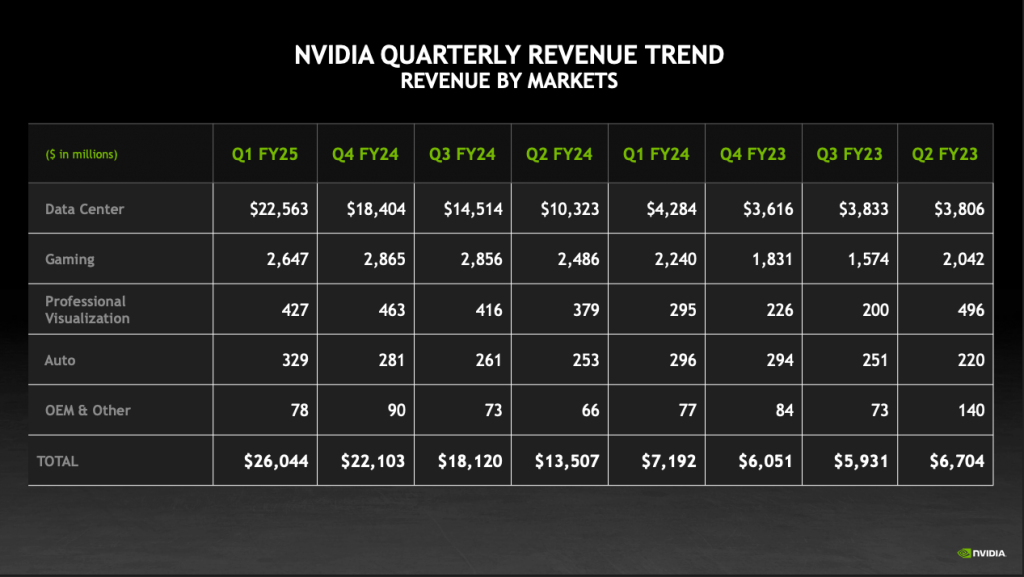
That revenue was driven largely by demand for AI computing infrastructure, not Bitcoin mining.
Source: Nvidia Q2 FY2027 earnings release. Values in USD billions.
Data Center: 92.5% of revenue. Other businesses: 7.5%. Data Center revenue is not a measure of crypto exposure.
The consequence is significant. Nvidia’s earnings now depend far more on AI infrastructure spending than on the economics of mining digital currencies.
That does not make NVDA irrelevant to crypto markets.
Why Can Nvidia and Bitcoin Move Together?
Bitcoin and Nvidia can respond to some of the same forces, even without a direct business connection.
For example, changes in US interest-rate expectations can affect investors’ willingness to hold risky assets.
If investors reduce exposure to technology stocks and Bitcoin at the same time, both prices may fall. But that does not mean one caused the other to decline.
| Market event | Possible impact on NVDA | Possible impact on BTC |
| Stronger appetite for risk | Higher demand for growth stocks | Higher demand for Bitcoin |
| Rising interest-rate expectations | Pressure on valuations | Pressure on speculative demand |
| AI spending slowdown | Direct earnings risk | No necessary direct effect |
| Bitcoin mining downturn | Limited, indirect GPU demand risk | Direct impact on miner profitability |
Suggested infographic: A two-path diagram showing Nvidia’s direct exposure to AI spending and Bitcoin’s exposure to crypto demand, with macroeconomic conditions influencing both.
What Does This Mean for NVDA Investors?
Buying Nvidia shares does not give an investor direct ownership of Bitcoin.
NVDA is primarily a bet on Nvidia’s business performance, including AI chip demand, competition, profit margins, and customer spending.
Bitcoin ownership creates a different exposure. Its value depends on Bitcoin’s market price, which can change independently of Nvidia’s earnings.
The two investments can sometimes move together. Their underlying risks remain different.
Final Thoughts
Nvidia’s historical link to crypto came from selling computing hardware to miners. Its current growth comes overwhelmingly from AI.
That resolves the central question: Nvidia has no separately disclosed Bitcoin treasury, and NVDA is not a direct substitute for Bitcoin exposure.
For investors comparing the two, the useful question is not whether their prices move together today. It is what must happen for each asset to gain value tomorrow.
interested in Nvidia’s price movements? WazirX Futures lets you trade NVDA without buying the underlying shares, with opportunities to take positions on both rising and falling prices.
 Disclaimer: Click Here to read the Disclaimer.