
Over seven million tokens were launched on Pump.fun between January 2024 and March 2025 (those with at least five trades). Only about 97,000 of them still held $1,000 or more in trading liquidity, according to Solidus Labs’ 2025 Rug Pull Report. That is roughly 1.4%.
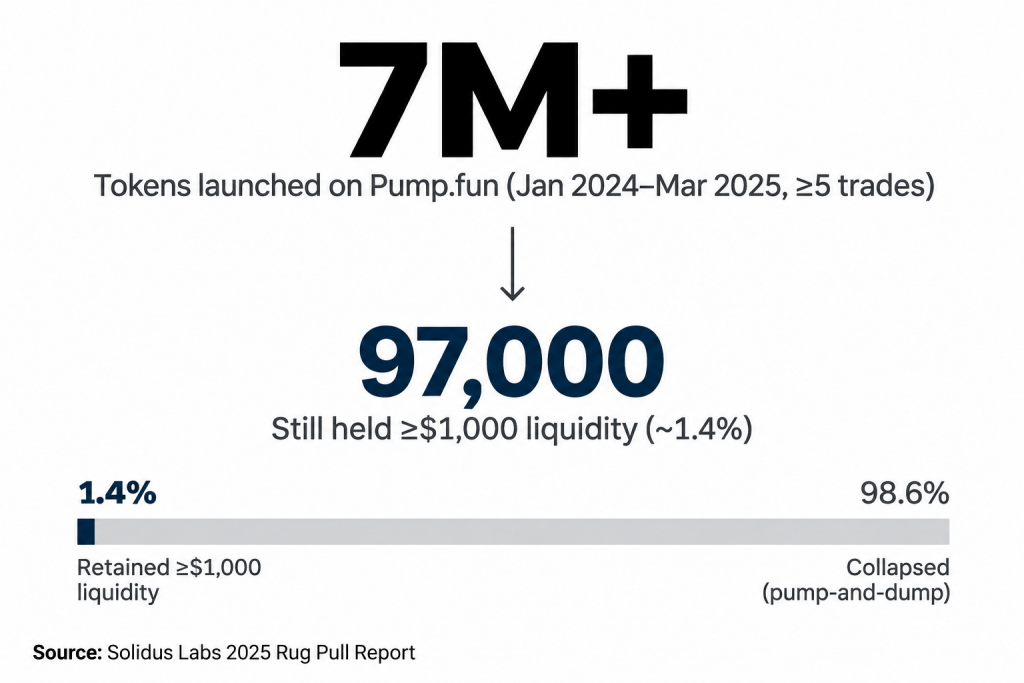
That number does not prove 98.6% were intentional scams. It does show that buying a random new memecoin is closer to a lottery ticket than an investment. Solidus itself described 98.6% of the tokens as collapsing into worthless pump-and-dump schemes shortly after launch. To see why, start with how a token gets born.
How a Pump.fun Token Goes From Zero to Tradable
Anyone can create a token on Pump.fun in minutes for very little money. The token starts on a bonding curve: every buy raises the price automatically, and every sell lowers it. Once enough money flows in, the token “graduates” to open trading (historically Raydium; later primarily PumpSwap).
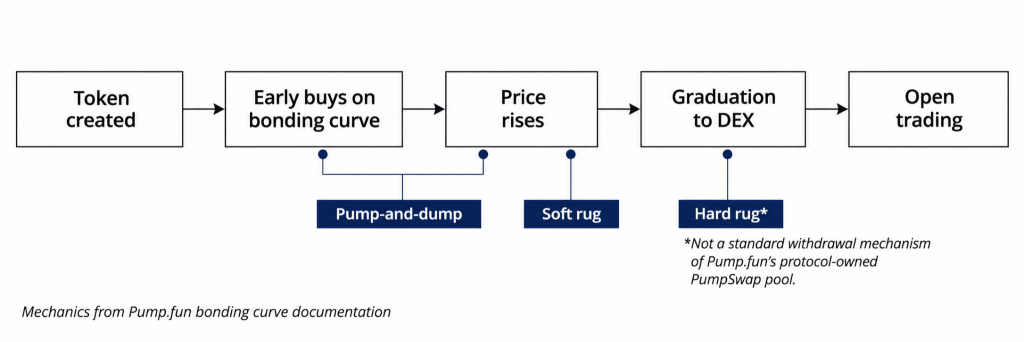
Low cost to launch is the point of the platform. It also means scammers can launch hundreds of tokens and only need a few to work.
3 Ways a Rug Pull Happens
A rug pull is when the people behind a token take buyers’ money and leave the token worthless. It comes in three forms.
Also read: What is a Rug pull? 6 Ways to avoid it
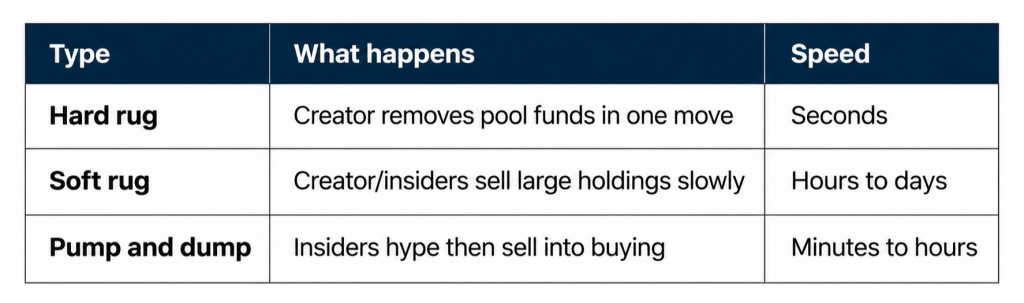
The soft rug is the most common pattern Solidus found. On Raydium (the Solana exchange where many Pump.fun tokens traded at the time), 93% of the 388,000 liquidity pools examined (approximately 361,000 pools) showed soft-rug characteristics.
What Documented Cases Actually Look Like
The headline percentages hide a detail that matters more: most rug pulls are small.
| Finding | Figure |
| Median Raydium rug pull | ~$2,832 |
| Bottom 25% of cases | Under $732 |
| Largest single case identified (MToken) | ~$1.9 million |
Source: Solidus Labs, via CoinDesk and BeInCrypto coverage of the report.
Also read: How to spot pump and dump schemes
Small amounts are the business model. A scammer running hundreds of $2,000 rugs makes more, with less attention, than one large fraud.
A 2026 academic preprint (arXiv:2603.24625, submitted March 2026, revised May 2026; not peer-reviewed) found a similar pattern on other Solana exchanges: 76,469 candidate rug-pull tokens out of 100,063 new tokens issued on Orca, Raydium, and Meteora in the first half of 2025, with at least $151 million in traceable losses. A random audit estimated a very low false-positive rate (0.26%).
Pump.fun disputed the Solidus report, arguing it misunderstood how memecoins work. Both things can be true: most tokens fail naturally, and many are also designed to fail.
6 Red Flags to Check Before Buying
Each takes under a minute with free tools like Solscan, RugCheck, or Bubblemaps.
- Top 10 wallets hold over 30% of supply. A few holders can crash the price at will.
- Creator wallet still holds a large share. That is a soft rug waiting to happen.
- Many wallets funded from one source. Often one person posing as many early buyers.
- Liquidity not locked or burned after graduation. The pool can be pulled.
- Token under 24 hours old with only social media hype behind it.
- Promoters push urgency: “last chance,” “100x,” “stealth launch.”
Two or more red flags mean the odds are heavily against the buyer.
Also read: Crypto Tokenomics, all you need to know
Final Thoughts
Pump.fun made token creation accessible to almost anyone. Its explosive growth also revealed how much the launch process matters, particularly when a handful of insiders control most of a token’s supply.
That is where newer platforms are beginning to rethink the model. India’s Sikka.fun, built on Shardeum, introduces a fair-launch approach with no pre-sales or reserved team allocations, alongside on-chain referral rewards that make promotional incentives more transparent.
For Indian memecoin enthusiasts, it offers a homegrown way to participate in a market that is still finding better ways to balance accessibility, transparency, and opportunity.
 Disclaimer: Click Here to read the Disclaimer.