

Bitcoin fell below $60,000 on November 25, losing 1.87% in 24 hours. Meanwhile, the dollar value of outstanding Bitcoin futures contracts, known as dollar-denominated “open interest,” fell by 0.31% to $38.90 billion, according to CoinGlass.
That in itself isn’t surprising. Some traders may be anticipating a recovery, while others expect prices to fall further.
Why did futures exposure barely fall when Bitcoin itself became cheaper? It turns out that traders may have actually increased their exposure to Bitcoin futures. Understanding how open interest is measured helps explain why, and what this tells us about trader behavior.
-
Bitcoin’s price fell by 1.87%, but dollar-denominated open interest fell by just 0.31%.
-
After accounting for the price change, BTC-equivalent futures exposure appears to have increased by approximately 1.6%.
-
Rising open interest during a price decline does not necessarily mean traders are becoming more bearish.
What Exactly is Open Interest?
Open interest is the total number of outstanding derivatives contracts that have not been closed or settled. In Bitcoin futures markets, it can be expressed in three ways: the number of contracts, the amount of Bitcoin (BTC) they represent, or the dollar value (USD) of that exposure.
Say on November 24, Bitcoin’s dollar-denominated open interest is $36 billion. This means that all open Bitcoin futures contracts, each involving a long and a short position and counted only once, have a combined value of $36 billion at current market prices.
Compare open interest of Bitcoin, or any other asset at any given time with that of a previous period, you get a sense of whether futures exposure for that particular asset is expanding or shrinking. In other words, Open interest gives you a picture of whether interest in the asset’s futures is growing or declining.
Also read: What Is Open Interest (OI) in Crypto Futures Trading?
What Happened in the Bitcoin Futures Market on November 25?
On November 25, Bitcoin’s dollar-denominated open interest fell by just 0.31%, even as Bitcoin’s price dropped by 1.87%.
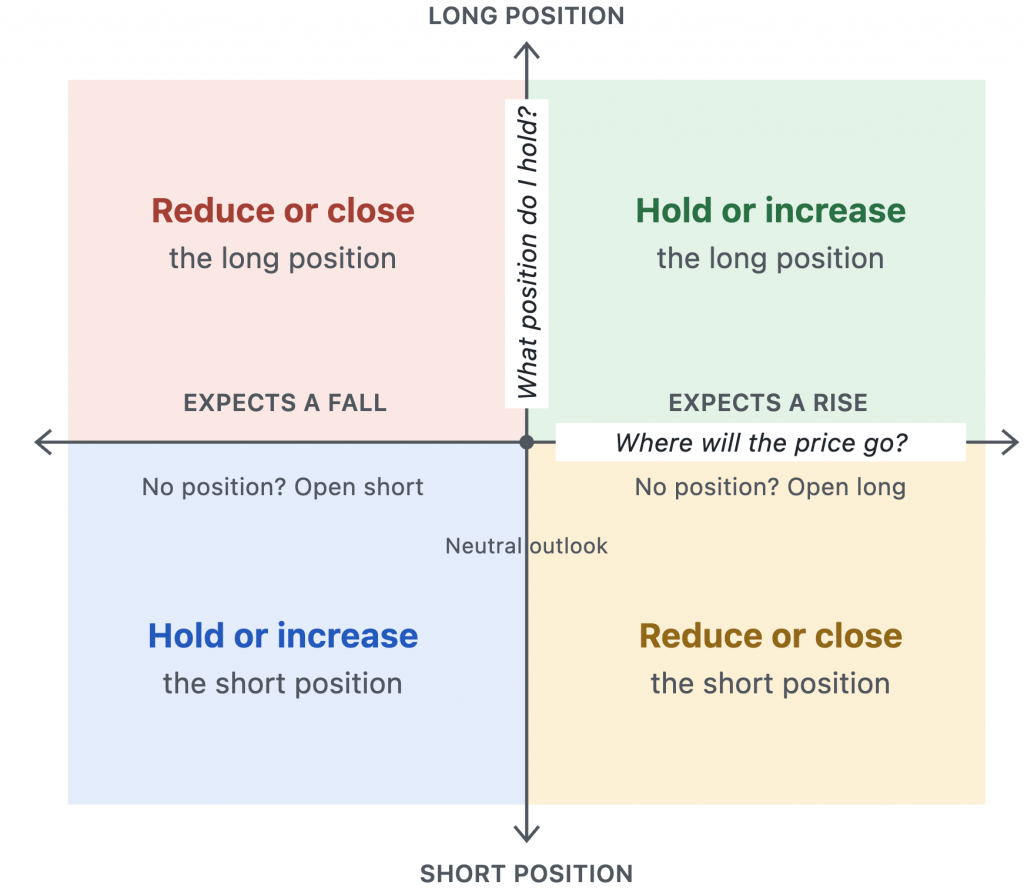
This is not unusual. The trader has several choices depending on the position they currently hold, and where they expect Bitcoin’s price to go next.
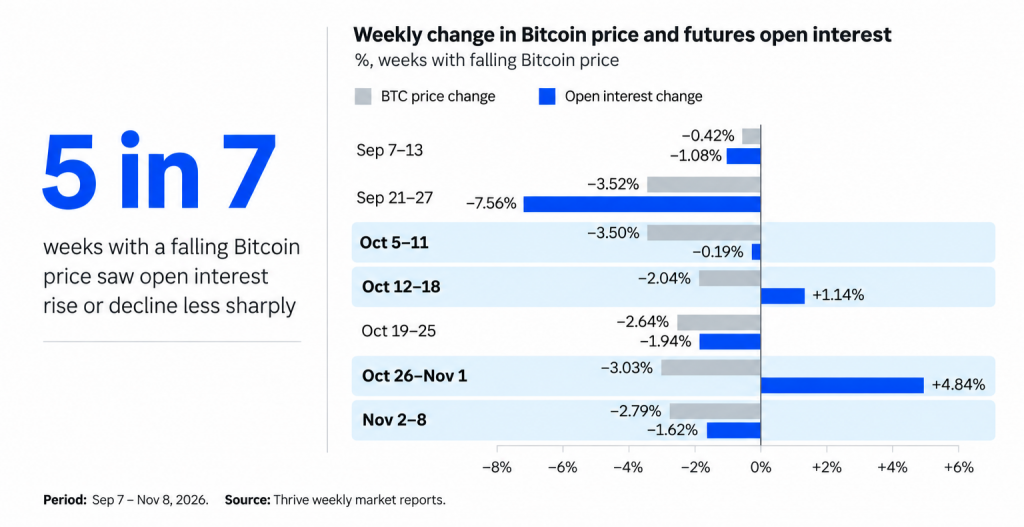
And if you look at historical data, you’ll see that open interest often falls less sharply than Bitcoin’s price.
But there is another reason why open interest and Bitcoin’s price may not fall at the same rate. It has to do with how we measure open interest.
What Dollar-Denominated Open Interest Doesn’t Tell Us
Measuring open interest in dollars alone can give us a misleading picture of changes in futures exposure.
Say the outstanding futures contracts in a market represent 100 BTC. The next day, Bitcoin’s price falls by 10%, but the amount of Bitcoin these contracts represent remains the same.
| Day 1 | Day 2 | Change | |
| Bitcoin price | $60,000 | $54,000 | −10% |
| Open interest in BTC | 100 BTC | 100 BTC | 0% |
| Open interest in USD | $6 million | $5.4 million | −10% |
Applying this calculation to the November 25 CoinGlass data gives us the following picture.
Notice what happens when we change the unit of measurement. What initially looked like a small decline in futures exposure now looks like an increase. Bitcoin became cheaper, but the dollar value of outstanding futures positions barely changed.
This suggests that the amount of Bitcoin-equivalent exposure represented by those contracts may have increased.
Does This Mean More Traders Are Shorting BTC?
Not necessarily. Open interest tells us how much futures exposure exists, but not which side of the market is under more pressure.
For that, let’s look at two other metrics from CoinGlass’s November 25 snapshot:
- Funding rate (+0.0050%): The funding rate was positive, meaning traders holding long positions were paying traders holding short positions in perpetual futures markets.
- 24-hour liquidations ($119.7 million): Most of these were long positions. Traders betting on a price increase were being forced to close their positions because they no longer had enough funds to keep them open.
What’s interesting here is that despite the forced closure of long positions, overall futures exposure in BTC terms appears to have increased. New exposure was being added faster than existing exposure was being closed.
If the Market Is in Extreme Fear, Why Is Futures Exposure Growing?
The past two weeks in crypto have been dominated by extreme fear. And the market is not wrong for it. US interest rates could go up again, money is flowing out of Bitcoin ETFs, and tech stocks have taken a beating.
CoinMarketCap’s Fear & Greed Index reflects this mood, falling from 12 last week to 8 on November 25.
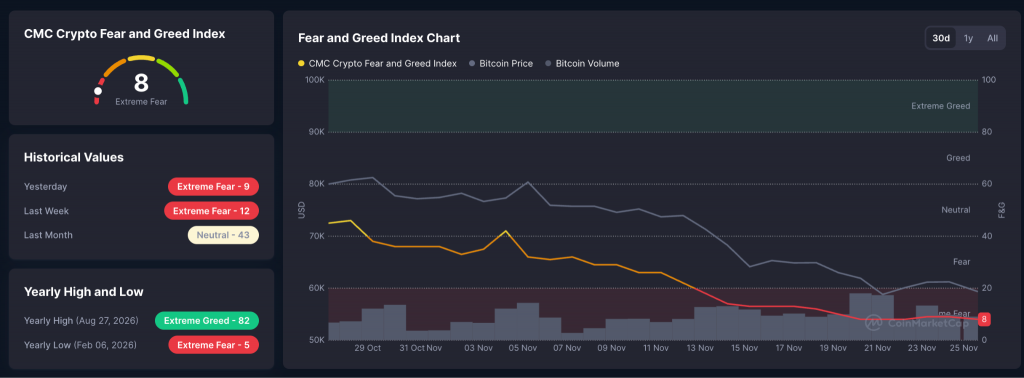
Yet, as we have seen, exposure to Bitcoin futures appears to be growing.
There is no real contradiction here. You can be pessimistic about where Bitcoin’s price is headed and still see opportunities in trading its price movements. In fact, the ability to trade in either direction makes the futures market particularly relevant during periods of uncertainty.
But does this growing futures exposure mean traders are becoming more active in the market?
Growing Futures Exposure Doesn’t Mean More Trading Activity
Open interest tells us how much future exposure exists at a given time. Trading volume tells us how much trading has taken place over a given period. The two don’t always move in the same direction.
According to CoinGlass, Bitcoin futures trading volume fell by 27.50% to $66.66 billion over the 24 hours leading up to November 25, even as BTC-equivalent open interest grew.
So, while outstanding futures exposure appears to have increased, overall trading activity has slowed down.
Final Thoughts
The November 25 data shows why we shouldn’t read open interest in isolation.
A falling dollar value of open interest can hide an increase in BTC-equivalent futures exposure. And growing exposure, as we have seen, doesn’t necessarily mean traders are becoming more optimistic or trading more frequently.
Reading open interest alongside price, funding rates, liquidations, and trading volume gives traders a more complete picture of what’s happening in the market.
Frequently Asked Questions
Bitcoin open interest is the total number of outstanding Bitcoin derivatives contracts that have not been closed or settled. It can be measured in contracts, BTC-equivalent quantities, or US dollars.
Rising BTC-equivalent open interest during a price decline indicates growing futures exposure. Traders may be positioning for further price declines, anticipating a recovery, or using futures to protect their existing Bitcoin holdings against losses.
High Bitcoin open interest is neither inherently bullish nor bearish. Every futures contract has a long and a short side. Traders should examine price movements, funding rates, and liquidations to better understand market sentiment.
Dollar-denominated open interest can be divided by Bitcoin’s current price to estimate BTC-equivalent open interest. This helps separate changes in the dollar value of futures exposure from changes in the amount of Bitcoin that exposure represents.
Open interest measures outstanding futures exposure at a given time, while trading volume measures the amount traded over a specific period. Open interest can increase even when trading volume declines.
 Disclaimer: Click Here to read the Disclaimer.