
On March 31, 2026, Google’s Quantum AI team published a paper titled “Securing Elliptic Curve Cryptocurrencies against Quantum Vulnerabilities.”
Most crypto ignored it for about 48 hours. Then traders noticed that Algorand was mentioned 32 times, singled out as the only major smart-contract blockchain with a live post-quantum cryptographic deployment on mainnet.
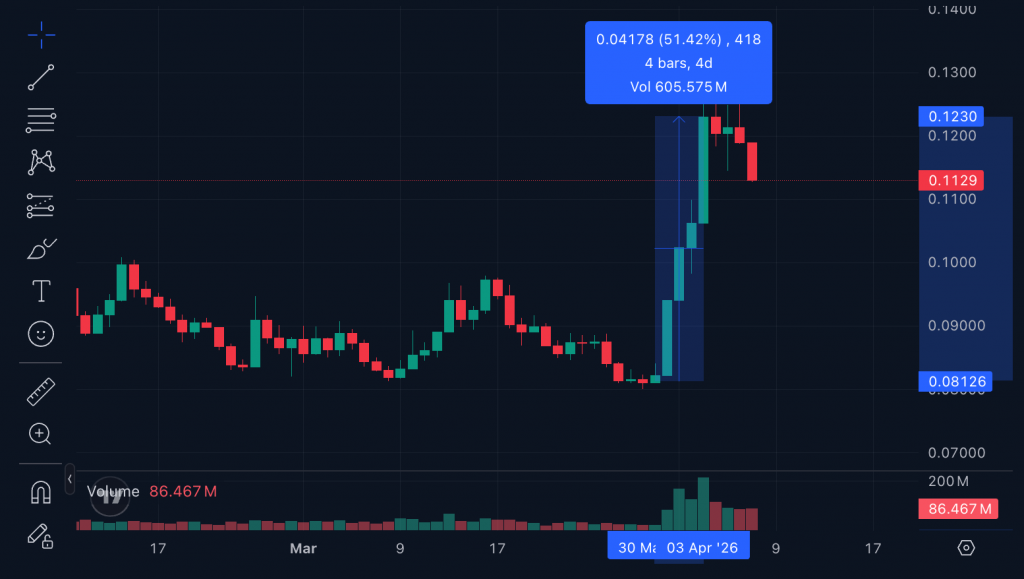
- Google’s quantum AI paper named Algorand as the real-world model for post-quantum blockchain security, sending ALGO up nearly 50% in April.
- The key tech is FALCON, a NIST-approved signature scheme already live on Algorand’s mainnet since 2025.
- Bitcoin and Ethereum have no live quantum-resistant implementations yet, creating a widening narrative gap.
ALGO went from roughly $0.08 to near $0.12. A 50% move in a week. Market cap crossed $1 billion again. And the quantum-resistance narrative, which had existed mostly on whitepapers and roadmap slides, suddenly became a live market trade. Here is what actually happened, why it matters.
What the Google Paper Actually Said
Google did not say quantum computers are here.
It said the timeline is compressing faster than most assumed.
The paper specifically warned that a sufficiently advanced quantum computer could break elliptic curve cryptography, the cryptographic foundation underlying Bitcoin, Ethereum, and most blockchains in existence. It estimated this could happen by 2030 or earlier.
More urgently, it introduced the concept of “harvest now, decrypt later,” where bad actors collect encrypted data today and decrypt it once quantum hardware is powerful enough.
In that context, the paper looked at which production blockchains had already moved beyond vulnerable cryptography.
Algorand was the standout example. The paper cited its use of FALCON signatures, its State Proofs architecture, and its native key rotation capability as concrete, live implementations, not future plans.
What FALCON Is and Why It Matters
FALCON stands for Fast Fourier Lattice-based Compact Signatures over NTRU.
That is a mouthful, but the core idea is simpler: it is a digital signature algorithm built on lattice mathematics, a class of problems that quantum computers cannot solve efficiently, unlike the elliptic curve problems they can break.
NIST, the US standards body, selected FALCON in 2022 as one of its official post-quantum cryptographic standards after an 8-year competition involving over 80 submissions from global researchers.
Algorand’s mainnet has used FALCON-signed State Proofs since 2025. State Proofs are cryptographic certificates generated every 256 rounds that attest to the integrity of the ledger. That means the chain’s history is already being secured by quantum-resistant signatures, not just planned to be.
This is the distinction Google highlighted. Most blockchains are debating post-quantum migration. Algorand has begun executing it.
The Contrast with Bitcoin and Ethereum
Bitcoin uses ECDSA for transaction signing. Ethereum uses a similar elliptic curve scheme. Neither is quantum-resistant.
Google’s paper estimated that a future quantum machine could crack a Bitcoin private key in approximately 9 minutes, which falls inside Bitcoin’s 10-minute block time. That would give an attacker enough time to forge a transaction before it settles.
Bitcoin’s community is debating BIP-360, a proposal for a quantum-resistant address format. There is no implementation timeline. Ethereum’s post-quantum roadmap exists on paper, but retrofitting a live network with years of deployed smart contracts is an engineering problem measured in years, not months.
This gap between “debating” and “deployed” is what the market began pricing after the Google paper.
Also read: Bitcoin vs Ethereum
Why the Regulatory Clarity Matters Too
The ALGO price move was not driven by the quantum narrative alone. In March and early April 2026, the SEC and CFTC jointly classified ALGO as a digital commodity.
That classification places it alongside Bitcoin and Ethereum in terms of regulatory treatment, reducing the compliance uncertainty that had kept institutional capital on the sidelines.
Revolut also launched ALGO staking for its approximately 70 million users around the same period. That combination: a credible technical narrative, regulatory clarity, and expanded retail access through regulated platforms, created compounding buying pressure.
Derivatives data confirmed the move was not purely speculative. ALGO open interest on derivatives platforms jumped from $38 million to $81 million, suggesting institutional participants were building positions, not just retail chasing a headline.
The Risk Surface
This is not a simple buy-the-paper trade. There are real limits to Algorand’s quantum readiness that the market is partially glossing over.
- Algorand’s core consensus mechanism still relies on Ed25519, an elliptic curve scheme that is quantum-vulnerable. FALCON is live for State Proofs and opt-in for certain transaction types, but full quantum security across the entire protocol is still a work in progress.
- No blockchain is 100% quantum-resistant today. Google’s paper said Algorand is ahead, not that it is finished. Traders conflating “further along” with “fully safe” are mispricing the risk.
- The quantum threat itself is probabilistic. Most estimates cluster around 2030 to 2035 for cryptographically relevant quantum machines, and some researchers believe the timeline extends further. A narrative trade driven by fear of a 2030 event can compress, reverse, or stall as new information arrives.
If you are looking at ALGO, the question is not whether the quantum narrative is real, it is whether the market has already priced the most accessible version of that narrative in a single week.
What Traders Are Watching Next
The quantum-resistance theme is not going away. Circle’s Arc blockchain released its own post-quantum roadmap on April 6. Ethereum’s foundation has published its migration plan. Every major announcement in this space will keep the narrative alive and create fresh catalysts for assets perceived as leading the transition.
For ALGO specifically, the next structural catalyst would be a consensus-layer upgrade that extends FALCON protection to core transaction signing, moving it from partial to comprehensive quantum resistance.
Until then, the trade is a narrative position on a real technical lead, with the caveat that the gap between current deployment and full quantum security is wider than the price action suggests.
If you want to trade ALGO or other altcoins on WazirX, understanding the underlying technology, not just the price chart, is the edge that separates informed positions from headline chasing.
This article is for informational purposes only and does not constitute investment advice. Cryptocurrency markets are volatile. Please conduct your own research before making any investment decisions.
FAQs
Algorand (ALGO) is considered a strong long-term blockchain project due to its fast transactions, low fees, and energy-efficient design. However, like all crypto assets, it is volatile and should be evaluated based on your risk appetite.
Algorand’s future depends on adoption across DeFi, payments, and tokenization. Its pure proof-of-stake model and scalable infrastructure position it as a potential backbone for real-world financial use cases.
ALGO reaching $10 would require significant adoption, ecosystem growth, and a strong bull market. While possible in optimistic scenarios, it remains speculative and market-dependent.
The price of 1 ALGO changes in real time based on market demand and supply. You can track the latest Algorand price directly on WazirX for accurate, live updates.
 Disclaimer: Click Here to read the Disclaimer.