

The Central Bureau of Investigation (CBI) has cautioned crypto users against the risks of informal peer-to-peer (P2P) transactions, particularly deals offering unusually attractive rates for USDT.

In its recent awareness message, the CBI highlighted a risk that may not always be obvious to the person selling crypto: the money received from a buyer could potentially be linked to cyber fraud.
The advisory serves as an important reminder that when it comes to crypto transactions, knowing where and with whom you transact matters.
Why Can Informal P2P Crypto Transactions Be Risky?
In an informal P2P transaction, two individuals directly agree to exchange crypto for money. Such deals may sometimes originate through Telegram, WhatsApp, or other social media channels, where the parties may have little or no verified information about each other.
One of the risks highlighted by the CBI is receiving money that may have originated from fraudulent activity.
For example, someone offering an above-market price for USDT may send money from a bank account associated with cyber fraud or from a third party unrelated to the actual buyer. A seller accepting that payment may have no knowledge of its source, but the transaction could still attract scrutiny if authorities later trace the movement of fraud-linked funds.
An attractive exchange rate, therefore, should not come at the cost of basic transaction checks.
What The CBI Recommends: Key Precautions to Follow
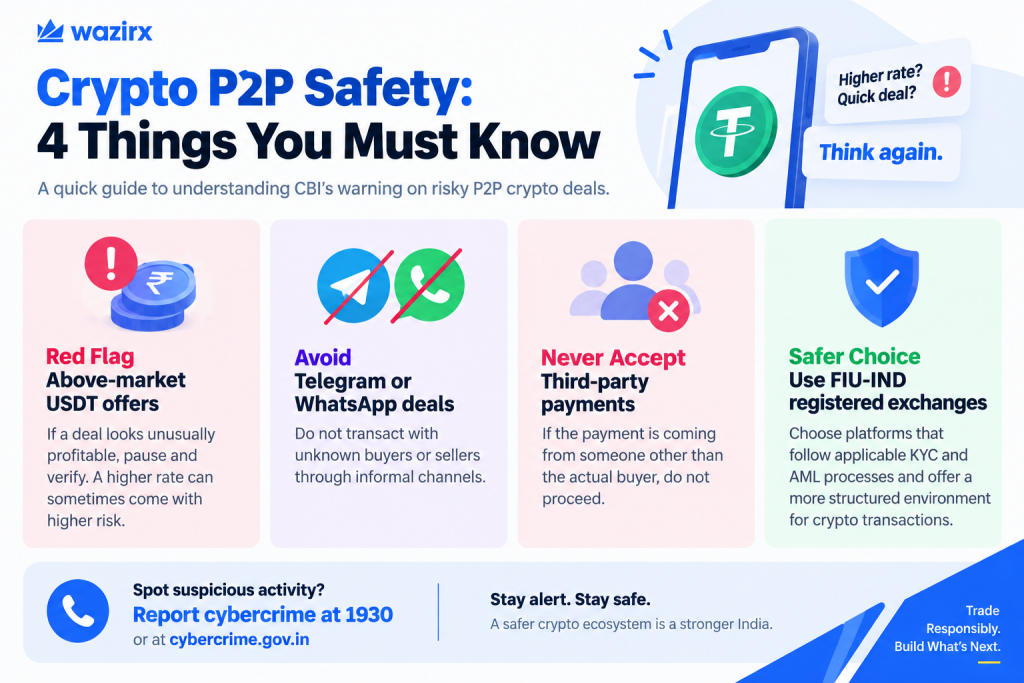
The CBI’s message gives crypto users three clear precautions to keep in mind:
- Use FIU-IND-registered exchanges when transacting in crypto.
- Avoid crypto deals arranged through Telegram, WhatsApp, or similar informal channels.
- Do not accept third-party payments where the person making the payment is different from the person involved in the transaction.
These practices can help reduce exposure to unknown counterparties and potentially suspicious sources of funds.
Here’s a quick recap of the key precautions highlighted in the CBI’s advisory:
Why Does Using an FIU-IND-Registered Crypto Exchange Like WazirX Matter?
In India, Virtual Digital Asset Service Providers registered with the Financial Intelligence Unit-India (FIU-IND) operate as reporting entities under the country’s applicable anti-money laundering framework.
This means registered platforms are subject to requirements around processes such as Know Your Customer (KYC), Anti-Money Laundering (AML) checks, transaction monitoring, and regulatory reporting.
WazirX is registered with FIU-IND as a reporting entity and follows applicable KYC and AML requirements.
Using an FIU-IND-registered exchange provides a more structured environment for crypto transactions than dealing with unknown individuals through informal social media channels.
What Should You Do If You Suspect Cyber Fraud?
If you believe you have encountered a suspicious transaction or have become a victim of cyber fraud, report it promptly through India’s official cybercrime reporting channels.
You can call the National Cybercrime Helpline at 1930 or report the incident through the National Cyber Crime Reporting Portal at cybercrime.gov.in.
As crypto participation grows in India, awareness remains an important part of staying safe. The CBI’s latest message is straightforward: avoid unknown counterparties, be cautious of unusually attractive P2P offers, and prefer FIU-IND-registered exchanges for crypto transactions.
 Disclaimer: Click Here to read the Disclaimer.