
Crypto futures positions can be liquidated despite stop losses because if the market moves sharply against your trade, your available margin can run out before your stop loss is triggered, forcing the exchange to close the position automatically.
Introduction
Setting a stop-loss order is the ultimate rule of risk management. It is designed to act as an automated safety switch, closing out a losing position at a predetermined price point to preserve remaining capital.
But many traders often face a frustrating and confusing scenario: their leveraged futures positions are completely liquidated by the exchange, even though they had a stop-loss explicitly active on the order book.
1. Market Orders vs. Stop-Loss Mechanics
Crypto exchanges process different order types differently during periods of market stress.
A standard Stop-Market Order (the most common type of stop-loss) consists of two components:
- Trigger Price: The price floor or ceiling you set on the chart that tells the exchange, “Activate my order now.”
- The Execution Order: Once that trigger price is touched, your stop-loss instantly transforms into a standard Market Order, demanding immediate execution at whatever price is currently available in the live order book.
Here’s the catch: Hitting your stop-loss price doesn’t mean you’ll exit at that exact price, especially during fast market moves.
For example If you use your ₹4,000 capital to open a long position and set a stop-loss trigger at ₹95, you are not guaranteed to sell at exactly ₹95. You have simply told the system to rush into the order book and sell at the next available price the millisecond the market hits ₹95.
2. Slippage and Price Gapping
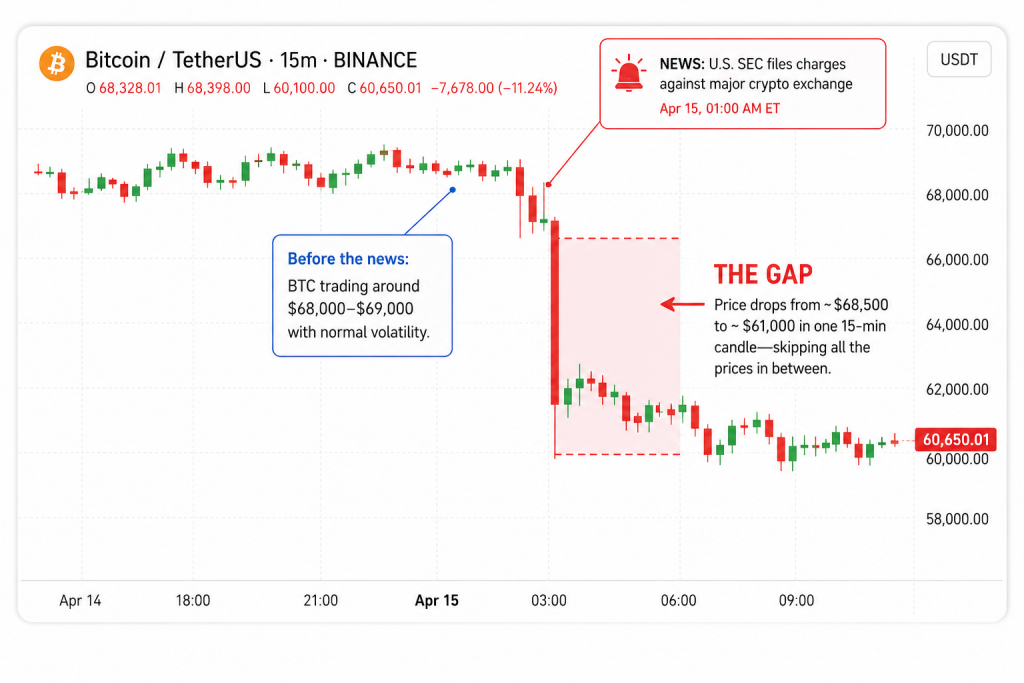
//caption for image: Price Gapping explained: prices, dates, and scenarios shown are for illustrative and educational purposes only.
Price Gapping
A price gap is when an asset’s price jumps sharply up or down without any trades in between, often due to sudden news or low liquidity.
During sudden, high-volatility events, such as unexpected regulatory updates, macroeconomic announcements, or systemic liquidations, crypto prices do not always move smoothly down a mathematical line. Instead, they “gap.”
Price gapping occurs when an asset jumps from one price level to a much lower level without executing any trades at the prices in between. This happens because panic causes liquidity providers (market makers) to pull their limit orders out of the book, leaving the ledger virtually empty.
The Slippage Cascade
Slippage
Slippage is when your trade executes at a different price than expected, usually because market volatility or low liquidity caused the price to move while your order was going through.
If the market gaps past your stop-loss trigger, or if the order book is too thin to absorb your position size, your order suffers severe Slippage.
Suppose you have a long position with a stop-loss trigger at ₹95 and a liquidation price at ₹90. A sudden flash crash occurs. The price jumps instantly from ₹97 down to ₹91, completely bypassing your ₹95 trigger without a single trade occurring at that price.
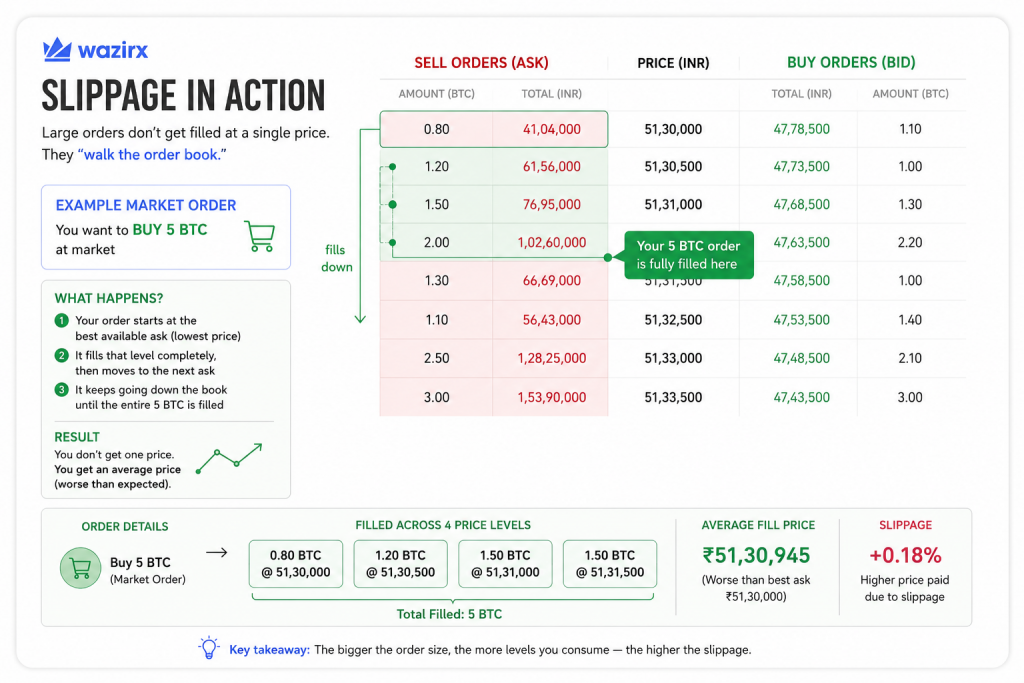
When the exchange finally processes your trigger at ₹91, your automated market order is thrown into a chaotic order book. If there are no buyers at ₹91, your order slips lower and lower to find a match. If your order walks down the book and hits ₹90 before finding a buyer, the exchange’s liquidation engine fires.
Because the liquidation engine operates with absolute priority to protect the exchange’s capital, it overrides your pending stop-loss market order, seizes your remaining collateral, and forcibly liquidates your position.
Liquidation Engine
The Exchange’s liquidation engine is an automated system that forcefully closes a trader’s position when their margin falls below the required minimum, to prevent the exchange from taking losses on loaned funds.
3. The Price Index Mismatch: Last Price vs. Mark Price
Another major structural reason a stop-loss fails to prevent liquidation is a fundamental misunderstanding of the different price feeds utilized by crypto derivatives exchanges. Platforms track two distinct prices simultaneously:
- Last Price (Last Traded Price): The real-time price at which the asset is currently being bought and sold on that specific exchange’s order book. This is the highly volatile price line you watch moving on the chart.
- Mark Price: A calculated global metric that aggregates live spot price data from multiple external global exchanges, smoothed out by a funding rate component. The Mark Price is designed specifically to prevent unfair liquidations caused by localized market manipulation or brief flash crashes on a single platform.
The Trigger Failure
By default, many platforms set your stop-loss order to trigger based on the Last Price. However, liquidations are always triggered exclusively by the Mark Price.
Imagine a scenario where a massive whale dump occurs on your specific exchange, causing the Last Price to crash violently from ₹100 down to ₹88 for three seconds before snapping back up. Meanwhile, across the rest of the global market, the asset stays steady at ₹100, meaning the global Mark Price only dips slightly to ₹98.
If your liquidation price was set at ₹90 and your stop-loss trigger was set at ₹93 based on the Mark Price, your stop-loss would never activate because the global Mark Price never dropped to ₹93. However, if your exchange’s internal system experiences a localized delay and the Mark Price suddenly catches up due to sustained pressure, you can find yourself liquidated because the liquidation engine fired before your Last Price stop-loss could clear the order book.
4. The Risk of Using Stop-Limit Orders
A stop-limit order dictates that once your trigger price is hit, your stop-loss becomes a Limit Order at a specific, fixed price. It tells the system: “Sell my position, but only if you can get me exactly this price or better.”
If the market is in freefall, the price will blast right through your limit price in milliseconds. Because a limit order refuses to accept a worse fill price, your order will sit unfilled in the red column of the order book while the price continues to crash beneath it.
Your position remains wide open and completely exposed, floating down helplessly until it hits your liquidation price, resulting in a total loss of your initial margin.
Final Thoughts
Preventing liquidation is part of your crypto position strategy. A stop-loss can only protect your portfolio if you give the exchange engine the physical space and order book depth to execute it. Using very high leverage and depending only on a stop loss can leave you feeling protected, but it often leads to losing your trading capital.
But If you keep your leverage low, and opt for stop-market orders over stop-limit variants, matching your trigger parameters to the Mark Price index, and avoiding high-frequency trading windows during extreme macroeconomic events, you ensure your risk mitigation tools function exactly as intended. Treat your position boundaries with meticulous care, guaranteeing that you maintain total control over your portfolio exits.
FAQs
Yes, liquidation can occur even with a stop-loss if the market moves too quickly, liquidity is low, or price gaps past your stop-loss level before the order is executed.
To reduce liquidation risk, use lower leverage, maintain sufficient margin, set stop-loss orders, manage position sizes carefully, and avoid overexposure during highly volatile market conditions.
Yes, stop-loss orders work on futures contracts by automatically closing positions when a specified price is reached, helping traders limit potential losses and manage risk.
Yes, futures positions can be liquidated when losses reduce your margin below the required maintenance level, causing the exchange to close the position automatically to prevent further losses.
 Disclaimer: Click Here to read the Disclaimer.