

Most crypto trading strategies depend on prices moving up or down. But what if a trader expects Bitcoin to remain within a particular price range? This is where an iron condor comes in, an options strategy that allows traders to collect premiums when prices remain within an expected range, while limiting their maximum potential loss.
The iron condor is a four-leg options trading strategy combining a bull put spread and a bear call spread with the same expiration date. It allows traders to earn a net premium when crypto prices remain within a defined range, with limited profit and predefined risk.
This guide covers how iron condors work, their profit and loss calculations, and trading considerations.
-
An iron condor combines four options contracts to create a range-bound trading strategy with defined maximum profit and loss.
-
The maximum profit equals the net premium received, while maximum loss depends on the spread width and premium collected.
-
Iron condors benefit from time decay and generally favor stable or range-bound market conditions.
-
Crypto traders must consider implied volatility, liquidity, trading fees, and position sizing when using this strategy.
Options Spreads 101: Understanding the Building Blocks
An options spread involves buying and selling two or more options contracts on the same underlying asset. These contracts generally have different strike prices, expiration dates, or both.
Traders use options spreads to create positions with specific profit, loss, and market-direction characteristics.
For beginners, understanding how crypto options trading works is useful before exploring multi-leg strategies.
Types of Options Spreads
| Spread Type | Market Outlook | Premium Structure | Risk |
| Bull Put Spread | Bullish or neutral | Net credit | Defined |
| Bear Call Spread | Bearish or neutral | Net credit | Defined |
| Bull Call Spread | Bullish | Net debit | Defined |
| Bear Put Spread | Bearish | Net debit | Defined |
An iron condor combines a bull put spread and a bear call spread, allowing traders to establish a position around an expected trading range.
What Is an Iron Condor Strategy?
An iron condor is a market-neutral options strategy involving four contracts with different strike prices but the same expiration date.
It combines two credit spreads:
- A bull put spread below the current market price.
- A bear call spread above the current market price.
The strategy gets its name from the shape of its profit-and-loss diagram, which resembles a bird with extended wings.
Four Legs of an Iron Condor
| Action | Option Type | Purpose |
| Buy | Lower-strike Put | Limits downside risk |
| Sell | Higher-strike Put | Collects premium |
| Sell | Lower-strike Call | Collects premium |
| Buy | Higher-strike Call | Limits upside risk |
The two purchased options help limit potential losses if the underlying asset moves significantly beyond the expected range.
How Does an Iron Condor Work?
An iron condor generates a net credit when the premiums received from selling options exceed the cost of purchasing the protective options.
Its maximum profit occurs when the underlying asset expires between the two short strike prices.
Iron Condor Profit and Loss Formula
For an iron condor with equal-width spreads:
Maximum Profit = Net Premium Received
Maximum Loss = Spread Width – Net Premium Received
Lower Breakeven = Short Put Strike – Net Premium Received
Upper Breakeven = Short Call Strike + Net Premium Received
These formulas assume equal contract quantities, consistent settlement units, and exclude trading fees. The strategy’s protective options define the maximum theoretical loss at expiration.
Iron Condor Example With Bitcoin (BTC)
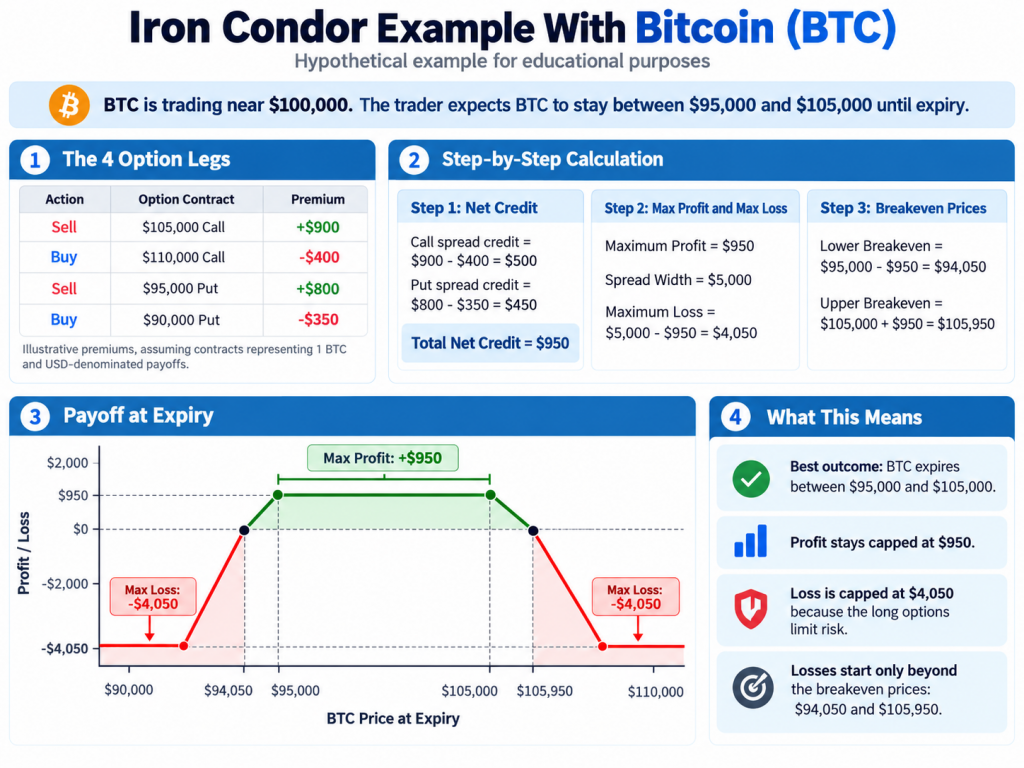
Consider a hypothetical situation where Bitcoin trades near $100,000.
A trader expects BTC to remain between $95,000 and $105,000 until the options expire.
The trader establishes the following iron condor:
| Action | Option Contract | Premium |
| Sell | $105,000 Call | +$900 |
| Buy | $110,000 Call | −$400 |
| Sell | $95,000 Put | +$800 |
| Buy | $90,000 Put | −$350 |
Illustrative premiums, assuming contracts representing one BTC and USD-denominated payoffs.
Step 1: Calculate Net Premium
Call spread credit = $900 − $400 = $500
Put spread credit = $800 − $350 = $450
Total Net Credit = $950
Step 2: Calculate Maximum Profit and Loss
Maximum Profit = $950
Spread Width = $5,000
Maximum Loss = $5,000 − $950 = $4,050
Step 3: Calculate Breakeven Prices
Lower Breakeven = $95,000 − $950 = $94,050
Upper Breakeven = $105,000 + $950 = $105,950
Iron Condor Payoff at Expiration
| BTC Price at Expiry | Profit/Loss |
| $90,000 or below | −$4,050 |
| $94,050 | $0 |
| 95,000–105,000 | +$950 |
| $105,950 | $0 |
| $110,000 or above | −$4,050 |
The trader earns the maximum profit if BTC expires between $95,000 and $105,000.
Beyond the breakeven points, the position begins generating losses. However, the purchased options limit the maximum theoretical loss to $4,050, excluding fees.
Why Do Crypto Traders Use Iron Condors?
Iron condors are primarily designed for markets where traders expect limited price movement.
Three factors make the strategy relevant:
- Range-Bound Markets: The strategy benefits when the underlying asset remains between the short strikes.
- Time Decay (Theta): As expiration approaches, options lose time value, potentially benefiting the net-selling position.
- Implied Volatility (Vega): Falling implied volatility can reduce option premiums and make closing the position less expensive, assuming other factors remain unchanged.
Unlike selling uncovered options, an iron condor uses protective options to define the maximum theoretical loss.
How to Choose Strike Prices and Expiration
Strike selection determines the balance between the premium collected and the probability of a profitable outcome.
- Consider Option Delta
Some traders use short options with approximately 0.30 absolute delta as a starting reference. Delta can provide a rough indication of how an option responds to price movements, but it does not guarantee a particular outcome.
- Evaluate Strike Distance
Short strikes closer to the current price generally generate larger premiums but leave less room for unfavorable price movement. Strikes farther away generally produce smaller premiums while creating a wider trading range.
- Choose Expiration Carefully
Weekly expirations involve faster time decay but may respond sharply to short-term movements.
Monthly expirations provide more time for the position to develop but introduce longer market exposure.
The width of the protective spreads also affects the maximum potential loss.
How to Manage an Iron Condor Position Effectively?
Iron condors require monitoring because the position’s value changes with price, volatility, and time.
Common management techniques include:
- Profit Targets: Some traders consider closing when approximately 50% of the maximum potential profit has been captured.
- Delta Monitoring: A rising absolute delta on a short option, such as approaching 0.45, may indicate increasing exposure to price movement.
- Position Adjustments: Rolling a threatened spread to different strikes or expiration dates may change the position’s risk profile.
- Exit Planning: Establishing maximum acceptable losses before entering the trade helps manage exposure.
These are trading rules of thumb, not universally optimal settings. Rolling can introduce additional fees and does not guarantee improved results.
Iron Condor Risks in Crypto Trading
Although iron condors have defined theoretical risk, several factors can influence actual trading outcomes.
- Continuous Market Activity: Crypto markets operate around the clock. Significant price movements can occur outside traditional market hours, including during periods of limited liquidity.
- Implied Volatility Spikes: Unexpected news can increase implied volatility and the value of options, potentially making an iron condor more expensive to close.
- Limited Options Liquidity: Some crypto options markets have thin order books and wide bid-ask spreads, which can increase execution costs.
- Fees, Margin, and Taxation: Four-leg strategies involve multiple transactions, potentially increasing fees. Margin requirements and settlement mechanisms vary by platform.
For Indian traders, the tax treatment of crypto options depends on the contract structure and applicable rules. Review the crypto taxation framework in India and consult a qualified tax professional.
Is an Iron Condor Profitable?
An iron condor can generate profits when the underlying asset remains within the expected trading range and the net premium received exceeds the cost of closing or settling the position.
However, its profit potential is limited to the initial net credit, while the maximum possible loss can be substantially larger.
Profitability depends on market conditions, strike selection, volatility, trading costs, and position management. There is no fixed success rate for iron condors across all markets.
The strategy generally suits experienced traders who understand options pricing and multi-leg execution.
Iron Condor vs. Other Crypto Options Strategies
Different options spreads serve different market expectations.
| Strategy | Market Outlook | Premium Structure | Maximum Risk |
| Iron Condor | Neutral, range-bound | Net credit | Defined |
| Iron Butterfly | Neutral, narrower target | Net credit | Defined |
| Long Iron Condor | Large movement expected | Net debit | Defined |
| Bull Put Spread | Bullish or neutral | Net credit | Defined |
| Bear Call Spread | Bearish or neutral | Net credit | Defined |
Traders choosing between strategies should consider the expected market direction, volatility, expiration date, and risk-to-reward ratio.
To understand how these instruments differ from Futures, read our guide on Crypto Futures vs Options.
Final Thoughts
Iron condors and options spreads offer structured approaches to crypto trading, helping traders define potential profits and losses across different market conditions. Understanding strike selection, time decay, implied volatility, and position sizing is essential for managing these strategies effectively.
While options provide one way to navigate crypto markets, traders can also explore WazirX Futures to participate in price movements across supported crypto assets through Futures trading opportunities.
Frequently Asked Questions
An iron condor is a four-leg options strategy combining a bull put spread and a bear call spread. It generates a net premium and aims to profit when the underlying asset remains within a defined price range at expiration.
The 3-5-7 rule is an informal trading risk-management guideline with different interpretations. Some versions address per-trade risk, portfolio exposure, and reward expectations. It is not a standardized options rule, so traders should prioritize clearly defined maximum losses and position limits.
Warren Buffett has historically used put-selling strategies through Berkshire Hathaway, including long-term equity index put options. However, there is no established evidence that iron condors are his preferred strategy. His publicly documented options transactions differ from conventional retail iron condor trading.
An iron condor can be suitable for traders expecting a range-bound market with relatively stable volatility. It offers defined maximum profit and theoretical loss but requires careful strike selection, position sizing, and monitoring. Its suitability depends on market conditions and experience.
Iron condors can be profitable when the underlying asset remains within the expected range and the premium collected exceeds applicable costs. However, unfavorable market movements can produce losses larger than the potential profit. Results depend on execution, volatility, and risk management.
 Disclaimer: Click Here to read the Disclaimer.