

Ask a handful of crypto users what a paper wallet is and you’ll get answers ranging from “an actual piece of paper with money on it” to blank stares. Both reactions make sense. It’s one of the oldest storage methods in crypto, and also one of the most misunderstood.
What Is A Paper Wallet, Really
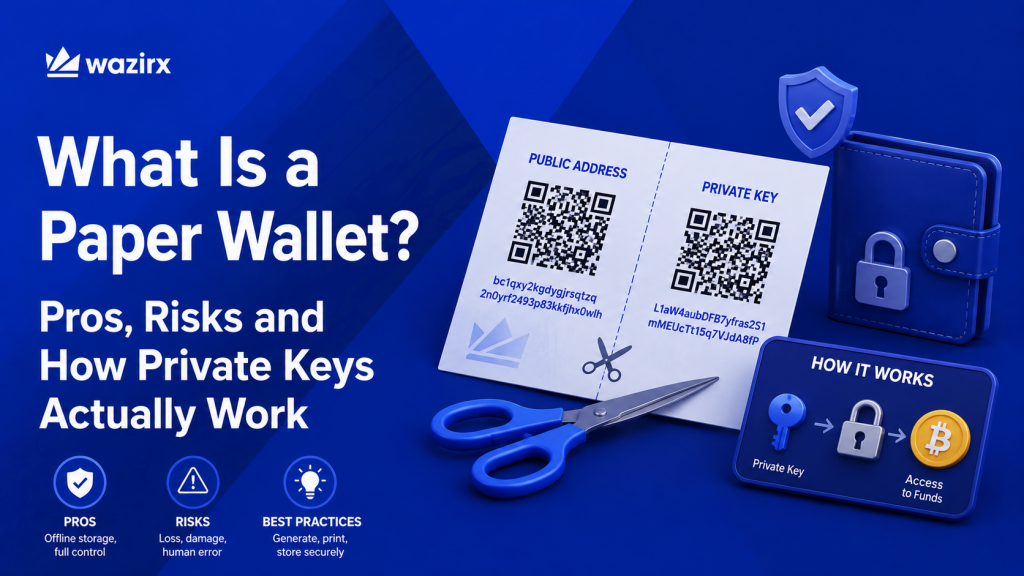
A paper wallet is a physical printout containing a public address and its matching private key, usually shown as text and as scannable QR codes. That’s it. No app, no login, no server holding your information. The keys are generated, printed, and from that point on they exist only on that piece of paper, unless you’ve made copies.
The idea behind it is simple. If your keys never touch an internet-connected device again after creation, they can’t be stolen remotely. No malware, no phishing link, no exchange breach can reach a private key that lives entirely offline. That’s the entire appeal of paper wallet crypto storage, and for a while, it was considered one of the gold standards of cold storage. If you’re weighing it against other options, WazirX’s breakdown of cold storage methods is a useful place to see how it compares.
How Do Private Keys Work
Every crypto address is built on a pair of mathematically linked keys. The private key is a long, randomly generated number. Run it through an established cryptographic function and it produces a public key, which in turn produces the address you share to receive funds. The math only works one way. You can get a public address from a private key easily, but you cannot reverse the process and derive the private key from the address. That one-way relationship is what secures the entire system.
Whoever holds the private key controls whatever sits at that address, full stop. Not the person who bought the coins, not the platform that facilitated the purchase, whoever physically has the key. This is where the well-known line “not your keys, not your coins” comes from, and it’s also exactly why paper wallets exist. They hand you the raw key rather than storing it on someone else’s server.
Worth noting here, an exchange account is not the same thing. On WazirX, your account balance is managed within the exchange’s own infrastructure rather than through a private key you personally hold, similar to how most crypto exchanges in India operate. If you want to move funds into true self-custody, including a paper wallet, you’d withdraw your crypto out of the exchange first, generate the wallet independently, then send the funds to that new address. WazirX’s guide on where crypto actually gets stored walks through this distinction in more detail.
The Pros
The biggest pro here is the cost and simplicity. Generating a paper wallet is free, and if it’s done properly, offline, it removes the internet-based attack vectors entirely. There’s no hardware to buy, no firmware to trust, no company that could go out of business and leave you locked out. For someone who is saving a small amount of crypto away for years without touching it, that offline nature has genuine value.
The Risks That Don’t Get Talked About Enough
Here’s where paper wallets start to show their age. Paper burns, gets soaked, fades, and gets thrown away by someone who didn’t know what it was. Unless you’ve made multiple copies stored in separate secure locations, a single ruined sheet means permanently lost funds. There’s no password reset for this.
Then there’s the spending problem, which trips up more people than almost anything else in crypto storage. Most paper wallets hold a single address, and spending only part of the balance requires “sweeping” the full amount into a software wallet first. Send from the paper wallet directly without doing this correctly, and the leftover change gets routed to a new address you never see, not back to the paper wallet. People have lost meaningful amounts this way, simply by assuming unspent funds would stay put.
Generation itself carries risk too. If the tool used to create the wallet wasn’t genuinely offline, or wasn’t trustworthy, the private key may have been captured or predictable from the start. There have been real, documented cases of people losing funds to compromised wallet generator websites, sometimes months after they’d created the wallet and assumed it was safe. And because a paper wallet reuses one address, every transaction tied to it becomes publicly traceable on the blockchain, which is a privacy trade-off most people don’t think about upfront.
Where This Leaves You
Paper wallets aren’t inherently unsafe, but they demand a level of discipline most casual holders underestimate. For active trading, a regulated exchange account handles the convenience side well. For long-term storage of a meaningful amount, most security-focused users have shifted toward hardware wallets, which handle the sweeping and address management automatically instead of leaving it to manual paper handling. WazirX’s guide on choosing a secure wallet is worth a read before deciding what fits your situation. Understanding how your keys work isn’t optional in this space. It’s the whole point.
 Disclaimer: Click Here to read the Disclaimer.