
In India’s crypto market, USDT sometimes trades above the official USD-INR rate. The USDT premium is the price gap between local USDT demand and dollar exchange rates, helping crypto users understand liquidity, demand, and market access. In this article, you will learn why the premium reportedly crossed 8.5% and what it means.
- USDT reportedly traded at a premium of over 8.5% in India in June 2026.
- A USDT premium means the local price of USDT is higher than the official USD-INR exchange value.
- Reports suggest that supply disruption, strong demand, and tighter enforcement action may have contributed to the spike.
- A higher premium can increase the effective cost of crypto transactions, so users should understand the risks before acting.
USDT is usually expected to move close to the value of one US dollar. But in India, its local price can sometimes trade higher than the official USD-INR exchange rate. This price gap is known as the USDT premium.
In June 2026, media reports stated that USDT’s premium in India crossed 8.5%, making it one of the most discussed developments in the local crypto market. The spike came at a time when reports pointed to tighter enforcement action, disruption in some payment-linked channels, and reduced stablecoin supply in the Indian market.
This article explains what the USDT premium means, why it may rise, and what users should keep in mind before making crypto-related decisions.
What Is USDT Premium?
USDT premium is the difference between the local market price of USDT and the official USD-INR exchange rate.
For example, if the USD-INR rate is around ₹85 and USDT is trading locally at ₹92, the extra amount paid above the dollar value is called the premium. This does not mean USDT has permanently become more valuable than the dollar. It means local market conditions are affecting its price.
USDT is a dollar-linked stablecoin. It is designed to track the value of the US dollar, but its local price can vary depending on supply, demand, liquidity, platform conditions, transaction routes, and broader market sentiment.
In India, the USDT premium has existed at different levels over time. Sometimes it stays within a smaller range. At other times, it can widen sharply when demand rises or supply becomes limited.
Also read: USDT Premium in India Has Collapsed. Here’s What’s Really Happening!
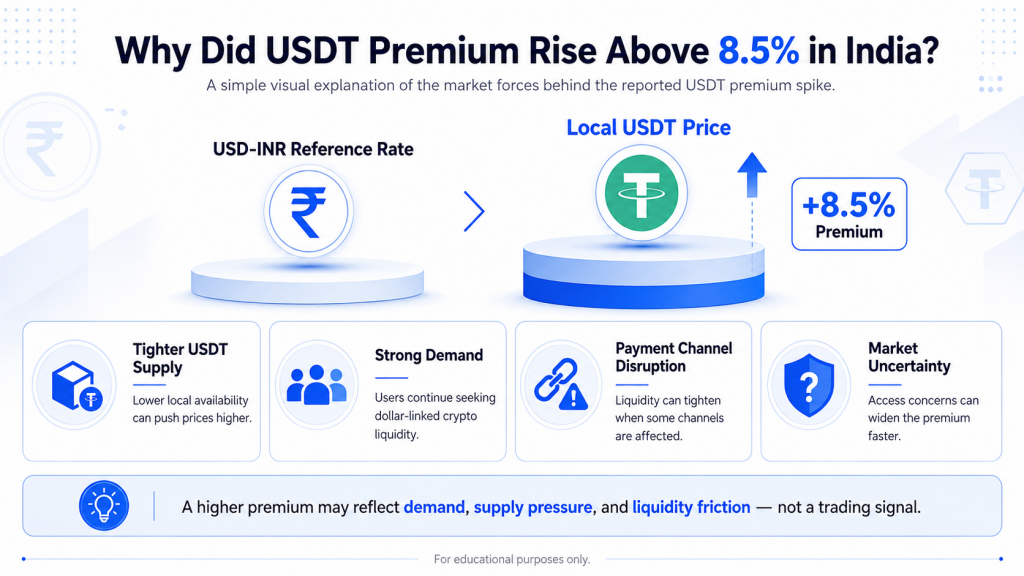
Why Did USDT Premium Rise Above 8.5% in India?
The recent spike was not caused by one single factor. Reports suggest that multiple market forces came together at the same time.
1. Tighter USDT Supply in the Local Market
The first factor is supply pressure. When fewer sellers are available or when the flow of stablecoins into the market slows down, buyers may have to pay more to access USDT. This can push the local price above the official dollar conversion rate.
2. Strong Demand for Dollar-Linked Crypto Liquidity
The second factor is demand. USDT remains one of the most widely used stablecoins in global crypto markets. Many users use it as a dollar-linked asset for trading, settlement, and moving between crypto pairs. When demand remains high while supply tightens, the premium can rise quickly.
3. Disruption in Some Payment-Linked Channels
The third factor is enforcement-linked disruption. Recent reports connected the premium spike with action against certain payment and remittance-linked operations. When any channel that supports liquidity is disrupted, the effect can show up in local USDT pricing.
4. Market Uncertainty Around Liquidity and Access
The fourth factor is market uncertainty. Whenever users are unsure about liquidity, access, or availability, prices can adjust faster than usual. In such situations, the premium may act as a signal of friction in the market.
It is important to understand that these are market explanations, not investment signals. A higher premium does not automatically mean users should buy or sell USDT.
Why Is USDT More Expensive Than USD in India?
USDT can become more expensive than the official USD-INR rate in India when local demand is higher than available supply.
The official USD-INR rate reflects the exchange value of the rupee against the US dollar in traditional currency markets. USDT’s local price, however, is shaped by crypto market conditions. These include liquidity, platform access, buyer demand, seller availability, payment flow, and perceived risk.
That is why USDT may trade above the dollar value in some markets and closer to the dollar value in others. The price difference is not unusual in markets where local supply and demand conditions are different from global rates.
For Indian users, this means USDT’s local price should not be viewed only through the lens of the dollar rate. It also reflects the cost of accessing stablecoin liquidity in the local market.
What Does an 8.5% USDT Premium Mean for Indian Crypto Users?
An 8.5% premium means users may be paying significantly more than the official dollar value to access USDT locally.
This matters because USDT is often used as a base asset in crypto trading. If a user buys USDT at a high premium, the effective cost of entering a crypto position also increases. The asset being traded may need to move enough to cover not just normal market movement, but also the premium paid upfront.
A higher premium can also affect users who are moving between crypto assets. Even when the global USDT price appears stable, the local cost can vary. This makes it important to check live crypto prices before every transaction.
For active traders, a premium can affect entry points, exit points, and overall cost calculations. For new users, it can create confusion because USDT may appear to be “more than one dollar” in INR terms.
Does a High USDT Premium Mean Crypto Demand Is Rising?
A high USDT premium can signal strong demand, but it does not tell the full story. Premiums often widen when buyers are willing to pay more for access to stablecoin liquidity. This may happen when users want to trade, hold dollar-linked crypto assets, or move between crypto markets. However, a premium can also rise because supply is limited.
Instead of reading it as a clear bullish or bearish signal, users should treat the premium as a market indicator of local demand, supply, and access conditions.
Why Stablecoin Premiums Matter in India’s Crypto Market
Stablecoin premiums matter because they show how local crypto markets are functioning beneath the surface.
When the premium is low and stable, it usually suggests that local demand and supply are more balanced. When the premium rises sharply, it may point to liquidity pressure, stronger demand, or reduced market access.
For Indian crypto users, the USDT premium can affect several things:
| Factor | Why It Matters |
| Entry cost | A higher premium increases the cost of buying USDT |
| Trading decisions | Users may need to factor the premium into trade planning |
| Liquidity | A sharp premium can signal tighter supply |
| Market access | Premiums may rise when access to stablecoin liquidity becomes harder |
| Risk awareness | Users need to understand that stablecoins are not free from market risk |
What Should Users Keep in Mind During a USDT Premium Spike?
The most important thing is to avoid panic-based decisions. Here are a few practical points to keep in mind:
- Check live USDT-INR prices before making a transaction.
- Compare the local USDT price with the official USD-INR rate.
- Understand the premium before entering a trade.
- Avoid informal payment channels and unverified parties.
- Keep records for tax and reporting purposes.
- Use compliant platforms and stay updated on regulatory developments.
- Do not treat a premium as guaranteed profit or an arbitrage opportunity.
The goal is not to react to the premium. The goal is to understand what it means.
Is a USDT Premium an Arbitrage Opportunity?
A USDT premium may appear to create a crypto arbitrage opportunity, but the actual outcome depends on liquidity, transfer access, fees, taxes, banking routes, compliance, and timing. Price gaps can remain open when they are difficult or costly to close. Users should treat the premium as a pricing signal, not as easy profit or trading advice.
What This Means for the Indian Crypto Market
The recent USDT premium spike shows how sensitive local crypto markets can be to changes in liquidity and compliance conditions.
It also highlights the growing importance of stablecoins in crypto market structure. Even though USDT is designed to track the dollar, its local price can reflect India-specific factors.
For users, the larger lesson is that crypto prices are not only shaped by global charts. Local market conditions can also play a major role. A stablecoin may look stable globally, but its local price can still move when supply, demand, and access change.
This makes user education even more important. Understanding premiums, spreads, liquidity, fees, and compliance can help users make more informed decisions.
Final Thoughts
The USDT premium spike in India is a reminder that crypto prices are shaped by more than global market charts. Local demand, liquidity, access, and compliance developments can all influence what users actually pay.
For Indian crypto users, the key takeaway is not to chase the premium. It is to understand it. A higher USDT premium can affect trading costs, risk calculations, and decision-making. Before making any crypto transaction, users should check prices carefully, understand applicable rules, and use compliant platforms.
Frequently Asked Questions
USDT can become expensive in India when local demand is high and available supply is limited. Reports in June 2026 linked the premium spike to supply disruption, enforcement-linked pressure on some channels, and continued demand for dollar-linked crypto liquidity.
USDT premium is the difference between USDT’s local market price and the official USD-INR exchange rate. If USDT trades higher than the converted dollar value, the extra amount is called the premium.
No. USDT is a stablecoin designed to track the value of the US dollar, but it is not the same as holding USD in a bank account. Its local price can vary based on market conditions.
It can suggest strong demand, but that is not the only reason. A high premium may also reflect limited supply, lower liquidity, payment friction, or regulatory uncertainty.
 Disclaimer: Click Here to read the Disclaimer.