

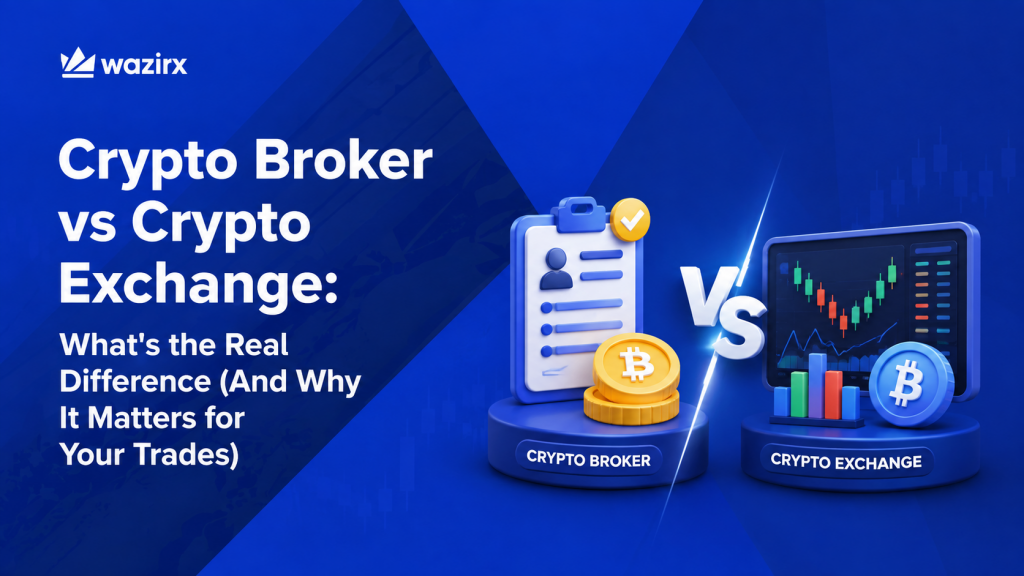
A crypto broker buys or sells crypto on your behalf, while a crypto exchange lets you trade directly through its marketplace. That difference matters because it affects how much control you have over your trades, the prices you get, and how your orders are executed.
If you want simpler buying and selling, a broker can make the process easier. But if you want more control, transparent pricing, deeper market access, and advanced trading tools, an exchange gives you more control over the trade.
| Crypto Broker | Crypto Exchange | |
| How it works | Acts as an intermediary and executes trades for you | Connects buyers and sellers on a trading platform |
| Pricing | Sets or quotes the price you receive | Shows market prices based on orders in the market |
| Trading control | Usually offers fewer order types and less control | Gives you greater control over orders and execution |
| Best for | Simple, occasional crypto purchases | Active traders who want more control |
| In India | Less common as the primary model for crypto trading | The more relevant model for spot crypto trading platforms such as WazirX |
| Trading tools | Generally focused on simple buying and selling | Can offer advanced orders, charts, futures and API trading |
The key difference in India: a crypto broker acts as the middleman for your trade, while a crypto exchange gives you a marketplace where you can place orders and trade against available liquidity. If you want more control over how you trade crypto, an exchange is the stronger choice.
What A Crypto Exchange Actually Does
A crypto exchange is a marketplace. Buyers and sellers place orders, and the platform matches them. When you buy BTC on an exchange, you’re not trading against the platform, you’re trading against another real person or a market maker on the other side of the order. This is order book crypto trading in its plainest form: a running list of buy orders and sell orders, sorted by price, waiting to be matched.
Once your order fills, you own the asset. It sits in your account, tied to your identity, and you can move it to your own wallet whenever you want. That last part matters more than most beginners realize. Buying crypto and holding it in your own wallet is one of the main reasons to use an exchange instead of a traditional broker. What you hold is actually yours, rather than simply having a claim on the platform to settle the value in cash later.
What A Crypto Broker Does Instead
A broker works differently. Instead of matching you with another trader, the broker takes the other side of your position itself. You’re not buying Bitcoin, you’re entering a contract that tracks Bitcoin’s price. This is where crypto CFD trading meaning becomes relevant. A CFD, or contract for difference, lets you speculate on whether a price goes up or down without ever owning the underlying asset. You settle the difference in cash when you close the position.
It sounds convenient on paper, especially with leverage thrown in, but there’s a catch worth knowing if you’re trading from India. No domestic broker offers them legally, and going through an offshore platform means you’re operating well outside Indian oversight, with none of the protections that come from a regulated exchange. That’s not a scare tactic, it’s just the current state of the rulebook, and it’s one more reason spot trading on a regulated platform tends to be the more grounded route for most Indian investors.
Why The Fee Structure Looks So Different
This is where crypto trading fees broker vs exchange stops being a technical detail and starts affecting your actual returns. Exchanges usually charge a straightforward trading fee per transaction, sometimes on a maker-taker model, sometimes flat. What you see is close to what you pay. WazirX, for instance, lays out its fee structure clearly so there’s no guesswork before you place an order.
Brokers offering CFDs tend to build their cost into the spread, the gap between buy and sell price, along with overnight financing charges if you hold a leveraged position past a day. Those costs aren’t always obvious upfront, and they compound in ways that are easy to underestimate until you check your account weeks later.
The regulatory picture is shifting, and it’s worth watching
This distinction between crypto exchanges and crypto brokers isn’t just an India conversation either. In the US, the SEC’s 2026 regulatory agenda includes proposed rule changes specifically targeting how crypto exchanges and broker-dealers operate, part of a broader push toward clearer rules for how digital assets are issued, custodied, and traded. It’s a reminder that regulators everywhere are still catching up to how these two models function, which is exactly why understanding the difference yourself matters more than relying on a platform’s marketing to explain it for you.
Which One Actually Fits How You Trade?
The right choice depends on what you want from a crypto platform. A crypto exchange gives you greater control over your trades, with live market prices, different order types, wider asset choice and direct ownership of crypto. A broker focuses more on simplifying the transaction or giving you exposure to price movements.
| Why choose an exchange? | In simple language |
| 1. More control over your trades | Choose the price, order type, timing and amount instead of simply accepting the broker’s available price. |
| 2. See the market directly | See live buy and sell prices and how much other people are willing to trade. This gives you a clearer picture of what’s happening in the market. |
| 3. Trade when you want | Place different types of orders, such as limit, market and stop orders, so you can decide how a trade should happen. |
| 4. More choice | Access a wider range of crypto assets and trading pairs instead of only the assets a broker chooses to offer. |
| 5. Better suited to active traders | Use charts, order books, advanced orders and trading tools to manage your trades with greater control. |
| 6. Your crypto can be held directly | A crypto exchange can let you buy and hold the actual crypto, depending on the platform and product, rather than simply getting price exposure. |
| 7. Potentially clearer pricing | See the market price and trading fee separately. With a broker, costs can sometimes sit inside the quoted price or spread. |
For Indian traders, there’s one more thing to check: don’t assume every platform that calls itself a crypto exchange offers the same structure.
Look at how it executes trades, whether you can access a live market and order book, whether you actually own the crypto you buy, and whether the platform meets the applicable compliance requirements in India.
If you want to buy and hold crypto, control your orders, and see the market you’re trading in, a crypto exchange fits that use case better than a broker.
How to Identify If a Crypto Platform is a Crypto Exchange or a Crypto Broker
Use these checks before you deposit money:
| Check | Crypto Exchange | Crypto Broker |
| How you trade | You place orders on a marketplace | The broker executes the trade for you |
| Pricing | You can see market prices and available orders | You receive a price quoted by the broker |
| Order book | Typically provides an order book or market depth | Usually does not provide a public order book |
| Order control | Offers greater control over price and order type | Usually offers simpler trade execution |
| Asset ownership | You buy the underlying crypto, subject to the platform’s terms | You may receive crypto or only price exposure, depending on the product |
| India-specific check | Check FIU-IND registration and applicable compliance | Check the entity, product structure and applicable compliance |
Don’t judge a platform based on their label. Check what it actually lets you do. If you want to trade and own crypto directly with greater visibility and control, a crypto exchange is the more suitable model.
Final Thoughts
A broker can make crypto trading simple, but an exchange gives you greater control over how you trade. You can see the market, choose how you place an order and manage the crypto you own. The right choice ultimately depends on whether you want simple price exposure or more control over your trading decisions.
Once you know the difference, the next step is choosing an exchange that helps you research, understand and act on the market. This is where WazirX comes in.
WazirX brings you:
- Access to 300+ crypto assets, including Bitcoin, Ethereum, Solana and XRP, across INR and USDT markets.
- Live market prices and order-book information, so you can understand liquidity and buying or selling interest before placing a trade.
- Market and limit orders, giving you control over the price and timing of your trades.
- WazirX AI, a chat-first trading copilot that lets you ask about markets, get portfolio briefings, research assets and act on trades within the same conversation.
- An India-first trading experience, with KYC-based onboarding, 2FA and customer support with clear response timelines.
The difference between a broker and an exchange ultimately comes down to how much control you want over your trades. If you want to see the market, make informed decisions and manage your crypto in one place, a crypto exchange gives you the tools to do that.
 Disclaimer: Click Here to read the Disclaimer.