

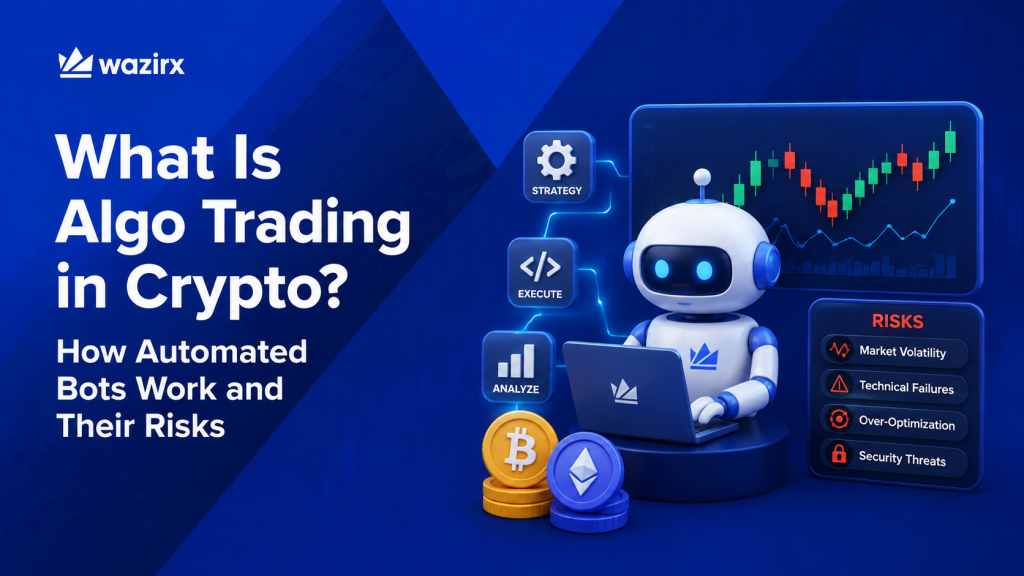
Algo trading in crypto is the use of software or bots to automatically execute trades based on predefined rules, such as price movements, technical indicators or market conditions. These systems can trade faster and more consistently than humans, but they also carry risks, including losses, technical failures, poor strategies and market volatility.
TL;DR
- Algo trading automates crypto trades using predefined rules, strategies or market signals.
- Bots can improve speed and consistency, allowing trades to execute without constant manual monitoring.
- Automation does not eliminate risk: poor strategies, volatile markets, technical errors and unexpected conditions can still lead to losses.
What Algo Trading Actually Means
Algorithmic trading is the practice of using pre-written rules, coded into software, to place buy and sell orders automatically. You define the conditions once. Buy BTC when the price drops 3% in an hour. Sell when a moving average crosses a certain line. Rebalance a portfolio every week. Once that logic is set, the bot executes it without waiting for you to open the app.
Crypto trading bots connect to an exchange through an API, a set of programmatic instructions that let software place orders the same way you would manually, just faster and without hesitation. WazirX, for instance, offers a public API that lets traders build or plug in bots to automate orders directly on its order books, and the platform has documented this openly for anyone who wants to see exactly how the connection works before trusting it with real funds.
How Automated Crypto Trading Actually Runs Day to Day
Once connected, a bot typically does three things on a loop: it reads market data, checks that data against your rules, and places an order if the conditions are met. Some bots run simple strategies like grid trading, where orders are placed at fixed intervals above and below the current price to profit from small swings. Others run dollar-cost averaging, buying a fixed amount at set intervals regardless of price, which is really just automating a habit a lot of long-term investors already practice manually.
None of this requires you to be a programmer anymore. Several third-party platforms connect to exchange APIs and offer bot templates you can configure through a simple interface. That accessibility is exactly why the category has grown so fast, and also why more people are asking sharper questions before they connect their account to one.
Algo Trading Vs Manual Crypto Trading: Honest Comparison
| Factor | Algo trading | Manual trading |
| Speed | Executes trades automatically in milliseconds or seconds | Depends on how quickly the trader can analyse and act |
| Consistency | Follows predefined rules without deviation | Decisions can change with market conditions or emotions |
| Emotions | Not affected by panic, FOMO or hesitation | Emotional decisions can influence trades |
| Market monitoring | Can operate 24/7 without constant attention | Requires the trader to actively monitor the market |
| Flexibility | Limited to the rules and conditions it is programmed to follow | Can adapt instantly to unexpected news or market events |
| Human judgement | Minimal once the system is running | Central to every trading decision |
| Main weakness | Can execute the wrong strategy consistently when market conditions change | Slower, more time-consuming and vulnerable to emotional decisions |
Manual trading gives you control and judgment in the moment. You can read news, sense when something feels off, and pull back even if your usual rules say otherwise. A bot can’t do that. It follows its logic exactly, even during conditions it was never built to handle, which is both its biggest strength and its most common failure point.
Algo trading vs manual trading crypto really comes down to what you’re optimizing for. Bots are consistent and fast, immune to panic selling or FOMO buying, and they work around the clock in a market that never closes. Manual trading is slower but adaptable, and it keeps a human judgment layer in place that automated systems simply don’t have. Most experienced traders don’t pick one exclusively. They use bots for repetitive, rules-based strategies and keep manual control over anything that needs real-time judgment.
Is Algo Trading Legal In India?
Yes, algo trading is legal in India, including for crypto trading, but the rules depend on the market and platform you use. For crypto, India does not currently have a specific law that bans traders from using automated trading bots. However, crypto exchanges and Virtual Digital Asset (VDA) service providers are subject to PMLA and FIU-IND compliance requirements, including KYC, transaction monitoring and reporting obligations. SEBI’s algorithmic trading rules apply to regulated securities markets, such as equities and derivatives traded through recognised exchanges. They should not be treated as the regulatory framework for crypto trading.
So, if you’re using a bot to trade crypto in India, the use of the bot itself is not prohibited. The bigger considerations are whether the exchange permits automated trading, whether your activity complies with applicable tax and AML requirements, and whether your trading strategy involves any prohibited or manipulative activity.
In plain terms, connecting a bot to a registered crypto exchange in India through its API isn’t illegal. But every trade a bot places is still your trade, and your tax obligation. Profits from crypto in India are taxed at a flat 30 percent under Section 115BBH, with 1 percent TDS deducted under Section 194S on most transfers, regardless of whether a human or a script placed the order. A bot trading fifty times a day doesn’t reduce that liability, it just makes tracking it more work.
The Risks Worth Taking Seriously
Bots don’t remove risk, they just change its shape. A strategy that worked in a calm market can fail badly during a sudden crash, because the bot has no instinct to pause and reassess. API keys are another real exposure point. Anyone who gets hold of your key with trading permissions enabled can place orders on your account, which is why platforms recommend setting IP restrictions and giving bots the minimum access they actually need.
There’s also the noise around third-party bot platforms promising guaranteed returns. No legitimate bot can guarantee profit in a market as volatile as crypto, and any tool claiming otherwise deserves more scrutiny, not less.
Where to Start If You’re Curious
If you already track the live crypto price in India and understand how order books work, algo trading is a natural next step rather than a leap. Start with something simple, like a dollar-cost averaging bot on an asset you already understand, and keep the position size small until you’ve watched it run through at least one volatile week. Check WazirX’s fee structure before scaling up, since a bot placing dozens of small trades a day will feel every basis point differently than a trader who buys once a month. Automation is a tool, not a strategy on its own. The thinking still has to come from you.
 Disclaimer: Click Here to read the Disclaimer.