

Bitcoin (BTC) is one of the most sought after assets amongst investors. But, despite its surging popularity, news covering BTC often quote gossip and hearsay.
And due to their massive reach, people consider them as official information.
It is essential to glean facts from the fluff. BTC’s design heavily borrows from mathematics and cryptography. The protocol functions with code and calculations.
Therefore, every discussion surrounding bitcoin should be logical and rational. And that can only happen by shunning ‘myths’ and ‘rumors’.
In this article, we intend to do exactly that. So that you can see BTC for what it is, and not how it appears.
Bitcoin Has No Intrinsic Value
Naysayers say that BTC doesn’t have any intrinsic value. They also say that bitcoins just ‘appear out of thin air’.
Get WazirX News First
An asset or a currency derives value out of people’s faith, e.g: the INR. More the trust, the more is the value.
Contrary to misconceptions, a large section of people has faith in BTC. This is perfectly visible from the latest Edelman Trust Barometer Survey.
As per the report, 73 percent of Indians trust cryptocurrencies and blockchain technology.
60 percent say that the impact of crypto/blockchain will be positive.
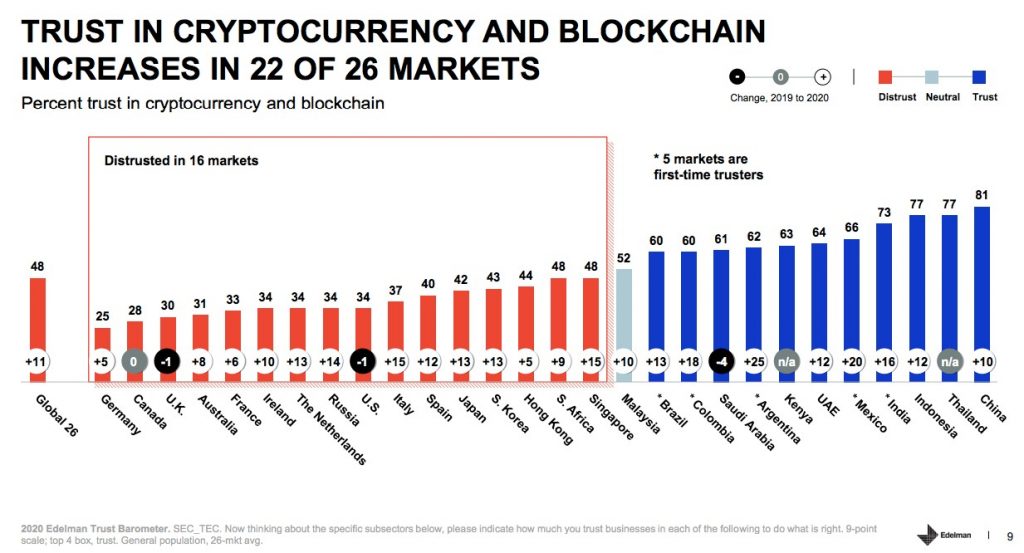
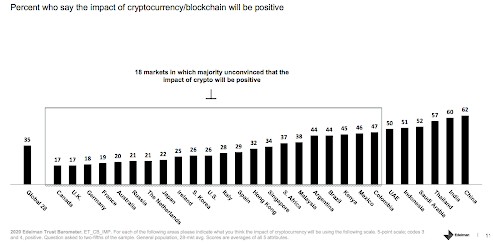
Apart from this, bitcoin’s value has exponentially appreciated over the last several years. This couldn’t have happened if investors didn’t think of BTC as ‘valuable’.
Also, bitcoins don’t ‘just happen’. A process called mining creates BTC. Folks with advanced hardware compete within themselves to quickly solve complex mathematical puzzles. To know more, check out the video below:
Criminals Use BTC
Some believe that bitcoin transactions are anonymous. And that makes BTC a suitable vehicle for all sorts of illegal activities.
Bitcoin operates on a blockchain-based protocol. It is a decentralized public ledger that records all BTC transactions. What this means is that all activities are openly visible to everyone.
An alphanumeric address masks the details of transacting parties. But, everything else like the transaction value, date, time is completely accessible.
That makes bitcoin ‘pseudo-anonymous’. As opposed to ‘pro-criminal’ claims, this feature helps law-enforcement authorities in nabbing felons. See the below video to know more:
Bitcoin Was Hacked
No, that’s not true. If Bitcoin was hacked, it wouldn’t have gained the trust of millions of investors across the country.
Hacking Bitcoin is near impossible. Because of its blockchain.
A ’51 percent attack’ could help gain control of the Bitcoin network. But, going by how much the ecosystem has matured, a 51 percent attack will be a very costly proposition. How costly?
According to data, it would cost almost USD 500,000 an hour to carry it out. No hacker would shell out that kind of money. Plus the chances of breaking in are minuscule to zero.
It’s a Ponzi Scheme
Normally a Ponzi scheme has a hierarchical arrangement with a boss at the top. The person who starts it all. Investors are guaranteed fixed returns on their capital but the underlying mechanism is fraudulent.
Although Satoshi Nakamoto created Bitcoin in 2009, he remains unknown. He/She designed the network so that anyone can participate and either contribute to its growth or just invest in BTC.
No central authority controls Bitcoin. There are no ‘middlemen’ facilitating transfers. And it will continue to remain that way in the foreseeable future.
BTC Investment is Costly
A lot of people, especially in India don’t buy bitcoin because they think it’s costly. They think they have to buy one whole BTC. Going by the ongoing market rates they bow out.
Here’s the fact. Despite rumors of a ‘highly-priced investment’, anyone can buy bitcoin. Why? Because 1 BTC is divisible into 100 million parts. That’s right. Because of its divisibility, investors can buy fractions of bitcoin.
It is not at all necessary to buy 1 full BTC.
Only Technically Proficient People Can Use It
This was said about the internet and email too. Initially, nobody understood how these two technologies would be utilized in the real world. But eventually, both have become widely popular and now life is very difficult to imagine without the two.
This holds for bitcoin too. There is a learning curve involved but it’s not rocket science. We at WazirX have put together an intuitive interface in place so that using BTC becomes a seamless experience.
See the below video to know how to use the WazirX phone app in detail:
These were a few bitcoin myths, but there are many more. BTC and the cryptocurrency ecosystem is paving the way for a bright future. To become a part of this future, you need to question everything that you come across, even hard facts. Only by ‘verifying’ and not blindly trusting, you can truly contribute to Bitcoin’s growth.
Further Reading:
5 Ripple (XRP) Myths you Should Stop Believing
Frequently Asked Questions
How Bitcoin Mining Works?
Bitcoin mining is a crucial element of the blockchain ledger's upkeep and development and the act of bringing new Bitcoins into circulation. It's done with the help of cutting-edge computers that solve exceedingly challenging computational arithmetic problems. Auditor miners are rewarded for their work. They're in charge of ensuring that Bitcoin transactions go through smoothly and legitimately. This standard was established by Satoshi Nakamoto, the founder of Bitcoin, to keep Bitcoin users ethical. By confirming transactions, miners assist in avoiding the "double-spending issue."
What Is Meant By Bitcoin?
Bitcoin is a digital currency that was initially released in January 2009. It is based on ideas offered by Satoshi Nakamoto, a mysterious and pseudonymous figure, in a whitepaper. The name of the person or individuals who invented technology has not been revealed. Bitcoin promises lower transaction fees than other online payment systems, and unlike government-issued currencies, it is decentralized.
Is Bitcoin Cash A Good Investment?
Bitcoin Cash is a hard fork of Bitcoin formed in 2017 to address Bitcoin's scalability and challenges. Bitcoin Cash seeks to make global transactions faster, cheaper, and more secure. Bitcoin Cash is now accepted by thousands of online and offline businesses all over the world. Studied correctly, Bitcoin Cash may be an investment worthy of consideration.
How Much Is 1 Bitcoin Worth Today?
Check out the current price of Bitcoin on the WazirX exchange. Bitcoin's value is primarily determined by its supply and demand in the market. Other elements have an impact on its worth. Its intrinsic value can also be calculated by calculating the average marginal cost of producing a Bitcoin at any given time, based on the block reward, electricity price, mining hardware energy efficiency, and mining difficulty.
How Many Bitcoins Are There?
There are 18,730,931.25 Bitcoins in circulation as of June 2021. The total number of Bitcoins that would ever be there is just 21 million. On average, 144 blocks are mined every day, with 6.25 Bitcoins per block. The average number of new Bitcoins mined every day is 900, calculated by multiplying 144 by 6.25.
Can Bitcoin Be Converted To Real Money?
Crypto exchanges, Bitcoin ATMs, Bitcoin Debit Cards, and Peer Peer Transactions are all options for converting Bitcoin to cash. This can be accomplished by using Bitcoin exchanges such as WazirX. A Bitcoin ATM is a real place where you may purchase and sell Bitcoins with cash, unlike standard ATMs that allow you to withdraw money from your bank account. Many websites provide the option of purchasing Bitcoin in return for a prepaid debit card that works similarly to a standard debit card. Through a peer-to-peer marketplace, you may sell Bitcoin for cash faster and more privately.
What Is Bitcoin Used For?
Bitcoin was created as a means of sending money over the internet. The digital currency was designed to be a non-centralized alternative payment system that could be used in the same way as traditional currencies. Bitcoin is being used by an increasing number of businesses and individuals. This includes establishments such as restaurants, apartments, and law firms.
Who Created Bitcoin?
Bitcoin is the first application of the concept of "cryptocurrency," first articulated in 1998 on the cypherpunks mailing list by Wei Dai, who proposed a new form of money that relies on cryptography rather than a central authority to manage its creation and transactions. Satoshi Nakamoto published the initial Bitcoin specification and proof of concept on the cryptography mailing list in 2009. Satoshi exited the project in late 2010, with little information about himself available. Since then, the community has evolved, with numerous people working on Bitcoin. Satoshi's anonymity has sparked unfounded fears, many of which may be traced back to a misunderstanding of Bitcoin's open-source nature.
How To Convert Bitcoin To Cash?
There are many ways of converting Bitcoin to cash, such as crypto exchanges, Bitcoin ATMs, Bitcoin Debit Cards, Peer to Peer Transactions. You can use cryptocurrency exchanges such as WazirX for this. Unlike typical ATMs, which allow you to withdraw money from your bank account, a Bitcoin ATM is a physical location where you may buy and sell Bitcoins using fiat currency. Several websites provide the option of selling Bitcoin in return for a prepaid debit card that may be used just like a standard debit card. You can sell Bitcoin for cash through a peer-to-peer platform in a faster and more anonymous manner.
Is Bitcoin A Good Investment For The Future?
Some investors are afraid of the risks or devastation, but others are very eager to pursue the possibility of profit from a Bitcoin investment. A Bitcoin investment is similar to stock investing, except it can be more volatile.
 Disclaimer: Click Here to read the Disclaimer.