

When you open a crypto futures trading interface, your eyes are naturally drawn to the fluctuating price chart. However, right next to that chart is a rapidly scrolling ledger of numbers, usually shifting in shades of red and green. This is the Order Book.
While price charts show where the market has been, the order book reveals real-time market intent, localized supply and demand, and the exact machinery behind price discovery. For crypto futures traders, understanding the mechanics of the order book is essential for optimizing trade execution and managing risk.
Crypto Order Book
A crypto order book is a real-time digital record that displays all outstanding buy and sell orders for a crypto at different price levels. By revealing where trading interest is concentrated, it helps traders identify liquidity zones, support and resistance areas, and potential entry or exit opportunities, enabling more informed trading decisions.
The Structural Anatomy of an Order Book
An order book is a real-time, digital ledger organized by a centralized exchange‘s matching engine to display all currently open, unexecuted resting orders for a specific trading pair. In crypto futures markets, where participants trade contracts rather than physical underlying tokens, the order book is divided into two distinct vertical columns.
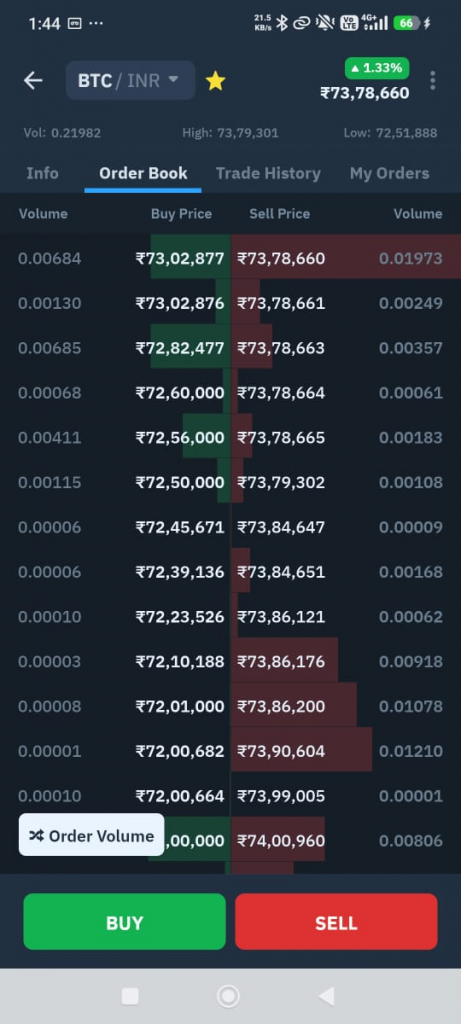
BTC-spot orderbook.
1. The Bid Side (The Green Column)
The bid side lists all pending buy orders, representing traders who want to open long positions or close existing short positions. The matching engine automatically sorts bids in descending order: the highest price someone is willing to pay sits at the absolute top. This top position is known as the “Best Bid.”
2. The Ask Side (The Red Column)
The ask side lists all pending sell orders, representing traders looking to open short positions or sell out of active long positions. Asks are organized in ascending order: the lowest price a seller is willing to accept sits at the absolute top. This is known as the “Best Ask.”
3. The Bid-Ask Spread
The structural gap between the Best Bid and the Best Ask is called the Spread.
- In highly liquid futures markets, such as high-volume Bitcoin pairs, this spread is razor-thin, often costing just pennies.
- In illiquid, low-volume alternative token markets, the spread widens significantly.
The spread represents the baseline friction cost of immediate market execution.
Market Makers vs. Market Takers: The Two Key Players
To understand how trades move through the order book, you must understand the interplay between the two types of market participants.
Market Makers (Liquidity Providers)
Makers place Limit Orders into the order book. A limit order is an instruction that says: “Do not execute my trade unless the market reaches this exact price or better.” Because these orders do not match immediately, they sit in the ledger, building structural market depth. Makers provide the inventory that keeps the exchange functional.
Market Takers (Liquidity Consumers)
Takers utilize Market Orders. A market order is an aggressive instruction that demands: “Execute my trade right now at the best available price currently sitting in the order book.” Takers cross the spread, instantly matching with the resting limit orders provided by the makers.
How Order Matching Works
Crypto futures exchanges process thousands of transactions per second utilizing a standardized engine algorithm called Price-Time Priority (PTP). This framework ensures execution integrity by matching trades based on two unyielding rules.
Rule 1: Price Priority
The matching engine always prioritizes the most competitive prices first. For buyers, the engine gives top priority to the trader willing to pay the most (highest bid). For sellers, the engine prioritizes the trader willing to sell for the least (lowest ask).
Rule 2: Time Priority
If multiple traders place limit orders at the exact same price level, the engine prioritizes the order that arrived first.
For example, if Trader A places a buy limit order for 1 BTC at ₹8,000 at 10:00 AM, and Trader B places an identical order at 10:05 AM, Trader A’s order will be completely filled before Trader B’s order receives a single satoshi of liquidity.
Order Book Depth and the Threat of Slippage
When analyzing an order book, experienced investors look closely at Market Depth, which measures the cumulative volume of limit orders resting at various price levels away from the current market price. This data is visually aggregated into a Depth Chart.
- Deep Order Books: Feature massive blocks of buy and sell limit orders packed closely around the current price. Deep books can absorb large market orders with minimal price distortion.
- Shallow Order Books: Contain sparse resting orders. If a trader submits a market order that is larger than the available volume at the best bid or ask, the matching engine forces the order to cascade down through multiple price layers to fulfill the requested size.
This discrepancy between your expected entry price and the actual execution price is called Slippage. In shallow or highly volatile markets, severe slippage can immediately push a leveraged futures trade into a net loss the moment it opens.
Final Thoughts
The order book should be treated as a direct window into current market conditions. Understanding the mechanics of order matching protects your portfolio from the invisible taxes of wide bid-ask spreads, high taker fees, and devastating execution slippage. By mastering how order flow interacts with market depth, you transform your execution strategy from blind, market-order gambling into a precise, calculated business operation.
Frequently Asked Questions
An order book is a real-time record of all open buy and sell orders for a crypto futures market. It shows bids, asks, price levels, and available volume, helping traders understand liquidity, market intent, and potential support or resistance zones before placing a trade.
Bids are buy orders placed by traders who want to go long or close short positions. Asks are sell orders from traders who want to go short or close long positions. The highest bid and lowest ask form the key prices visible at the top of the order book.
Market depth shows how much volume is available at different price levels. A deep order book can handle larger trades with less price movement, while a shallow order book may cause slippage. This is especially important in crypto futures, where leverage can amplify losses.
Slippage happens when a trade executes at a different price than expected. In crypto futures, this often occurs when the order book has low liquidity or during volatile market conditions. Large market orders may move through multiple price levels, resulting in a worse execution price.
 Disclaimer: Click Here to read the Disclaimer.